
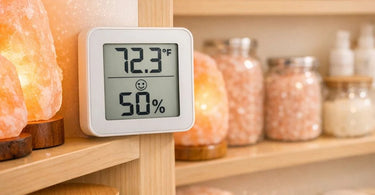
Your next big seller might not be the fanciest High Frequency Machine or the most decadent Sugar Scrub. Sometimes, it’s the humble, behind-the-scenes tools that protect your investment and ensure your treatments are flawless. Enter the hygrometer, the unsung hero of your salt therapy room and product storage area. If you’ve ever watched your premium hard wax turn into a gloopy mess or your expensive salt bricks start to sweat like a client in a hot yoga class, you know the enemy is humidity. This little device is your spa’s personal weather reporter, and choosing the right one is less about rocket science and more about not letting your beautiful, serene space turn into a moldy science experiment.
Think of your halotherapy room as a delicate ecosystem. The perfect microclimate isn’t just for the clients; it’s crucial for protecting the equipment, the salt, and all the other spa essentials you keep nearby. Getting the humidity wrong is like storing your luxury towels in a puddle or your gel polishes in a sauna—a costly, sticky, and entirely preventable disaster. Let’s navigate the wonderfully dry world of hygrometers so you can make an informed choice and keep your spa running smoothly, from your pedicure thrones to your salt-lined walls.
Why Your Salt Room Deserves Its Own Weather Station
First things first, let’s talk about why this matters so much. Salt is hygroscopic, which is a fancy word for “it loves to drink moisture from the air like it’s happy hour.” In a salt therapy room, controlled humidity is part of the therapeutic environment. But if humidity gets too high, the salt can clump, dissolve prematurely, or even damage the halotherapy generator. Beyond the room itself, adjacent storage areas house products that are just as moisture-sensitive. Your premium skincare serums, your heated blanket liners, even your stock of cotton rounds can be compromised. A hygrometer gives you the data to act before you have to throw out hundreds of dollars in product because they grew their own fuzzy sweaters.
The Main Types: Analog Charm vs. Digital Precision
You’ve got two primary camps in the hygrometer world, and choosing between them is a bit like choosing between a classic straight razor and a modern clipper—both get the job done, but with different styles.
Analog Hygrometers: These are the old-school dial types. They often have a rustic, spa-appropriate look that can blend beautifully with your luxury spa decor. They work through a coil made of a moisture-sensitive material that expands and contracts. The pros? No batteries needed, and they can be quite charming. The cons? They are generally less accurate and can be slower to respond to changes. They might also need occasional calibration (a.k.a., the “salt test”). If you need pinpoint accuracy for critical equipment, they might not be your best bet.
Digital Hygrometers: These are your modern, sleek, number-on-a-screen gadgets. They use electronic sensors to measure humidity and often come with nifty bonus features like temperature readouts, high/low memory, and even connectivity to apps. They’re typically more accurate, faster, and easier to read at a glance. The downside? They require batteries (so keep some spools of batteries on hand) and their aesthetic might be more clinical than cozy. For monitoring the precise environment around sensitive aesthetic technology, digital is usually the way to go.
Key Features to Look For: Beyond Just a Number
Don’t just grab the first thing you see. Here are the features that turn a simple meter into a powerful spa management tool:
Accuracy & Range: Look for a device with an accuracy of ±2% to ±5% RH (Relative Humidity). For a salt room, you’ll want a model that performs well in the typical range of 40-60% RH. Check the product specs!
Temperature Display: Most digital models include this, and it’s incredibly useful. Temperature affects humidity perception and is vital for storing products like massage lotions and wax.
High/Low Memory: This feature records the maximum and minimum humidity/temperature levels since the last reset. It’s perfect for answering the question, “What happened in here overnight while I was gone?” Did the AC fail? Did someone leave the Vichy shower running? This feature will tattle.
Mounting & Placement: Can it be wall-mounted, stand on a shelf, or sit on your manicure station? Consider where you need to monitor. You might want one permanently in the salt room and another in your main product storage. Avoid placing it right next to a door, a facial steamer, or a vent, as this will give false readings.
Calibration: Some higher-end models offer manual calibration. This is like giving your clippers a professional sharpening—it ensures long-term accuracy. If you’re a “set it and forget it” person, maybe skip this. If you’re a data-obsessed perfectionist (we see you), it’s a great feature.
Implementing Your Hygrometer: From Reading to Reacting
Buying the tool is only half the battle. Now, you need to use it! Place your hygrometer at client breathing level in the salt room for the most relevant reading. In storage areas, place it centrally among your products. Check it daily, just like you check your stock of compressed sponges or cuticle oil.
If the humidity is too high (>60% RH in most cases), it’s time to act. Turn up the dehumidification function on your HVAC, use a standalone dehumidifier, or improve ventilation. If it’s too low (<40% RH), the air can become uncomfortably dry for clients and affect certain treatments. A humidifier or adjusting your system may be needed. It’s all about balance, much like applying the perfect amount of lash adhesive—too little and it fails, too much and it’s a mess.
Protecting Your Entire Spa Ecosystem
While your salt room is a priority, don’t forget other humidity-sensitive zones. Your waxing suite where temperature and humidity affect wax performance. Your storage for paper products and linens. Even your room where you store essential oils—heat and humidity can degrade their potency. A few strategically placed hygrometers can save you a fortune in spoiled inventory and keep every treatment, from a cupping therapy session to a brow lamination, consistently perfect.
Choosing the right hygrometer isn’t the most glamorous part of running a spa or salon, but it’s a hallmark of a true professional. It shows you care about the details that clients never see but always feel. It protects the investment you’ve made in top-tier brands like Lycon and CND, and ensures your halotherapy equipment delivers the breathtaking results your clients expect. So don’t let humidity be the villain in your wellness story. Get a reliable hygrometer, give it a prime spot on your spa’s dashboard, and breathe easy knowing your zen—and your stock—is perfectly preserved.
