
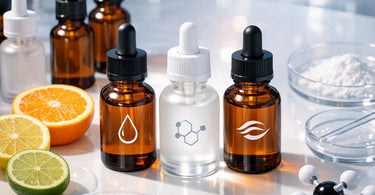
Take control of your outcomes by first mastering the ingredients at the core of your most transformative treatments. For spa and salon professionals, building a service menu that delivers visible, lasting results is non-negotiable. Clients trust you not just with their relaxation, but with their skin's health and radiance. That's why understanding the heroes and the divas of the skincare world is so critical. Enter Vitamin C: the undisputed gold-standard antioxidant celebrated for brightening, protecting, and firming the skin. Yet, for all its superstar benefits, pure Vitamin C (L-ascorbic acid) is notoriously high-maintenance. It degrades when it flirts with air, throws a fit in light, and can't handle the heat, often turning a tell-tale brown and losing its potency faster than you can say "hot dog water". This instability is a professional's headache, risking inconsistent results and disappointed clients. But what if you could have the power without the drama? This guide dives deep into the world of stable Vitamin C derivatives, giving you the knowledge to choose professional formulas that perform consistently, treatment after treatment, ensuring your clients leave glowing every single time.
Forget the one-size-fits-all approach. Your client with resilient, oily skin has different needs than the one with sensitive, rosacea-prone complexion. The key to professional success is matching the right active ingredient to the right skin. While pure L-ascorbic acid is the most researched and potent form, its required low pH (around 3.5) can be irritating for many. This is where savvy formulation comes in. Scientists have created a family of Vitamin C derivatives—chemically modified versions designed for greater stability and gentleness. Think of them as Vitamin C's more easy-going, reliable cousins. They may require a quick conversion back to the active form within the skin, but they show up to work consistently, don't degrade on your shelf, and play nicely with a wider range of clients. Your choice in treatment room isn't just about "Vitamin C;" it&aposs about selecting the specific derivative that aligns with your targeted service outcomes, whether that&aposs combating acne, calming sensitivity, or delivering intense brightening.
The Vitamin C Derivative Line-Up: Casting Call for Your Treatment Menu
Let's meet the candidates. Knowing their unique profiles helps you build a smarter, more effective skincare service arsenal.
Magnesium Ascorbyl Phosphate (MAP) & Sodium Ascorbyl Phosphate (SAP): The gentle achievers. These water-soluble derivatives are famously stable and work at a skin-friendly pH, making them ideal introductory actives for clients new to Vitamin C or with sensitive skin. MAP is a proven skin brightener and has even shown promise in supporting collagen production. SAP shares the stability benefits but brings a unique advantage: it has antimicrobial properties studied for acne-prone skin. Perfect for adding a clarifying boost to a facial treatment without the sting.
3-O-Ethyl Ascorbic Acid (Ethylated Vitamin C): The current stability champion. Hailed for being up to 50 times more stable than pure L-ascorbic acid, this derivative doesn't require a low pH and resists oxidation from air, light, and heat. It's a lipophilic (oil-loving) molecule, which means it penetrates the skin's lipid layers effectively. While its brightest spotlight is on skin brightening and tackling hyperpigmentation, it's a superb choice for formulations that need to last in your professional space and in your client's home care routine.
Ascorbyl Glucoside & Tetrahexyldecyl Ascorbate (THD): The deep penetrators. Ascorbyl glucoside is a stable, slow-release option common in K-beauty and J-beauty inspired treatments, great for sustained brightening. THD ascorbate is oil-soluble, allowing it to penetrate deeper into the skin, and is often found in higher-end professional formulations. It's a powerful option for targeted anti-aging protocols, especially when paired with other lipid-soluble actives.
Ascorbyl Palmitate: The fat-soluble partner. Often used as a supportive antioxidant in the oil phase of an emulsion, it helps stabilize other ingredients and boosts the overall antioxidant network of a formulation.
Beyond the Ingredient List: The Professional's Formula for Stability
Choosing the right derivative is half the battle. The other half is ensuring the entire formulation is built to protect its potency. As a pro, you should be auditing products like a quality control expert. Here's what to look for:
1. The Stabilizing Squad: A great formula never lets Vitamin C fight alone. Look for supporting ingredients that act as a protective entourage. Vitamin E (Tocopherol) and Ferulic Acid are a classic power duo. Ferulic acid not only boosts the antioxidant power but also helps stabilize Vitamin C and E, extending their shelf life and efficacy. Chelators like EDTA or phytic acid are unsung heroes; they bind to trace metals (like iron or copper in water) that can catalyze the oxidation of Vitamin C, keeping it clear and active.
2. The Packaging Armor: This is non-negotiable. No matter how stable the derivative, light and air are the enemies of efficacy. Insist on products packaged in opaque, airless pump bottles or sealed ampoules. Dark amber glass with a dropper can work if the formula is exceptionally well-stabilized, but airless is the gold standard for minimizing oxidation every time a client uses it. Clear bottles or jar packaging are red flags for any professional-grade Vitamin C product.
3. The Concentration Sweet Spot: More isn't always better. Research indicates that for L-ascorbic acid, absorption plateaus around 15-20%, and higher concentrations mainly increase the risk of irritation. For derivatives, effective concentrations can vary. A well-formulated 10-15% L-ascorbic acid serum or a 2-3% ethylated ascorbic acid formula can be more effective and stable than a poorly made 20% product that degrades in a month. Trust brands that prioritize smart formulation over marketing hype.
Integrating Stable Vitamin C into Your Professional Services
Now for the fun part: putting this knowledge into practice on the treatment bed.
Treatment Room Application: Vitamin C is a brilliant morning antioxidant, shielding skin from daily environmental aggressors like pollution and UV exposure. Incorporate a Vitamin C serum or booster into your daytime facials, bridal glow packages, or post-treatment recovery protocols. After thorough cleansing and a balancing toner, apply the Vitamin C product to maximize contact with the skin. Follow with a hydrating serum, moisturizer, and always, always finish with a broad-spectrum SPF. This layered approach locks in protection and moisture. For a luxurious touch, use a Facial Steamer beforehand to gently open pores and enhance product absorption.
Layering with Other Actives: To avoid irritation, it's generally best not to mix Vitamin C (especially L-ascorbic acid) with other low-pH actives like direct exfoliating acids or retinoids in the same session. A smart service plan is to feature Vitamin C in morning or antioxidant-focused treatments, and reserve retinoids and stronger exfoliants for evening or resurfacing protocols. Derivatives like MAP or SAP are more forgiving and can be excellent choices for combination treatments.
Client Home Care Recommendations: Your service is only as good as the home care that follows. When retailing a Vitamin C product, educate your client on stability. Tell them to store it in a cool, dark place—not their humid bathroom shower ledge! Instruct them to apply it to clean, dry skin in the morning. Teach them the signs of oxidation: if the serum turns a deep yellow, orange, or brown, or develops an off odor, it's time to replace it. Empowering them with this knowledge builds trust and ensures they see the results you promised.
Stock Your Backbar with Confidence at Pure Spa Direct
Equipping your spa with reliable, professional-grade skincare is the foundation of exceptional service. At Pure Spa Direct, we understand that your reputation depends on the performance of the products you use. That's why we curate collections from trusted brands that prioritize the sophisticated formulation science discussed here.
Explore our Premium Skincare collection to find stable, effective Vitamin C serums and boosters perfect for your treatment room. For comprehensive facial services, ensure you have all the supporting tools, from Magnifying Lights for detailed analysis to Compressed Sponges for hygienic application. Create the ultimate client experience with comfortable Luxury Spa Furniture and pristine High-Quality Towels.
Remember, in the world of professional skincare, stability isn't just a chemical property—it's the foundation of client trust and repeat business. By choosing the right Vitamin C derivatives and pairing them with impeccable formulation and packaging, you're not just selling a facial; you're guaranteeing an outcome. And that's the most beautiful result of all.
