
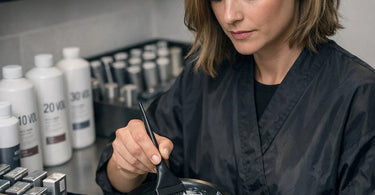
Your business needs this... an undeniable edge in the color department. Let's face it, in a world full of DIY disasters and box-dye bandits, your expertise is what clients are paying for. And the secret sauce to that expertise isn't just a steady hand—it's a perfectly calibrated mix of hair color and developer. Think of it as the magical, chemical handshake that turns your creative vision into a client's dream come true. Forget about "eyeballing it" and hoping for the best; this is where science meets art, and your salon's reputation is built. I'm about to spill the tea (and the peroxide) on everything you need to know, from the foundational 1:2 ratio to the advanced custom mixes that will make you a color wizard. Let's get mixing!
Why does this matter so much? A flawless color mix is the single most important step for achieving professional, repeatable results in your salon. When your ratio is correct, the chemical process activates exactly as intended, giving you full control over the final outcome. This precision builds unshakeable client trust and is the key differentiator that turns a one-time visitor into a loyal fan who books with you every six weeks like clockwork. It's the foundation of your color service—mess it up, and everything that follows is an uphill battle. Get it right, and you're the hero.
Developer 101: Your Secret Weapon for Lift, Deposit, and Control
First things first, let's demystify the developer. That creamy stuff isn't just filler; it's the engine of your entire color transformation. A hair color developer is a creamy solution that contains hydrogen peroxide. Its main job is to open the cuticle layer of the hair, allowing the color molecules from the dye to go inside and settle. Without it, permanent color simply wouldn't work—it'd just sit on the surface and wash right out, which is a fast track to a bad review and a sad client. Think of developer as the key that unlocks the hair's front door so the color can move in and redecorate.
But not all keys are the same! Developers come in different strengths, called volumes. Choosing the right one is a strategic decision, not just a matter of habit. Using the wrong volume is a leading cause of hair damage and unpredictable color. Here's your quick-reference guide to becoming a developer volume virtuoso:
- 10 Volume (3% Peroxide): Your deposit-only darling. This mild option opens the cuticle just a little, perfect for toning pre-lightened hair, adding depth, darkening a shade, or glossing services without lifting natural pigment. It's like a gentle nudge for the hair.
- 20 Volume (6% Peroxide): The salon workhorse and MVP for a reason. This is the standard for reliable gray coverage and achieving 1-2 levels of lift. It's your go-to for clients covering grays while staying close to their natural level. For stubborn gray coverage, many experts recommend 20 volume specifically, as it provides the necessary softening and opening for the pigment to penetrate deeply.
- 30 Volume (9% Peroxide): Your tool for more significant change. It provides 2-3 levels of lift, ideal for creating vibrant reds or achieving brighter blonde results on darker natural bases. It's a powerful step up, so use with intention.
- 40 Volume (12% Peroxide): The heavy artillery. Reserve this for high-lift applications on coarse, dark, exceptionally healthy hair where you need up to 4 levels of lift. A word to the wise: use with extreme caution and constant monitoring. It's not generally recommended to use 40 volume with regular color to try and avoid bleaching, as it can swell the cuticle too much and risk damage. For lifts beyond 3 levels, a double process with bleach is often the safer, more effective route.
Cracking the Ratio Code: It's More Than Just 1:2
Okay, you've picked your potion (I mean, developer). Now, how much do you use? While the 1:2 ratio of color to developer is a famous industry standard starting point, treat it as a flexible guideline, not a rigid rule. This mindset empowers you to create a custom formula for every single head in your chair. Your client's desired lift, their stubborn grays, and even their hair texture all demand adjustments.
To streamline your process at the color bar, use this table as your ultimate cheat sheet. Remember, always consult your specific brand's instructions first, as formulations can vary.
| Ratio (Color:Developer) | Primary Use Case | Expected Result |
|---|---|---|
| 1:1 | Maximum gray coverage, deposit-only color, level-on-level coloring. | Deep, opaque color with minimal to no lift. |
| 1:1.5 | Standard coloring, balancing deposit and lift, treating resistant grays. | Balanced color with up to 1-2 levels of lift. |
| 1:2 | High-lift coloring, lightening, toning. | Maximum lift (up to 4 levels), sheer toning results. |
| 1:2.5 | Very coarse, thick, or resistant hair requiring extra power. | Extra lightening power for hard-to-lift hair. |
Let's put this into real-world scenarios. For your "Gray Coverage Guru" client with over 50% gray wanting a solid brunette, mix a 1:1 ratio. This ensures every resistant gray strand is fully saturated with pigment for a flawless, uniform finish. For your "Blonde Ambition" client with dark blonde hair aiming for a light ash blonde, a 1:2 mix is your go-to. It provides the necessary lift to break through their natural base while depositing those delicate cool tones. See? Customization is key!
The Pro's Mixing Station: Tools and Technique for Flawless Results
Now, let's talk about the actual mixing. This is where precision becomes non-negotiable. The most common professional error is "eyeballing" measurements instead of using proper tools. This leads to inconsistent color, poor coverage, and the dreaded splotchy look. Let's set up your station for success.
Your Essential Tool Kit:
- Digital Scale: This is your best friend. Measuring by weight is the only method that guarantees accuracy every single time. Ditch the guessing game.
- Non-Metallic Bowls & Tools: Metal can cause premature oxidation of the hair color, altering your final shade in weird and unexpected ways. Always use plastic or glass. Check out our Mixing Bowls for professional options.
- Color Whisk or Brush: For achieving that perfectly smooth, lump-free consistency.
The Step-by-Step Mixing Method:
- Measure Accurately: Use your scale to weigh out the color and developer according to your chosen ratio.
- Combine Smartly: Here's a pro-tip to reduce mess: pour your developer into the bowl first, then add the color. This helps everything blend faster and prevents color from sticking to the bottom.
- Mix Thoroughly: Whisk until you achieve a smooth, creamy consistency, like yogurt or pudding. No lumps allowed! A lumpy formula will not apply evenly, leading to splotchy patches that scream "amateur hour".
A perfectly uniform mixture is essential for an even application and is what distinguishes a novice from an expert colorist. This attention to detail guarantees a premium service and saves you from costly (and time-consuming) color corrections later.
Advanced Formulation: Special Scenarios and Troubleshooting
You've mastered the basics. Now let's level up and tackle the tricky stuff. This is where you earn your stripes (or should I say, highlights?).
Conquering Stubborn Gray Hair: Gray hair can be notoriously resistant because it tends to be harder and have a more closed cuticle. The old myth of using only 10 volume for gray coverage often falls flat. In reality, 20 volume is frequently the best solution as it provides the necessary softening to open up the hair for maximum pigment penetration. For extremely resistant cases, some colorists use a technique called "mordancage," which involves pre-soaking the hair with 20 volume developer before applying the color mix. Remember, for gray coverage, a 1:1 mix is typically recommended to ensure opaque, lasting results.
Lightening More Than 3 Levels: What if your client wants to go from dark brown to platinum? You can't (and shouldn't) try to do this with regular permanent color and a high-volume developer alone. For lifts greater than 3 levels, you need a double process. This means lightening the hair first with bleach and developer, then applying your target shade or toner. For bleach, a common ratio is 1 part bleach to 2 parts developer. A crucial tip: the hair nearest the root processes faster due to scalp heat. To avoid "hot roots," you can use a lower volume (like 20 volume) on the roots and a higher volume (like 30 volume) on the lengths, or apply to the roots last.
Working with Previously Colored or Porous Hair: Hair that's already been colored, especially with box dye, henna, or metallic salts, is harder to lift. You may need to adjust your strategy. Conversely, porous hair (often the ends) lifts and absorbs color very quickly but also fades fast. For porous ends, consider using a lower volume developer or diluting your mix with a bit of water to prevent over-processing and uneven results.
Avoiding Catastrophe: Common Mixing Mistakes and How to Fix Them
We've all been there. A color goes sideways, and you're in correction mode. But most color corrections start with a preventable mistake at the mixing station. Here's how to dodge the drama:
- Mistake #1: The "Eyeball" Estimate. The Fix: I can't say it enough—use a digital scale. This non-negotiable step guarantees precision and saves you product, time, and your sanity.
- Mistake #2: Using the Wrong Tools. The Fix: Banish all metal from your mixing station. Use only professional, non-metallic bowls and whisks to prevent chemical reactions.
- Mistake #3: Under-Mixing. The Fix: Whisk until completely smooth. A lumpy, streaky mix equals a splotchy, banded color result. Take the extra 30 seconds to blend it perfectly.
- Mistake #4: Using Too Much Developer. The Fix: Stick to your ratios! Overdoing the developer can lead to over-processing, making hair dry, brittle, and dull. It can also desaturate the color, leaving it weak and faded-looking.
Treat your mixing station as your quality control center. Investing a few extra seconds in accuracy will save you hours of corrective work and protect your salon's bottom line and reputation. For maintaining that reputation, ensure your entire space is spotless with our Professional Cleaners & Disinfectants.
Stocking Your Salon for Color Success
Consistently amazing color starts with consistently amazing products. You can't create magic with subpar ingredients. At Pure Spa Direct, we're your partners in this, offering everything you need to build a formidable color bar.
Start with a foundation of premium Professional Hair Color and pair it with the right developers. For all your lightening needs, from balayage to full transformations, explore our Hair Bleaches and Lighteners collection.
Don't forget the tools of the trade! A comfortable, stylish client experience begins with your furniture. Check out our Stylish Salon & Barber Furniture and Top Quality Massage Tables & Chairs for the perfect service setting. Keep your station organized and your clients protected with High-Quality Towels and Protective Gloves & Masks.
And because the service doesn't end when the color is rinsed, offer take-home care to lock in your beautiful work. Our Premium Hair Care Products are perfect for retail, ensuring clients maintain their color and hair health until their next visit with you.
Mastering custom color formulation is the ultimate power move for a salon professional. It transforms you from a technician into a true artist and trusted advisor. By understanding the "why" behind every ratio and volume choice, you predict results, troubleshoot proactively, and customize with unshakable confidence. This is the skill that builds a legendary clientele and a thriving business. Now go forth and mix with mastery!
