
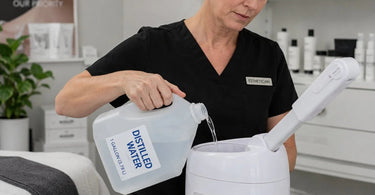
Pros rely on this daily essential, and for good reason. Let’s be real for a second: you didn’t get into the beauty industry to become a part-time plumber or a full-time machine whisperer, yet here you are, staring at a Facial Steamer that’s decided to rebel against tap water. The white crusty buildup, the sputtering, the weird smell that reminds you of an old coffee maker having a tantrum in a science lab—it’s the kind of drama nobody signed up for. But here’s the plot twist that can save your equipment, your sanity, and your clients’ complexions: the humble, mighty jug of distilled water. It’s not just for irons and car batteries, folks; it’s the unsung hero of the spa and salon world.
So, let’s dive into the glorious, money-saving, machine-loving world of distilled water. If you’ve ever wondered why your Pedicure Chairs/Spas start acting up or why your Towel Steamers smell a little funky after a few months, the answer is probably swimming around in your tap water. Spoiler alert: it’s not your fault, but it is definitely your problem. Until now. We’re going to explore how this simple switch can revolutionize your treatment room, from boosting performance to keeping your clients’ skin happy, and maybe even saving you from a few gray hairs in the process.
What Is Distilled Water, and Why Should You Care?
Let’s get science-y for a hot second. Distilled water is basically tap water that went to a very fancy finishing school . It gets heated into steam, leaving behind all the heavy metals, minerals, chlorine, and other uninvited guests, and then condensed back into pure, pristine H2O. No calcium, no magnesium, no limescale, and definitely no attitude . When you pour it into your professional salon equipment, you’re giving your machines a drink that won’t clog their arteries. Think of it as a kale smoothie for your Facial Steamers instead of feeding them fast food grease.
The Gross Truth About Tap Water in Salon Gear
Let’s get graphic, because the truth is not pretty. Tap water is essentially a traveling mineral parade, bringing calcium, magnesium, iron, and sometimes even sediment right into the delicate hearts of your expensive machines . Over time, these minerals build up inside Towel Steamers, sterilizers, and Pedicure Chairs/Spas. This buildup, known as scale, acts like cholesterol for your equipment. It narrows the passages, reduces water flow, and insulates heating elements, causing them to overheat and fail . Plus, it creates the perfect breeding ground for bacteria, which love hanging out on mineral scale like it’s a VIP party. That’s not the kind of party you want near your clients’ faces, feet, or freshly waxed skin .
Facial Steamers: The Ultimate Distilled Water Success Story
Your Facial Steamer is probably the hardest-working machine in your treatment room, and also the most abused when it comes to water quality . When you use tap water, the minerals don’t just stay inside the machine. They get vaporized and sprayed directly onto your client’s freshly cleansed pores . Congratulations, you just gave them a mineral mist they never asked for. That can lead to skin irritation, dryness, and reduced effectiveness of your Advanced Facial Treatment Products. Distilled water, on the other hand, produces a pure, clean steam that opens pores gently, hydrates effectively, and works beautifully with your Premium Skincare Products . Plus, your steamer’s heating element will last years longer, and you will never again have to explain to a client why white flakes are coming out of the nozzle .
Towel Steamers: Soft, Fluffy, and Smelling Like Roses
Nothing says luxury like a warm, fluffy towel draped over a client’s neck during a waxing service or massage therapy session. But when you use tap water in your Towel Steamers, those towels can eventually develop a musty, metallic odor even after steaming . Why? The minerals in tap water leave residue inside the steamer, and that residue traps bacteria and odors. Distilled water eliminates that problem completely. Your towels will come out smelling fresh every single time, and your steamer will not require constant descaling or premature replacement . Your clients will notice the difference, even if they can’t put their finger on it. They’ll just know your towels feel softer and smell cleaner than that other place down the street.
Pedicure Spas: Saving You From the Biofilm Nightmare
If there’s one piece of salon equipment that absolutely requires distilled water, it’s your Pedicure Chairs/Spas . The jets, pumps, and internal plumbing are notorious for trapping water, which then sits there between clients. Tap water leaves behind mineral deposits that create biofilm—a slimy layer of bacteria that is incredibly difficult to remove completely . Even with proper disinfection, biofilm can persist and contaminate fresh water during the next service. Distilled water drastically reduces mineral buildup, meaning less surface area for biofilm to cling to . Combine distilled water with proper cleaning protocols and your Professional Nail Care Collections will shine, your clients’ feet will be safer, and your state board inspector will give you that approving nod that makes your whole week.
Wax Warmers and Distilled Water: Wait, What?
Okay, so your Professional Wax Warmers don’t actually use water inside the wax pot. But many warmers use a water bath or heating element that can corrode over time if you’re using tap water for cleaning. More importantly, when you use a steamer filled with distilled water as part of your waxing services, your clients experience less post-wax irritation. Steam from distilled water is purer and less likely to cause heat bumps or sensitivity, which means happier clients and fewer complaints about redness after using ItalWax, Starpil Wax, or Lycon . Everything connects, darling. Distilled water is the secret ingredient in your Complete Waxing Kits that nobody talks about, but everyone should.
Autoclaves and Sterilizers: Non-Negotiable Distilled Water Zone
If you use an autoclave or tabletop sterilizer for your Shears, Clippers, and Trimmers, listen up . Most manufacturers explicitly require distilled water because tap water minerals will coat the internal sensors and heating elements, causing inaccurate temperature readings and failed sterilization cycles. A failed sterilization cycle means your tools are not truly sterile, and that is a liability nightmare you do not want. Distilled water keeps your UV Sterilizers and autoclaves running accurately, so you can focus on your clients instead of worrying about whether your equipment is actually working.
The Money Talk: Distilled Water Saves You Real Cash
Let’s talk dollars and cents because pretty steam is great, but your bottom line is better. A gallon of distilled water typically costs between one and two dollars. Compare that to the cost of replacing a single Facial Steamer that died from scale buildup, which can run anywhere from two hundred to over a thousand dollars . Now multiply that by your High Frequency Machines, Ultrasonic Skin Scrubbers, Galvanic Machines, and Microcurrent Machines. Suddenly that tiny investment looks like the smartest financial decision you have made all year, right behind buying from Pure Spa Direct for all your wholesale needs. You also save on descaling solutions, repair calls, and the headache of explaining to your team why the steamer is down again. Your time is money, honey.
Which Salon Equipment Needs Distilled Water Most?
While we would love to say everything in your salon runs better on distilled water, let’s focus on the VIPs. Your Facial Steamers top the list, followed closely by Towel Steamers and Pedicure Chairs/Spas . Any autoclave or sterilizer absolutely requires distilled water. Your humidifiers, Oxygen Facial Machines, and Vichy Showers also benefit enormously. Even your Hot Stone Heaters and Paraffin Warmers can develop mineral buildup if you use tap water for cleaning or filling water baths. Basically, if it heats water, sprays water, or recirculates water, give it the good stuff .
Switching to distilled water is one of those rare professional upgrades that is inexpensive, incredibly easy, and pays for itself almost immediately. It’s the difference between being a hero who saves the day and a villain who keeps a cranky steamer in the corner. So, on your next supply run, make sure to stock up on distilled water. Your machines, your bank account, and your clients’ glowing skin will thank you profusely.
