
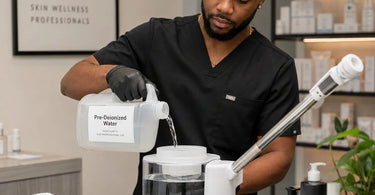
Your next hit starts here... but not that kind of hit! We're talking about the absolutely essential, non-negotiable, 'please-for-the-love-of-all-that-is-holy-do-not-use-tap-water' kind of hit that will save your equipment, your sanity, and your clients' glowing complexions. We are, of course, diving into the wonderful world of pre-deionized water for your facial steamers. Let's be real, nobody tells you in esthetician school that the secret to a long and happy relationship with your steamer isn't just a gentle touch, it's the type of water you put in it. So, grab a cup of something caffeinated and get ready to learn why this humble liquid is the unsung hero of your treatment room, because using the wrong water is like feeding your expensive Italian leather handbag to a dog. It's just not going to end well, and honestly, who has the time or money for that kind of drama? We're talking about extending the life of your equipment, giving your clients the best possible facial experience, and saving yourself from the dreaded 'my steamer is spitting white dust' panic attack. Let's get into it, shall we?
Think of your Facial Steamer as a high-maintenance, but wildly popular, celebrity. It requires special treatment, the finest things in life, and absolutely cannot be exposed to the common riff-raff found in regular tap water. Tap water is packed with minerals like calcium and magnesium. While these are great for, say, building strong bones, they are the absolute nemesis of your steamer's delicate heating elements. Over time, these minerals build up, creating a crusty scale that dramatically reduces efficiency. It's like trying to run a marathon with a brick in your backpack. You might get there, but it's going to be a struggle, and you'll probably break something in the process.
When you use regular water, you're essentially creating a microscopic rock garden inside your machine. That limescale buildup is a grimy, stubborn substance that causes several problems. It clogs the internal components, leading to reduced steam output, sputtering, and that horrible spitting that can literally burn a client. It also provides the perfect cozy home for bacteria and odors, which means your lovely, relaxing facial steam will start to smell a bit like a damp basement. Not exactly the luxury spa experience you were going for. In fact, limescale is such a common culprit for breakdowns that it's often cited as the number one cause of premature equipment failure in the beauty industry . Nobody wants to be the one responsible for that.
This is where pre-deionized water saunters in to save the day like a knight in shining, H2O-based armor. Pre-deionized water, also known as demineralized water, has been purified to remove all of those pesky mineral ions, like sodium, calcium, iron, and copper . Without these minerals, there is zero chance of limescale forming inside your steamer. This means your heating elements stay pristine, the internal workings remain clear, and your machine can operate at peak performance for years, not months . It's basically a fountain of youth for your professional equipment, and who wouldn't want that?
Keep Your Equipment in Tip-Top Shape (No More Surprise Repairs)
Let's talk about the real cost of using tap water. It's not just about the water; it's about the financial nightmare of a broken steamer in the middle of a busy Saturday. Replacing a professional-grade facial steamer is a significant investment. Using pre-deionized water is a tiny, almost laughable expense in comparison to the cost of a new machine. It's the ultimate preventative maintenance hack. By simply switching your water source, you're actively preventing the buildup that leads to clogs, reduced steam, and sputtering. You're not just being good to your steamer; you're being good to your bank account. A clean machine is a happy machine, and a happy machine means you can focus on providing exceptional facials instead of trying to figure out what that awful grinding noise is .
You might think, 'Oh, I'll just clean it with vinegar, it's fine.' And while a vinegar rinse can help with minor scaling, it's a treatment, not a cure. The very best practice is to prevent the problem in the first place by using the right water from the start. Distilled water, which is a very close cousin to deionized water, is also an excellent option. The main difference is the process: deionization uses ion exchange resins to remove the minerals, while distillation boils the water and collects the steam, leaving the impurities behind. Both are fantastic choices and a million times better for your steamer than tap water, which is essentially the enemy .
Optimal Steam Quality for an Unforgettable Client Experience
Now, let's switch gears from protecting your equipment to pampering your clients. The quality of the steam is everything in a facial. When you use pre-deionized water, the steam you produce is pure, clean, and free of any impurities or odor. This is the kind of steam that gently opens pores, allowing for deep cleansing and better absorption of your meticulously chosen Premium Skincare Products. There is a tangible difference in the experience. It feels softer, more hydrating, and your clients will notice. It's the difference between a normal spa day and a transcendent, 'I feel like a new person' kind of experience. The pure, mineral-free steam is also less likely to cause any irritation to sensitive skin types, making it a safer and more comfortable treatment for everyone. Think of it as the premium fuel for your skin's glow-up engine.
Imagine you're giving a luxurious facial with a top-tier Oxygen Facial Machine or a revitalizing Microdermabrasion treatment, but the steam used in preparation is subpar. It just doesn't compute. The finest treatments deserve the finest ingredients, and water is the primary ingredient in any steam-based facial. When you're offering Advanced Facial Treatment Products, you want every element of the service to reflect that level of quality, and that includes the steam itself. Using pre-deionized water is a small detail that demonstrates a massive commitment to professional excellence.
So, what does this mean for your daily routine? It means making a conscious choice to only fill your steamer's reservoir with distilled or deionized water. It's a habit that takes literally seconds but pays dividends in client satisfaction and equipment longevity. It also means you'll spend less time on cleaning and maintenance and more time doing what you love – making people feel and look amazing. If you are using a professional steamer from a brand like Spa Masters or Prosana, you can be sure they are built for performance. Give them the fuel they need to perform their very best.
And just a fun little pro-tip from your friends at Pure Spa Direct: keep a dedicated bottle of deionized water labeled 'STEAMER ONLY' right next to your machine. This simple act of organization will prevent any accidental 'oops, I used the sink water' moments. Trust me, it's easier than trying to explain to your boss why the steamer is now coughing up white dust like it's in a 90s grunge band. We're all about helping you avoid the 'equipment failure freakout'. We're a distributor, not a magician, but we know the best tricks to keep your business running smoothly .
In the end, the choice is simple. Do you want a steamer that performs flawlessly for years, delivering pure, luxurious steam to every client, or do you want a steamer that's a ticking time bomb of mineral deposits and foul odors? With pre-deionized water, you're choosing the former. You're choosing to protect your investment, enhance your client experience, and position yourself as a true skincare professional who pays attention to every single detail. So, the next time you're about to top off that water tank, just remember – your steamer is thirsty. Be a good host and give it the good stuff. Your clients, your accountant, and your future self will thank you. And if you're looking to outfit your entire spa with the best equipment, remember you can find everything you need right here, from High Frequency Machines to Galvanic Machines and beyond.
)