
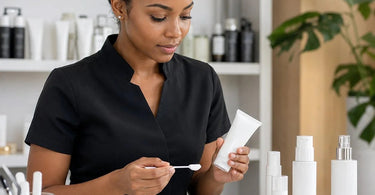
Smarter tools, better outcomes. That is the mantra we live by here at Pure Spa Direct. We are always hunting for that secret ingredient that makes you look like a miracle worker to your clients. So, lets talk about something that looks like a ghost costume but acts like a suit of armor for the skin. We are talking about Zinc Oxide. If you have ever smeared a thick white paste on your nose during a beach day, you already know the look. But hold onto your spatulas, ladies, because professional-grade Zinc Oxide has had a serious glow-up. It is no longer just for lifeguards and cricket players. It is your new best friend for post-procedure care, everyday retail sales, and keeping your clients' complexions calmer than a luxury spa furniture setup on a rainy Monday.
Let us be real for a second. We estheticians and skincare pros have a love-hate relationship with the sun. We love that it exists (Vitamin D, hooray!), but we hate what it does to the hard work we put into our clients' faces. Hyperpigmentation, wrinkles, and collagen breakdown are the enemies of glowing skin. While chemical sunscreens have had their moment in the sun (pun intended), mineral options are taking over. Specifically, formulations featuring everyone's favorite opaque mineral: Zinc Oxide. It is time to get intimate with the science behind the white stuff so you can educate your clients and boost your retail sales without breaking a sweat.
What Even Is Zinc Oxide? (And Why Is It Suddenly Cool?)
Chemically speaking, Zinc Oxide (ZnO) is an inorganic compound. It is a fine white powder that is insoluble in water . In the old days, it was the main ingredient in diaper rash cream. Hot, right? But here is the kicker: when formulated for professional skincare, it is a powerhouse. Unlike chemical sunscreens that absorb UV rays and turn them into heat (which is bad news for rosacea or freshly microdermabraded skin), Zinc Oxide sits on top of the skin. It acts as a physical shield. It reflects, scatters, and absorbs harmful UV radiation like a tiny, microscopic bouncer at a nightclub . You might have heard of Titanium Dioxide, its mineral cousin. While both are great, Zinc Oxide is the overachiever. Titanium dioxide is excellent at blocking UVB (the burning rays), but Zinc Oxide covers the whole spectrum. We are talking UVB, UVA2, and UVA1 . If you want broad-spectrum protection that actually means something, you go with zinc.
The Holy Grail: Broad Spectrum and Blue Light Defense
Here is your sales pitch for today, ladies. You know how every client walks in complaining about their \"winter weight\" or \"tech neck\"? Well, add \"screen face\" to the list. We are glued to our phones and computers. That LED light emits High Energy Visible (HEV) light, aka Blue Light. It digs deep into the skin and causes pigmentation that looks suspiciously like sun damage. Guess what blocks Blue Light? You guessed it. Good old Zinc Oxide . When you sell a Zinc Oxide-based mineral sunscreen, you aren't just selling anti-sun protection. You are selling anti-pollution, anti-screen-time, anti-aging armor. It is the Swiss Army knife of the skincare world. Tell your client who sits in a grey cubicle under fluorescent lights all day that she needs this just as much as the jogger who runs at noon. Suddenly, the \"white cast\" doesn't seem like such a big deal when she realizes she is preventing that dark spot on her cheek from getting darker.
Gentle Enough for the \"Ouches\": Post-Wax and Post-Treatment Safety
If you are a waxing professional, you know the drill. Client comes in, gets a Brazilian or a delicate facial wax, and then... goes to lunch on a patio. The horror! The fresh, open follicles are screaming. Chemical sunscreens often contain alcohol or irritating esters that will make that area sting like crazy. Zinc Oxide, however, is an anti-inflammatory superhero . It is actually used to treat rashes, eczema, and general irritation. So, when you apply a zinc-based SPF to a freshly waxed hard wax area, you aren't just protecting it from UV; you are soothing it. The same goes for your lash lift clients or those recovering from a strong high frequency treatment. It is calming. It is healing. It is antibacterial . Basically, Zinc Oxide is the skincare equivalent of a warm hug and a cup of tea after a bad day.
The \"Ghosting\" Problem and Modern Solutions
Okay, let's address the elephant in the treatment room. The white cast. We have all seen it. A client leaves the spa looking like they are about to perform in a Kabuki theater. That happens because traditional zinc particles are large. They reflect visible light (which makes them look white) as well as UV light . However, science is amazing, friends. Modern micronized or nano-particle Zinc Oxide keeps the UV protection but reduces the scattering of visible light. It disappears into the skin . If you really want to knock their socks off, look for tinted formulations. By adding Iron Oxides, you cancel out the white hue and get a flawless finish that acts like a primer . Honestly, I tell my ladies to throw away their heavy foundation and just use a tinted zinc SPF. It covers redness, blurs pores, and protects them from death rays. It is a triple threat.
Retail Royalty: Why Your Back Bar Needs Zinc
Let us talk money, honey. Retail is the lifeblood of a profitable spa business. You need products that clients run out of and come back for. Zinc Oxide sunscreens have the highest repurchase rate. Why? Because they work without drama. Clients with sensitive skin, rosacea, or melasma see immediate results (aka, no burning sensation and reduced redness). Plus, because Zinc Oxide is photostable, it doesn't degrade in the bottle . That bottle of chemical sunscreen your client bought last year? It is probably rancid or useless by now. But zinc stays stable. It is reliable. It is the Honda Civic of skincare. It is also \"reef-safe\" and environmentally friendly, which matters to your eco-conscious clientele . When you retail a high-quality Murad or June Jacobs zinc SPF, you aren't just selling sunscreen. You are selling peace of mind, environmental responsibility, and the promise of looking 25 when they are 45.
Incorporating Sunscreen into the Service Menu
For the love of all that is holy, stop finishing your facials with moisturizer and sending them out the door! The final step of every single service, whether it is a ultrasonic facial, a chemical peel, or even just a dermaplaning session, should be SPF. Get yourself a lightweight, sheer Zinc Oxide formula for your back bar. Apply it as the last step before they get off the table. Explain to them while you are applying it: \"Darling, I just spent an hour getting this dead skin off and boosting your circulation. Your skin is a sponge right now. If you walk out to your car without this, the UV rays are going to waltz right into those pores and ruin my handiwork.\" Be dramatic. Be funny. Be honest. They need to hear it. Keep a bottle at your manicure table too, because hands age fast! And if you are a massage therapist, don't forget the back of the neck and the décolleté.
Pairing with Your Favorite Tools
Zinc Oxide plays well with others. It is a non-comedogenic ingredient (it won't clog pores), making it safe to use immediately after galvanic machines or microcurrent treatments . In fact, because it reflects light, it can actually enhance the results of LED light therapy by keeping the heat out while the red light does its job. You can confidently retail a zinc SPF to your acne clients, your aging clients, and even your teenage clients. It is universally flattering (especially the tinted versions) and universally protective.
Wrapping It Up (In a White, Opaque Blanket)
Zinc Oxide is not just an ingredient. It is a lifestyle. As a professional wholesaler, we see trends come and go. K-beauty, glass skin, waxing innovations... they all have their day. But minerals? Minerals are forever. They are safe, effective, and backed by science (and the FDA). Stop letting your clients burn. Stop letting them ruin their collagen with chemical filters. Embrace the zinc. Show them the light (by blocking it). Your clients will look younger, you will sell more retail, and the world will be a slightly less pink and blotchy place. Now, go forth and apply that SPF like you mean it. Your future self (and your clients' future faces) will thank you.
