
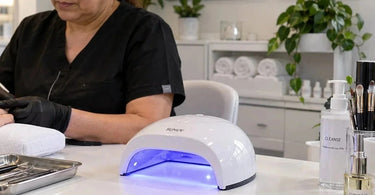
Boost sales with this winning pick, and let me tell you a little secret that your gel polish has been dying to share: nail lamps are like that one friend who needs a little breathing room. You know the type. Get too close, and things get hot, sweaty, and dramatic. Your Professional Gel Polish deserves better. So does your client, who is currently wondering why the curing process feels like a tiny sauna for her fingertips. Let us talk about something most nail techs overlook, something that quietly affects every single service: airflow around your nail lamp.
Here is the thing. A nail lamp is not just a box with lights inside. It is a small appliance that generates heat every time you cure a layer of gel. That heat has to go somewhere. If your lamp is shoved against a wall, buried under clutter, or sitting on top of a towel, that heat just sits there. And when heat sits, things get weird. Curing gets uneven. The lamp works harder. Your client winces. Nobody wins.
Your Nail Lamp Is Basically a Tiny Space Heater (No, Really)
Every time you pop a hand into your UV or LED lamp, the light sources inside start working. And like any electrical component, they generate heat as a byproduct . The more powerful the lamp, the more heat it produces. A 380W beast with 81 LED beads? That thing is doing serious work, and it is getting warm while it does it .
Most professional-grade lamps are designed with ventilation in mind. You will see small holes or vents on the housing. Maybe a built-in fan. Maybe just passive airflow channels. But here is the catch: those features only work if air can actually move. If your lamp is pressed against a wall, or sitting on a surface that blocks its vents, the heat has nowhere to go.
The result? The internal temperature climbs. The lamp's performance drops. And your curing times start to feel like suggestions rather than reliable standards.
What Happens When Your Lamp Cannot Breathe
Let us get specific about the consequences. This is not just about the lamp feeling warm on the outside. It is about what happens inside when heat builds up.
First, the light source itself suffers. LED beads and UV bulbs are sensitive to heat. When they run too hot, their output can drop. That means the wavelengths hitting your client's gel might not be as strong or consistent as they should be. Uneven curing leads to gel that looks fine when she leaves the salon and starts peeling three days later. Not a great look for your business.
Second, the electrical components inside the lamp take a beating. Circuit boards, wiring, sensors. These parts are not designed to bake. Over time, heat damage can shorten the lamp's lifespan significantly . You might be replacing a lamp every year instead of every three or four.
Third, and this is the one your clients care about most: heat transfers to their hands. A lamp that cannot dissipate heat efficiently becomes a lamp that makes fingers uncomfortable. The dreaded "heat spike" during curing is bad enough on its own, but a poorly ventilated lamp makes it worse . Clients remember discomfort. They do not remember that you used the perfect shade of dusty rose.
The Space Rule: Simple, But Often Ignored
So how much space does a nail lamp actually need? The answer is simpler than you might think: enough for air to circulate freely around the housing.
In practice, that means a few inches of clearance on all sides. Do not push the lamp flush against a wall. Do not tuck it under a shelf. Do not stack things on top of it. Do not let it sit on a soft surface like a towel or cushion that can block bottom vents.
If your lamp has a fan, you will often feel warm air exiting from specific vents. Those vents need to breathe. If you feel the lamp getting unusually hot on the outside, that is a sign heat is not escaping efficiently.
Think of it this way. You would not put a laptop on a pillow and expect it to stay cool. Same energy. Same physics. Same frustrated little computer. Or, in this case, frustrated little nail lamp.
Placement Tips That Actually Matter
Where you place your lamp matters as much as how you maintain it. A Nail Tables and Manicure Stations setup gives you a dedicated surface, but even the best station can become a cluttered mess if you are not intentional.
Keep the area around your lamp clear during services. Do not pile up gel bottles, tools, or towels around it. The lamp needs its personal bubble.
If your lamp has adjustable settings or a removable tray for pedicures, make sure you are not blocking vents when you reconfigure it. The bottom of the lamp often has intake areas that get overlooked.
And if you use a LED Bright Lamps for detail work, keep those separate from your curing lamp. Two heat sources in one cramped space is not doing either of them any favors.
Signs Your Lamp Is Screaming for Airflow
How do you know if your lamp is struggling? Pay attention to these clues:
The housing feels hot to the touch after a few cures. Some warmth is normal. Significant heat is not.
Curing times seem longer than they used to. If your go-to 30-second cure is suddenly taking 45 seconds to feel fully set, your lamp might be underperforming due to heat stress.
The lamp shuts off unexpectedly. Many modern lamps have thermal protection that kicks in when internal temperatures get too high. If yours is shutting down mid-service, that is a red flag .
Your clients complain about heat spikes more often. A well-ventilated lamp still produces some heat during curing, but a poorly ventilated one amplifies the discomfort.
Maintenance Habits That Extend Lamp Life
Airflow is not just about placement. It is also about keeping the lamp clean and functional.
Dust accumulates inside vents over time. A quick wipe with a dry cloth or a gentle blast of compressed air can keep those pathways clear. Do not use liquid cleaners near the vents, and definitely do not spray anything directly into the housing.
Check the fan if your lamp has one. You should be able to hear it running softly during operation. If it sounds strained or you hear grinding, the fan might be failing. A fan that does not spin is a fan that is not cooling anything.
And if your lamp has removable parts, like a bottom tray for pedicure curing, make sure those are properly seated. A tray that does not fit correctly can block internal airflow paths .
Pairing Good Airflow with Great Products
When your lamp is working properly, everything downstream works better. Your Professional Nail Care Collections perform the way they were designed to. Curing is consistent. Clients leave with nails that look fantastic and stay that way.
Speaking of which, a well-cured manicure deserves a finishing touch that makes it sing. A drop of Cuticle Oil after service keeps the skin around the nails soft and nourished. It is a small detail that clients notice, especially when their hands feel as good as their nails look.
And if you are working with nail art, proper curing is non-negotiable. A Nail Art Rhinestones placement that is not fully secured will pop off at the worst possible moment. Usually when your client is reaching for her car keys. Usually in front of someone she wants to impress. Airflow matters for the details too.
The Bottom Line on Breathing Room
Give your nail lamp space. Not because it is moody, but because it is an electrical appliance that generates heat and needs to release that heat to function correctly. A few inches of clearance. A clean workspace. A little attention to how warm things feel.
Your lamp will last longer. Your curing will be more consistent. Your clients will be more comfortable. And honestly, you will have one less thing to worry about during a busy day of back-to-back appointments.
It is a small change with a big return. The kind of thing that separates a good nail station from a great one. And great stations are the ones clients come back to.
)