
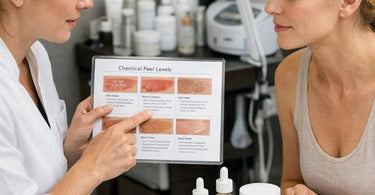
Excellence starts with smarter tools, but it is built on the foundation of knowing exactly where your boundaries are. Let me ask you something, hot stuff. Have you ever had a client saunter in, plop down on your luxury spa furniture, and demand a peel that sounds like it belongs in a chemistry lab explosion? They want the ‘deepest, strongest, fastest’ fix for their skin, and they read online that ‘Jessner’s is the bomb.’ While we love an ambitious client, as a professional esthetician, your license isn’t just a piece of paper; it is a legally binding permission slip that tells you exactly how deep you can go. Pushing past that limit is like trying to wax a client with ItalWax and forgetting to heat it up first; messy, painful, and potentially career-ending. Today, we are going to break down the four levels of chemical peels, figure out exactly where you can play based on your state laws and setting (Spa vs. Medical), and how to build a service menu that keeps your clients glowing and your liability insurance agents happy.
Whether you are a solo esthetician in a cozy studio or managing a bustling professional salon, understanding the science of skin penetration is your superpower. We aren't just wiping on goo; we are performing a controlled injury to regenerate tissue. It sounds intense because it is! But when done right, it is pure magic. Let’s dive into the layers, the laws, and the laughs (because if we don't laugh, we will cry over the state board regulations).
The Peel Pyramid: From ‘Tickle’ to ‘Terrifying’
Before we get into the legal mumbo-jumbo, we need to geek out on the science for a second. Chemical peels are classified by how deep they penetrate the skin. Think of it like ordering spicy food. You have the ‘white people spicy’ (very superficial), the ‘I feel a tingle’ (superficial), the ‘sweating at the table’ (medium), and the ‘sign a waiver and call your mom’ (deep). As a distributor, we see thousands of products pass through our warehouse, but the respect we have for acids is higher than our respect for gravity.
According to standard dermatological classification, peels range from destroying just the very top dead skin cells to diving deep into the reticular dermis. You do not need a medical degree to understand this, but you do need a healthy dose of common sense. Let's look at the hierarchy, keeping in mind that your scope of practice usually caps out at the ‘Medium’ level unless you have a medical director holding your hand.
Level 1: The ‘Lunch Break’ Peel (Very Superficial)
This is your bread and butter. These peels only remove the stratum corneum (that crunchy outer layer). We are talking about gentle acids like Mandelic 30%, low-percentage Glycolic 30%, or Lactic 30%. There is zero downtime. Your client might feel a slight ‘fizzy’ sensation, but mostly they just look a little shiny. They can go back to work, post a selfie, and pretend they just have great lighting. These are perfect for first-timers or for that maintenance glow before a big event. You can offer these all day long in almost any spa setting because you aren't breaking the skin barrier; you are just gently nudging dead skin cells to get out of the pool.
Level 2: The ‘Visible Flake’ (Superficial)
Now we are getting into the exfoliation event of the season. Superficial peels penetrate the entire epidermis down to the basal layer. You are looking at Glycolic 50-70%, Salicylic 20-30%, or Jessner's solutions. Your client will feel it. They will look like a lizard for about 3-5 days as their skin sheds. It is fantastic for acne, sun damage, and texture. However, this is where you need to be careful. Even though it is still technically ‘superficial’ in the medical world, some states get nervous about high-concentration acids. If you are in a basic spa setting with no medical oversight, you can usually do these, but you better have your informed consent forms laminated and your aftercare speech memorized.
Level 3: The ‘Line in the Sand’ (Medium Depth)
Alright, pros. This is where we separate the hobbyists from the heavy hitters. Medium depth peels go through the epidermis and into the papillary dermis (the upper layer of the ‘living’ skin). We are talking about TCA (Trichloroacetic Acid) in concentrations of 35% or combined peels like Jessner’s plus 35% TCA. These peels hurt. They frost (turn white) instantly. The downtime is a week of looking like you lost a fight with a sunlamp.
Here is the million-dollar question: Can you offer this as an esthetician? It depends. In many states (like Michigan as of 2024/2025), estheticians are allowed to perform ‘non-medical grade’ chemical peels, but the definition of ‘non-medical’ usually means superficial or very superficial. Some states allow Medium peels only under the supervision of a physician. In other states, like Florida or Virginia, Estheticians cannot touch Medium peels at all without a medical director. Do NOT offer a TCA 35% peel in a basic salon suite unless you have the legal paperwork to back it up. That is a fast track to losing your license.
Level 4: The ‘Do Not Touch’ (Deep Depth)
And then there is the forbidden fruit. Deep peels penetrate into the reticular dermis. We are talking Phenol, high-concentration TCA (>50%), or the infamous Baker-Gordon peel. These require sedation. They require cardiac monitoring (Phenol is toxic to the heart). They cause permanent skin lightening.
Estheticians, I am going to say this loudly for the people in the back: STOP. DO NOT PASS GO. DO NOT COLLECT $200. You cannot do these. Even if your cousin’s best friend’s dog’s previous owner is a ‘spa owner’ who does them, they are practicing medicine without a license. Unless you have an MD after your name, walk away. Leave the heavy lifting to the plastic surgeons. You can, however, sell them the post-procedure retail products to soothe that raw face later.
Navigating the Legal Jungle (Without Getting Eaten)
I know, I know. The laws are about as clear as a muddy pedicure spa after a rush. Each state has its own definition of what constitutes a ‘cosmetic’ vs. ‘medical’ procedure. For example, as of March 2025, Michigan expanded their scope to allow estheticians to perform dermaplaning and non-medical grade peels, but they still cap the depth. Meanwhile, states like Texas have historically been stricter about acid percentages.
If you are working in a high-end spa that offers Hydrodermabrasion and Microdermabrasion, stick to Level 1 and Level 2 peels. They are profitable, safe, and repeatable. If you want to play with Level 3 (Medium) peels, you need one of two things: 1) A medical director (a doctor who oversees your protocols) or 2) A job in a medical spa where the doctor is on-site or easily reachable.
The ‘No-No’ List: What to Refuse (Even if they pay extra)
Let’s talk about the client who wants to ‘fast-forward’ their results. You know the one. They ask, “Can you just leave it on a little longer?” or “Can we mix these two high-percentage acids together?” The answer is NO, and here is why: Hyperpigmentation. Scarring. Chemical burns. These are not fun words. They are liability lawsuits waiting to happen.
You should never, ever perform a chemical peel on a client who is currently using Accutane (wait at least 6 months), has active cold sores (unless you have prophylactic meds from a doc), or has an unknown sensitivity. Also, do not peel someone who just got lash extensions or a fresh spray tan unless you want to see a grown adult cry.
Specifically, do not offer combination ‘extreme’ peels like 70% Glycolic layered with 30% Salicylic in a standard salon environment. That is a medium-depth peel in disguise, and it requires medical-level knowledge of neutralization and skin pH balancing. Stick to your lane. Your lane is very profitable if you drive it correctly.
Building Your Peel Menu for Profit
So, what should you offer? Let’s build a menu that keeps the lights on and the lawyers away. Start with a ‘Gentle Glow’ peel using low-percentage Lactic or Mandelic acid. Market it to brides and folks with sensitive skin. Price it around $80-$120.
Next, offer a ‘Power Refresh’ using 30% Glycolic or 20% Salicylic for the acne kids. Price it at $150-$200. This is where you make your money. You can pair this with a facial steamer and high frequency for an acne bootcamp package.
Finally, if you have the legal clearance (Medical Director), offer a ‘Clinical Resurfacing’ using TCA 20-30% or a Jessner’s/TCA combo. This is a $300+ service. Make sure you have hygienic table paper ready because it gets goopy. Educate your clients on the post-peel protocol rigorously. If they pick at their skin, that is on them, but only if you warned them in writing!
The Retail Opportunity (Cha-Ching!)
Here is the secret sauce to making peels worth your while: the home care. A chemical peel is a ‘controlled injury.’ You cannot just send them out into the Florida sun with a slap on the back. They need medical-grade sunblock (SPF 30 or higher), gentle cleansers, and healing balms.
Set them up with a post-procedure cleanser, a barrier repair moisturizer, and a massive bottle of zinc oxide. That is an easy $150-$200 retail sale walking out the door. Plus, when their skin looks amazing in two weeks, they will credit you for it and book their next series. It is the circle of profit, and it is beautiful.
Remember, being a professional is not about how deep you can go; it is about how well you know your limits. The chemical peel market is booming, but it is also heavily regulated. At Pure Spa Direct, we supply the tools—the magnifying lights, the Wood’s Lamps for skin analysis, and the applicators—but you supply the expertise. Stay educated, stay insured, and stay funny. Now go slough some dead skin, legally.
%20%26ndash;%20A%20Pro's%20Guide%20to%20Safe,%20Profitable%20Peels)