
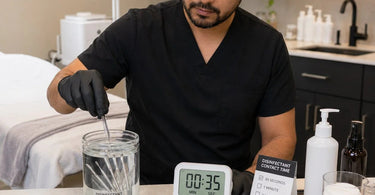
Take pride in the results you deliver. You've perfected the perfect balayage, mastered the art of a relaxing hot stone massage, and can wax a brow into an arch that would make a Greek goddess jealous. But let's be real, the most unglamorous, yet absolutely critical part of your job is the part nobody sees: the disinfection dance. Specifically, that awkward pause where you're staring at a timer, waiting for your disinfectant to actually, you know, do its job. It's the spa and salon equivalent of watching paint dry, but with significantly higher stakes. If you've ever found yourself wondering if you can just wipe that surface down early and call it a day, grab a seat (preferably on a freshly sanitized one), because we're about to dive deep into the wonderful world of contact times. Because getting this right is the difference between a relaxing retreat and a potential public health nightmare.
Let's be honest, the word "disinfectant" isn't exactly the sexiest topic in the beauty world. It doesn't have the allure of a new professional gel polish or the transformative promise of a brow lamination kit. But here's a hard truth that's about as fun as a lash glue mishap: that spray bottle and those wipes are your first and best line of defense against turning your serene sanctuary into a petri dish. And the secret sauce, the magic ingredient that makes it all work? It's not a fancy chemical name you can't pronounce. It's something far simpler, and yet, far too often ignored: contact time. It's the amount of time that disinfectant needs to stay wet on a surface to actually kill the germs it promises to obliterate. Think of it like a face mask. If you wash it off after 30 seconds, you're not getting the glow, you're just wasting product. So, why would you treat your disinfectant any differently?
The Ticking Clock of Clean: Why Contact Time is Everything
Imagine you're baking a cake, and the recipe says bake for 30 minutes at 350°F. Now, imagine you pull it out after 10 minutes because you're impatient. What do you have? A soupy, gooey mess that's a disaster, not a delicious treat. The same principle applies to your disinfectants. That label on the bottle is your recipe, and the contact time is your bake time. It's a non-negotiable, scientifically-proven requirement for the product to be effective against pathogens like bacteria, fungi, and viruses. The EPA sets these standards. When a disinfectant claims to kill, say, the Hepatitis B virus, that claim is backed by testing that was done for a specific amount of time. You can't just make the rules up as you go along. It's a violation of federal law to use the product in a way that contradicts its label.
And it's not just about the law. It's about your clients, your reputation, and your sanity. Cutting corners here is like trying to save time by not washing your hands. It's a false economy. A quick wipe might look clean, but as one myth-busting blog post points out, "if a surface looks clean, it must be safe" is a dangerous misconception. Harmful germs are invisible. So, while you might save 30 seconds by wiping down a nail table before the disinfectant has had its full contact time, you're essentially just moving dirt and germs around. You're not protecting your client. You're not protecting yourself. And if a health inspector walks in, you're definitely not protecting your business license.
Decoding the Disinfectant Dance: What the Rules Really Say
If you've ever tried to decipher a state board's sanitation rules, you know it's about as fun as a root canal. But the requirements boil down to a few key principles that can save your skin (literally). Let's break it down, because even though contact times are a snooze-fest to read about, they're the foundation of everything we do.
State regulations across the board are very clear: Disinfectants must be used according to the manufacturer's directions. This is rule number one. The Kentucky Administrative Regulations, for example, define contact time as "the amount of wet contact time required for a disinfectant to be effective against the pathogens on the label." It even clarifies that items must remain completely immersed or visibly wet for the full contact time to be effective. This isn't a suggestion. It's the rule.
Similarly, Virginia's regulations for barbers and cosmetology require that implements be fully immersed in a disinfectant solution for a minimum of 10 minutes, while California's Board of Barbering and Cosmetology mandates a 10-minute circulation time for pedicure chairs and whirlpool footspas. Even Minnesota's rules, which are notoriously strict, mandate that "disinfectants must be used according to the manufacturer's directions, including contact time, safety precautions, dilution requirements if any, and proper disposal." See the pattern here? The government isn't trying to ruin your fun. They're trying to keep your clients safe from infections that can be passed through contaminated tools and surfaces. These regulations are your roadmap to compliance.
Why Your Timer is Your New Best Friend (Sorry, Not Sorry)
So, you have your EPA-registered, hospital-grade disinfectant. You've got your professional cleaners and disinfectants ready to go. But how do you ensure you're actually hitting that contact time? This is where the concept of a "reminder system" comes in. In the hustle and bustle of a busy salon or spa, it's easy to get distracted. You spray down a surface, and then a client calls, the phone rings, or you realize you're out of wax strips.
An effective reminder system isn't always a fancy piece of technology. Sometimes, it's just a mindset and a protocol. For example, many state boards require a log for cleaning and disinfecting equipment like pedicure chairs. This not only serves as a record for the inspector but also as a mental checklist for you. But beyond that, you can train yourself to use the contact time for other tasks. Spray down your table at the beginning of your cleaning routine and use that time to organize your supplies, restock your professional cotton, or prepare your tools. Many modern disinfectants offer shorter contact times to fit your workflow. For instance, Prevention® is a disinfectant with a one-minute contact time, designed to reduce turnaround time. PREempt RTU disinfectants, on the other hand, have a 3-minute contact time for viruses, bacteria, and fungi. Knowing the specific time for your product and integrating it into your routine is half the battle.
If you're in a high-volume spa and using a product like Barbicide, which is a go-to for many professionals, remember that it sanitizes, but does not sterilize. For blood spills or more serious contamination, you may need a disinfectant with a longer, tuberculocidal claim. The key is to have the right product for the right job and to give it the time it needs to do that job effectively. It's about working smarter, not harder, and honoring the science that keeps everyone safe.
Your Game Plan for Flawless Disinfection
Alright, enough of the doom and gloom. Let's turn this into a winning game plan. Because when you get your disinfection routine right, you can focus on what you do best: making your clients feel amazing.
- Read the Label. Then Read It Again. This cannot be overstated. Your disinfectant's label is your one-stop shop for all the answers. It will tell you the exact contact time for the specific pathogens you're concerned about. Don't just glance at it. Study it. The contact time for tuberculosis might be different than for influenza. Always use the longest time listed for the most resilient pathogen you could potentially encounter.
- Clean First, Disinfect Second. This is a two-step process. You can't just spray disinfectant on a dirty surface. Organic matter like skin cells and oils from massage oils, lotions, and creams can shield germs and deactivate your disinfectant. Think of it this way: you wouldn't apply a face mask without cleansing your skin first. Same principle. You must clean with soap and water, rinse, and dry before applying your disinfectant.
- Maintain the Wet Contact. The surface must remain visibly wet for the entire contact time. In a warm room with good airflow, liquids evaporate quickly. This may mean you need to reapply the disinfectant partway through the contact period to keep it wet. If it dries, you have to start the clock over. This is a crucial step that's often missed.
- Set a System, Not a Memory. Use a timer! Your phone has one. Many digital scales have one. Use it for every single disinfection. To make it even easier, pair your disinfection tasks with another task. For instance, spray your massage table, set a timer for the required contact time, and while that's happening, you can organize your professional spa apparel or fold clean towels. This way, you're not just standing around waiting. You're being productive and ensuring compliance.
Your Partner in Prevention: Stocking Up for Success
At Pure Spa Direct, we know that a clean spa is a happy spa. And a happy spa is a profitable one. That's why we carry a huge selection of EPA-registered, hospital-grade professional cleaners & disinfectants from trusted brands to meet your every need. Whether you're looking for fast-acting wipes for quick turnarounds or concentrated solutions for deep cleaning, we've got you covered.
But we're more than just a distributor. We're your partner in creating a safe, healthy, and welcoming environment for both your clients and your team. When you shop with us, you're not just buying a product; you're investing in peace of mind and a reputation for excellence. From Barbicide to the latest in advanced disinfectant technology, we offer a curated selection of the best products on the market.
Remember, proper disinfection is a sign of respect for your craft and the people who trust you with their care. It's the unspoken promise that their health is your top priority. So, the next time you reach for that spray bottle, take a moment to set your timer, follow the label, and let the science do its work. Your clients will thank you, your state board will be impressed, and your business will thrive. Now, go forth and disinfect with confidence!
)