
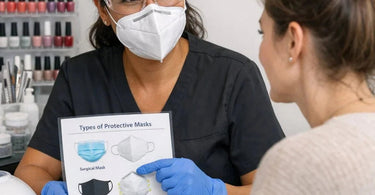
Clients notice the difference when you're not gasping for air like you just ran a marathon in a wool sweater. Let's be honest, nothing kills the serene "spa voice" vibe quite like a technician who sounds like Darth Vader struggling with allergies. But here at Pure Spa Direct, we know that the cloud of acrylic nail dust, the haze of hair lightener fumes, and the general "what died in here?" aroma of a busy waxing room is no laughing matter. Your lungs are your most important tool, even more than your favorite Facial Steamer or that expensive Microdermabrasion machine. So, let's talk about the unsexy hero of the treatment room: the humble face mask. But not just any mask—we're diving deep into Choosing The Right Type Of Mask For Professional Air Quality because your health (and your ability to smell the lavender essential oil) literally depends on it.
If you've been grabbing the same dusty box of masks from the back of the supply closet since 2020, it's time for an intervention. The world of respiratory protection has evolved, folks. We aren't just dodging the morning commute sniffles anymore; we are in the trenches with chemical vapors, biological particulates, and enough nail dust to build a sandcastle. Using the wrong mask is like using a spoon to dig a swimming pool—it technically touches the dirt, but you aren't getting the job done. We need to look at ratings, fit, and filtration. So, grab a cup of detox tea, and let's get nerdy about safety.
Why Your Basic Cloth Mask Isn't Cutting It Anymore (Sorry, Not Sorry)
Remember that adorable leopard print cloth mask you sewed during the great toilet paper crisis of 2020? It was cute for the grocery store, but in a professional salon or barber shop environment, it's basically a fashion accessory. It stops sneezes, sure. But does it stop the microscopic micro-plastics from nail filing? Does it filter out the volatile organic compounds (VOCs) from that industrial-strength hair color? Absolutely not. We need to step up our game.
Think of it this way: you wouldn't use dish soap to wash a client's color-treated hair, right? The tools have to match the job. In the world of professional hygiene, we are dealing with three main enemies: Dust (from nails, hair, and dry skin), Droplets (from sprays and Vichy showers), and Fumes (from chemical services). A basic cloth mask handles droplets okay, but it fails miserably at dust and fumes. That means your lungs are acting as the filter, and let me tell you, lungs hate that job. They didn't sign up for it.
The Dust Busters: Winning The War Against Physical Particles
If you do nails, you know the struggle. That fine pink or white dust that gets absolutely everywhere? It looks pretty on the floor, but inside your respiratory tract, it's a nightmare. Acrylic nail dust is specifically nasty because it doesn't dissolve. It sits in your lungs like a tiny, sharp piece of plastic. The same goes for dust from sugar scrubs mixing with air or the fallout from a heavy Dermaplaning session. You are essentially creating a confetti of dead skin and keratin.
Here is where you need a particulate respirator. You've seen them; they usually have a rating like N95 or N99. The "N" stands for "Not oil resistant," and the number is the percentage of particles it filters out (95% or 99%). For spa and salon use, an N95 mask is the gold standard. It is designed to seal tightly to your face and force the air through the filter media. We love the Graham Beauty options available on our site because they balance high quality with breathability. You need something that stops the dust but doesn't make you pass out from lack of oxygen while doing a intricate Nail Art design.
For those of you who are really dealing with heavy dust loads (looking at you, high-volume pedicure stations with electric files), consider stepping up to a half-facepiece elastomeric respirator. They look a little industrial, sure, but they are comfortable for hours and the filters last forever. Plus, you can wipe them down with hospital-grade disinfectant after every shift. They are the Portable Massage Tables of the mask world—rugged, reliable, and designed for heavy lifting .
Chemical Warfare: Fumes, Vapors, And The "Brain Fog"
Have you ever left work after a busy Saturday of hair coloring and brow lamination and felt a little... fuzzy? That isn't just exhaustion; that is chemical exposure. The bleach and lighteners we use release ammonia and other VOCs. Gel polish removers (acetone) and monomers for acrylic nails are also potent respiratory irritants .
Here is the critical thing to remember: Dust masks do not stop chemical fumes. An N95 mask is great for dust, but a chemical vapor molecule is much smaller than a dust particle. It goes right through the electrostatic charge of a standard N95 like a ninja in the night. To stop fumes, you need a cartridge respirator. These are the masks with the big pink or grey pucks on the sides. These cartridges contain activated charcoal or other specialized media that adsorb the chemicals before they hit your nose.
It sounds scary, but it's simple. If you are doing a lot of acrylic nails (monomer is a doozy) or heavy highlighting with powder lightener, get a respirator with Organic Vapor cartridges. Brands like 3M make them readily available. Your staff might think they look like a sci-fi movie extra, but when they aren't going home with a splitting headache, they will convert to the cult of the cartridge. Trust me, your brain cells will thank you. It is the best investment you can make next to a high-quality Towel Steamer.
Fit Is Everything: The Glasses Fog Test
You can buy the most expensive, NASA-grade mask on the market, but if it leaks around your nose, you may as well be wearing a fishnet stocking on your face. The seal is the secret sauce. This is especially true for the lash and brow technicians out there. You cannot do a precise lash tint or lift if your mask is fogging up your magnifying glasses every two seconds .
How do you know if you have a good fit? Do the "User Seal Check." Put the mask on. Cup your hands over it (don't push down hard, just cover it). Exhale sharply. If you feel air rushing out the sides near your eyes or chin, you have a leak. Adjust the nose wire. Try a different size. Many of us have smaller faces (petite queens, rise up!) and need a specific "small" size. If you wear a spa uniform in XS, you probably need a small mask.
I also want to talk about comfort features because happy technicians are productive technicians. Look for masks with foam nose bridges. That little strip of foam stops glasses from fogging and prevents the dreaded raw nose bridge after an 8-hour shift. Also, look for braided head straps instead of rubber bands. Rubber bands pinch your hair and snap your ears off. Braided straps are gentle on your hairstyle and don't cut off circulation. Protective Gloves and Masks should be comfortable, not torture devices.
The "Vent" Debate: To Valve Or Not To Valve?
This is a fun one. You see masks with little plastic exhalation valves. Those valves make it much easier to breathe out, reducing heat and humidity inside the mask. For the wearer, a valved mask is heaven. You stay cooler, your breath doesn't smell like last night's garlic bread as much, and you don't feel like you're suffocating.
However! A valved mask protects you from the environment, but it does not protect the environment from you. The valve opens when you exhale, sending your breath directly into the room. In a waxing suite or massage therapy room, this is rude unless you are 100% sure you are healthy. For source control (keeping your germs to yourself), choose a mask without a valve. For dusty environments where you are alone or away from clients (like a back room mixing chemicals), a valve is great for your comfort .
If you are doing close-proximity services like eyelash extensions or facials, please, for the love of all that is holy, wear a non-valved mask. Your client does not want your exhalation particles landing directly in their freshly steamed pores. That's just common courtesy, like rinsing your mixing bowls instead of leaving them for the morning person.
When To Toss It: The Lifespan Of Your Lung Buddy
Masks are not immortal. That N95 you've been using for three weeks? It's done. Dead. The electrostatic charge that grabs the tiny particles wears out with moisture from your breath. If the mask is dirty, crushed in your pocket, or smells like your last client's perm solution, throw it away. Disposable masks are called disposable for a reason. Do not be a hero. Do not try to wash it. Washing an N95 destroys the filtration media.
For reusable respirators with cartridges, change the cartridges when you start to taste or smell the chemicals you are trying to avoid, or on a strict schedule (like every 40 hours of use or once a month). Write the date on the cartridge with a sharpie. Treat it like an expiration date on milk—don't push it .
And for goodness sake, store your masks properly. Throwing a clean mask into the bottom of your messy bag where your lunch leaked? That's a no-go. Keep them in a clean, dry place. If you use UV Sterilizers for your tools, don't put your masks in there unless the manufacturer says so. UV light can degrade some mask materials. Use common sense!
Mask Magic For Specific Services
Let's break it down by department because a one-size-fits-all approach doesn't work here.
For Nail Techs: You are the dust kings and queens. You need an N95 (non-valved is best for client safety). Look for one with a "cool flow" valve if you are working alone, but prioritize seal. The Gelish and CND products smell lovely, but the dust from filing and the fumes from monomers and acetone are serious. Consider a desktop Nail Dust Collector to work alongside your mask—double the protection, double the fun.
For Hair Stylists & Barbers: You have a duel threat: hair clippings (which are organic and can mold in your lungs—gross) and chemical sprays. For cutting, a basic surgical mask or a reusable cloth mask (that you wash daily!) is fine for clippings. For coloring and perming? Break out the respirator with organic vapor cartridges. Especially when you are mixing Clairol Professional or Wella color lines. The powder bleach is a nightmare if you inhale it .
For Estheticians & Waxers: You are generally dealing with biologicals and steam. Standard procedure masks (the blue surgical ones) are great for ItalWax applications and Hydrodermabrasion to catch splashes. However, if you are using High Frequency Machines (which produce ozone—great for skin, bad for lungs), you need good ventilation and a mask rated for gases. Also, if you are doing Dermaplaning, you are literally scraping off clouds of dead skin cells. Wear an N95. You don't want to be breathing in those skin snowflakes .
For Massage Therapists: If you are just doing massage and using Bon Vital lotions, you are usually fine. But if you are the one cleaning the sheets or spraying down the room with disinfectants that aerosolize, put a mask on. Your lungs don't need a daily dose of quaternary ammonium compounds.
Building Your Spa's Safety Kit
At Pure Spa Direct, we don't just sell the fancy gadgets; we sell the boring safety stuff too, because we love you and want you to breathe easy. When you are building your supply order, don't forget the cotton balls, the towels, and the masks. Stock a variety. Have Graham Beauty procedure masks for the estheticians, N95s for the nail techs, and a couple of cartridge respirators in the back for the heavy chemical mixing days.
Train your staff on how to wear them properly. I cannot tell you how many times I've seen a technician wearing a mask below their nose. That is called a "chin diaper," and it does nothing. The mask must cover the nose AND the mouth. It is not a chin cozy. If you are wearing glasses or magnifying lights, mold the nose wire around the bridge of your nose. Take the two minutes to adjust it.
The Bottom Line (And The Laughs)
Listen, looking cute in your Barco Uniforms is important. Having a flawless gel polish finish is crucial. But being able to take a deep breath without coughing up a glitter bomb of nail dust and hair dye? That is priceless. Choosing the right mask isn't just about OSHA compliance (though that's part of it); it's about longevity in this industry.
We want you waxing, snipping, and massaging for decades, not burning out because your lungs are shot by age 40. So, take a look at your current mask situation. Is it sad? Is it loose? Is it a relic from 2022? Head over to our Protective Gloves & Masks collection and gear up. Your future self, breathing easy and smelling the roses (or the essential oils), will thank you profusely.
Now, go forth and breathe safely, you glorious, hard-working professionals. And remember, if your mask fogs up your glasses so bad you can't see, you're doing it wrong—come back and read this again!
