
Efficiency meets quality with this choice, and honestly, nothing kills the vibe of a relaxing spa day quite like wondering if the tools used were cleaner than your average city sidewalk. Let's be real, we're in the business of making people feel gorgeous, pampered, and safe enough to fall asleep while we wield sharp objects near their eyebrows. That means our disinfection game has to be absolutely on point. But with terms like 'hospital-grade,' 'Barbicide,' and 'alcohol' getting thrown around, it can feel like you need a chemistry degree just to clean a pair of shears. Fear not, beauty warriors! We're about to break down Disinfection 101 in a way that won't put you to sleep (unless you're on a super comfortable massage table, in which case, we totally understand).
From the iconic blue liquid that has been a salon staple for decades to the powerful sprays that nuke germs in a minute flat, we're mapping out exactly what should be soaking, what should be spraying, and what should be tossed. So grab your favorite spatula (a clean one, obvi), and let's dive into the wonderfully hygienic world of killing germs. Your clients' immune systems—and your state board inspector—will thank you.
Barbicide: The Iconic Blue in a Jar
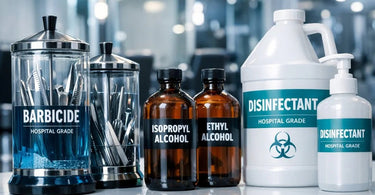
If disinfection were a Hollywood movie, Barbicide would be the original blockbuster that spawned a thousand sequels. That unmistakable blue liquid sitting in a wet disinfection jar on your station isn't just for show; it's a certified heavy-hitter in the world of infection control . This stuff is an EPA-registered, hospital-grade, broad-spectrum disinfectant . In plain English? It means Barbicide is powerful enough to be used in a hospital but is specifically formulated to be safe for the things we love, like combs, shears, and metal implements .
Think of it as the superhero for your non-porous tools. It's proven effective against a rogues' gallery of villains including HIV-1, Hepatitis B and C, MRSA, and even that pesky fungus that causes Athlete's Foot . But, and this is a big but, it's not magic. You can't just dunk a comb covered in hair and product goo and expect it to emerge sparkling clean. The proper protocol is to first give your tools a good scrub with soap and water to remove any visible debris . Then you give them a ten-minute spa day of their own, fully immersed in that beautiful blue solution . And please, for the love of all that is holy, don't let them soak overnight—it can be rough on your expensive shears . Follow the manufacturer's instructions, change that solution every day (or sooner if it looks cloudy), and your iconic Barbicide jar will keep your tools (and your reputation) pristine .
Hospital-Grade Disinfectants: When You Need the Big Guns
So, you've got Barbicide for your tools, but what about the treatment table after a client? What about the pedicure chair that just hosted a marathon foot soak? That's where other hospital-grade disinfectants come into play, and they're not all created equal. The term 'hospital-grade' simply means the disinfectant has passed specific EPA tests showing it can kill certain bacteria and viruses . It's the gold standard for a reason, and many state boards explicitly require an EPA-registered disinfectant that is bactericidal, virucidal, and fungicidal .
Products like LUCAS-CIDE or Prevention offer a whole arsenal of hospital-grade options . Some come as concentrates, which are super economical for soaking tools and doing a deep clean on pedicure spas. Others are ready-to-use (RTU) sprays or wipes, which are a godsend for quickly wiping down workstations, chairs, and counters between clients . These are your 'between-client BFFs.' The key thing to remember here is contact time (sometimes called 'dwell time'). This is the amount of time a surface must stay visibly wet for the disinfectant to actually work . Some powerful new formulas, using tech like Accelerated Hydrogen Peroxide, can kill everything on their label in just one minute . Others might need ten minutes. Always, always read the label. Spraying and immediately wiping is just an expensive way to get a slightly damp countertop.
Isopropyl Alcohol: The Misunderstood Workhorse
Ah, alcohol. It's the reliable friend who shows up to every party. But in the salon, it's often misunderstood. You'll see bottles of 70% isopropyl alcohol everywhere, and it's great for some things, but it's not a one-stop-shop for disinfection. For starters, it evaporates super fast, which makes it difficult to maintain that critical wet contact time needed to kill tougher bugs . It also isn't effective against some non-enveloped viruses and can be harsh on certain surfaces, drying out plastics or rubbers over time.
So, where does it shine? It's fantastic for quickly sanitizing metal implements like tweezers or metal cuticle pushers after they've been through the full disinfection process and are just being stored. Many pros use an alcohol soak as an extra precaution for storage. It's also your best friend for wiping down glass surfaces and mirrors to get them streak-free. Plus, it's a key ingredient in many of those quick-dry hand sanitizers we all came to know and love. But for your primary disinfection step on tools and high-touch surfaces? Leave it to the EPA-registered hospital-grade solutions. Think of alcohol as the supporting actress, not the star of the show.
What Goes Where? A Handy Guide for the Perplexed Pro
This is where the rubber meets the road, or in our case, where the soft wax meets the skin. Knowing what cleaning method to use on what item is the secret to passing inspections and keeping clients safe. The golden rule is based on the item's material and function. Non-porous items—think hard surfaces like metal, glass, and some plastics—can and must be disinfected. Porous items—like wood, foam, or natural fiber—are basically tiny hotels for germs and must be treated as single-use .
- Metal Tools (Cuticle Nippers, Scissors, Tweezers, Metal Pushers): These guys are the all-stars of disinfection. Step 1: Clean. Scrub off any gunk with soap and warm water. Step 2: Rinse and dry. Step 3: Fully immerse in an EPA-registered disinfectant like Barbicide or a LUCAS-CIDE concentrate for the full contact time (usually 10 minutes) . Step 4: Remove, rinse, dry, and store in a clean, covered container .
- Plastic Tools (Combs, Brushes, Hair Clips): If they're non-porous (and most salon-quality ones are), they get the same A-list treatment as metal tools: clean, soak for the full contact time, rinse, dry, and store .
- Electrical Clippers and Trimmers: These can't take a bath, so they need a sponge bath. First, brush off all the hair. Then, apply a spray or foam specifically designed for clippers (like LUCAS-CIDE Clipper Cleanfectant), ensuring the blade is saturated, and let it sit for the required contact time (often 10 minutes) . Don't forget to wipe down the whole handle with a disinfectant wipe!
- Pedicure Bowls and Spas: These can be a breeding ground for trouble if not done right. After each client, drain debris, scrub the bowl with soap and water, then fill with water and the correct amount of EPA-registered disinfectant. Run the jets to circulate it for the full contact time (check your pedicure spa's manual and the disinfectant label) . Then drain, rinse, and wipe dry. It's a process, but non-negotiable.
- Wax Pots and Spatulas: This is a two-parter. Wooden spatulas are single-use only. One dip, then straight in the trash . For the pot itself, if it gets contaminated, you must empty the wax, wash the pot with detergent, and then disinfect all surfaces with an EPA-registered spray or wipe . Never, ever double-dip a used stick!
- Single-Use Items (The 'Toss It' Pile): This includes nail files, buffers, toe separators, orangewood sticks, sponges, and waxing sticks. If it's porous or can't be fully immersed and scrubbed, it's a one-hit wonder and must be discarded after a single use . Your cotton balls and wipes fall into this category, too.
Staying on the Right Side of the Rules (and Keeping Clients Happy)
Look, we know that between running a business, managing a team, and perfecting the latest brow lamination technique, staying on top of disinfection rules can feel like a chore. But it's the ultimate chore that protects your business. State boards, like the one in Virginia or Kentucky, have very clear, very specific regulations about this stuff . They require wet disinfection units at every station, proper storage of chemicals with accessible Safety Data Sheets (SDS), and meticulous cleaning logs. An inspection fail because of a dirty wax pot or a cloudy disinfectant solution isn't just embarrassing; it can cost you.
More importantly, it's about trust. When a client sees you pull a fresh set of tools from a sealed bag and watches you wipe down the chair with a disinfectant wipe, they feel safe. They know you're a pro who cares about more than just the aesthetic. So, stock up on the good stuff—the professional cleaners and disinfectants—from a source you trust. Make it a seamless part of your workflow. Your future self (and your clients) will be so glad you did. Now go forth and disinfect with confidence! And maybe put on some good music while you do it.
)