
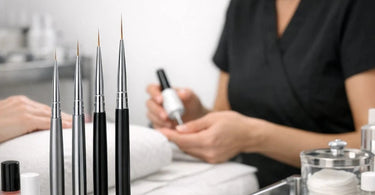
Deliver quality that clients can see... and right now, what they want to see are those crisp, clean, Instagram-worthy lines that look like they were painted by a tiny, very sober robot. If you've ever picked up a striper brush only to have the line look like a wobbly creek instead of a sleek river, or flopped down a bead of gel the size of Texas, take a deep breath. It's not you. Well, mostly, it's not you. It's about Selecting The Proper Diameter For Professional Nail Art Striper Brushes. We spend so much time worrying about the color of the gel or the shine of the top coat, but the real magic happens in the millimeters. We are going to strip down (pun absolutely intended) the mystery of bristle diameter so you can stop fighting your tools and start creating masterpieces. Grab your favorite beverage, settle into your Stylish Salon & Barber Furniture, and lets get our geek on about brushes.
I know what you are thinking. “Zoey, its just a brush. How complicated can it be?” Oh, my sweet summer child. Have you ever tried to paint a delicate butterfly wing with a brush meant for filling in an F-150’s pinstripe? Conversely, have you ever tried to paint a straight French smile line with a brush so thin it bends if you look at it wrong? The diameter, or the thickness of the bristle bunch, dictates the maximum line width, the paint load, and the flexibility. Get it right, and you glide. Get it wrong, and you’ll be reaching for the Nail Art Supplies remover in frustration. Let’s break down the sizes like we are ordering coffee, because honestly, it’s that specific.
The “Tiny Dancer” (0.5mm - 1mm Diameter)
This little guy is for the detail junkies. We are talking micro-lines, floral veins, the whiskers on a cat, or lettering so small your client needs reading glasses to appreciate it. This brush holds very little product, which is great because you aren’t trying to flood the nail, but bad because you will be dipping it into your pot of gel or paint every two seconds. It takes patience. If you are the type of tech who drinks espresso and has steady hands, this is your soulmate. Use this one for those hyper-realistic designs where precision is king. If you have a tremor from that third cup of coffee, maybe put this one down and step away slowly.
The “Goldilocks” (1.5mm - 2mm Diameter)
This is the workhorse of the Professional Nail Care Collections. This diameter is neither too skinny nor too fat. It holds enough gel or paint to draw a continuous line from cuticle to free edge without running dry in the middle (which is always awkward). It creates crisp, sharp lines for geometric patterns, classic French tips, and that trendy asymmetrical squiggle everyone is asking for. If you are a professional tech who needs speed and reliability, this is your best friend. It offers enough resistance to keep the line straight, but enough flex to curve around the cuticle. I tell my students to start here. Master this, and you can conquer the world.
The “Bold & Beautiful” (3mm - 4mm Diameter)
Now we are talking chunky. You reach for this heavy lifter when you need to lay down a thick stripe, fill in negative space designs, or create those chunky, retro 80’s swirls. This brush holds a significant amount of product, so it’s great for even coverage on those thick lines. It is also surprisingly excellent for clean-up. If you dip this bad boy in acetone, the flat edge can swipe away a messy cuticle line in one go. However, do not try to draw a delicate daisy with this unless you want a daisy that looks like it was hit by a truck. Respect the chunk.
The “Is That a Marker?” (5mm+ Diameter)
Honestly, at this point, you might just be using a sharpie. But in all seriousness, these wide brushes are for specific techniques like creating high-voltage color blocking or painting thick layers of Professional Gel Polish in a single stroke. They are rare in striper brushes because once you hit this width, you lose the “stripe” identity and move into “flat brush” territory. Save these for covering large areas, not for the fine print.
Material Matters: Synthetic vs. Natural Hair
Before you click away, listen up! Diameter isn’t the only factor. The hair type changes everything. Acrylic Nail Supplies often use natural Kolinsky sable because it holds a sharp point and resists the harsh monomer. However, for gel polishes (which are stickier), you generally want synthetic fibers. Synthetic bristles don’t absorb the product as much, they clean up easier, and they stand up to the wiping required for gel. Synthetic brushes also tend to be a bit stiffer, which helps when you are trying to drag that thick gel into a straight line . If you use a natural hair brush for gel, you might find it gets gummy and loses its shape fast. Don’t be that person. Match your hair type to your product type for a long-lasting relationship.
Length Matters Too (But That’s Another Blog)
While diameter is the width, length is the reach. A short bristle (5-8mm) gives you maximum control and stiffness, perfect for pushing against the edge of the nail. A long bristle (10mm+) gives you flow and allows you to pull long, sweeping lines without stopping, but it requires a much lighter touch. I like a 7mm to 10mm length combined with a 1.5mm diameter for the best of both worlds. It’s the athletic trainer of nail art tools: stable, flexible, and ready to sweat .
Real Talk: Why Your Stripes Look Wobbly
Even with the perfect diameter, sometimes the line wiggles. Is it the brush? Possibly. But usually, it’s the anchor point. You can’t paint a straight line if your hand is floating in the air like a ghost. Anchor your pinky finger on the table or on the client’s hand. Use a Nail Files & Buffers to create a smooth surface; a bumpy nail makes for a bumpy ride. And for the love of all that is holy, do not overload the brush. If there is a giant blob of gel on the end, you are not painting; you are flooding. Wipe the excess on the rim of the bottle or on a lint-free wipe. You want the brush damp, not dripping.
Your Homework Assignment
Go to your station and look at your brushes. Honestly look at them. If they look like a frayed broomstick or if the diameter is wrong for the work you do most (stop trying to do ombre with a striper brush, please), it is time for a refresh. Stocking up on the right tools is just as important as stocking up on Premium Nail Polish. At Pure Spa Direct, we carry a massive range of Nail Brushes & Tools specifically for the pro who demands excellence. Don’t settle for a brush that fights you every step of the way. Find your diameter, find your flow, and watch your retention rate soar because clients won’t let anyone else touch their nails.
Now go forth and stripe with confidence. And remember, if at first you don’t succeed, use more glitter. It hides everything.
)