
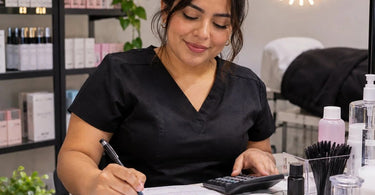
Solutions for every challenge... including the surprisingly sneaky challenge of figuring out exactly how much money disappears into disposable supplies during a full lash extension appointment! A gorgeous set of lashes might be the star of the show, but behind every flawless application is a collection of eye pads, microbrushes, mascara wands, adhesive accessories, tape, wipes, and protective materials quietly contributing to your service costs. Those little items may seem inexpensive individually, but multiply them across dozens of clients and suddenly your disposable supply budget deserves its own spotlight. Understanding how to calculate disposable supply costs for a full lash extension set helps professional lash artists, salon owners, and spa managers establish profitable pricing, control waste, and purchase supplies more intelligently. With the right system, you can account for every cotton pad and spoolie without turning your treatment room into an accounting department.
The goal is simple: identify every disposable item used during a full set, calculate its actual cost per appointment, and build that expense into your service pricing. Whether you specialize in classic, hybrid, or volume applications, the same method works. Start by reviewing your everyday professional lash extension supplies and separating single-use materials from reusable tools and longer-lasting products.
Why Disposable Supply Costs Matter More Than You Think
A lash extension appointment involves more than adhesive and extensions. Every service also requires preparation, lower-lash protection, precise application, hygiene procedures, and cleanup. Each stage can consume materials that must be replaced between clients.
For an individual appointment, spending an additional $0.20 on an applicator might not seem important. Across 100 monthly appointments, however, that same expense becomes $20. Add a few extra eye pads, unnecessary adhesive accessories, unused disposable brushes, and excessive tape, and the difference becomes significant.
Tracking disposable expenses allows salon professionals to identify purchasing opportunities without sacrificing quality, client comfort, or appropriate infection-control practices. It also helps distinguish between a profitable service price and a price that merely looks attractive on the booking menu.
Most importantly, accurate supply costing allows you to make business decisions using actual numbers rather than optimistic guesses. Because hope is lovely for your vacation plans, but it is not a particularly reliable inventory-management strategy.
Step 1: Identify Every Disposable Supply Used During a Full Lash Set
Begin by documenting every single-use material your technician normally consumes during one complete lash extension appointment. Work through the service from preparation to cleanup rather than relying on memory.
Common disposable lash extension supplies include:
- Under-eye gel pads or protective eye patches
- Disposable mascara wands and spoolies
- Microbrushes and precision applicators
- Lint-free wipes and adhesive nozzle wipes
- Disposable adhesive rings, cups, or glue palettes
- Medical-grade or lash-specific application tape
- Single-use cotton pads and cleansing applicators
- Disposable bed coverings or treatment table paper
- Disposable gloves when appropriate for the procedure and facility protocols
- Single-use mapping strips or disposable marking materials
- Protective barriers for frequently touched work surfaces
- Disposable aftercare applicators supplied to clients
You can organize your workstation with supplies from Lash & Brow Service Supplies, along with professional cotton, sponges, and wipes and protective gloves and masks as appropriate for your services.
Not every studio uses every item on this list. Your calculation should reflect your actual procedure, product instructions, sanitation requirements, and technician workflow. Avoid including materials that are not used, and never reduce essential hygiene supplies simply to improve the numbers.
Step 2: Calculate the Unit Cost of Each Disposable Product
The foundation of accurate supply costing is knowing what one usable piece costs rather than focusing only on the package price.
Unit Cost = Total Purchase Cost / Number of Usable Units
For example, imagine purchasing 100 disposable mascara wands for $8. Your cost per wand is $0.08. If your technician uses two wands during a full set, the service consumes $0.16 in disposable mascara wands.
Consider another hypothetical purchase: a package containing 50 pairs of under-eye pads costs $20. Divide $20 by 50 pairs and the cost is $0.40 per pair. If one pair is used during the appointment, your eye pad expense is $0.40.
Be careful with package descriptions. A package containing 100 individual eye pads provides only 50 pairs. Confusing pieces with pairs can underestimate this expense by half.
For materials sold by length, weight, or volume, calculate the usable quantity instead. If a $5 roll of lash tape contains 10 meters and a service uses 0.25 meter, the tape expense is $0.125, which rounds to approximately $0.13.
Include applicable shipping charges, nonrecoverable taxes, and other landed purchasing costs when building your inventory-cost system. For products purchased together, allocate shared shipping costs consistently rather than ignoring them.
Step 3: Build a Realistic Full Lash Extension Disposable Cost Breakdown
Now for the interesting part: putting those tiny expenses together. The following example uses hypothetical prices and quantities for illustration, not current product quotations or universal industry averages. Replace them with your own supplier invoices and actual consumption records.
| Disposable Supply | Example Package Cost | Quantity Per Package | Usage Per Full Set | Cost Per Service |
|---|---|---|---|---|
| Under-eye pads | $20.00 | 50 pairs | 1 pair | $0.40 |
| Disposable mascara wands | $8.00 | 100 wands | 2 wands | $0.16 |
| Microbrush applicators | $10.00 | 100 brushes | 4 brushes | $0.40 |
| Disposable adhesive rings | $6.00 | 100 rings | 1 ring | $0.06 |
| Lint-free wipes | $8.00 | 200 wipes | 4 wipes | $0.16 |
| Lash application tape | $5.00 | 10 meters | 0.25 meter | $0.13 |
| Cotton cleansing pads | $4.00 | 100 pads | 3 pads | $0.12 |
| Disposable table covering | $18.00 | 50 coverings | 1 covering | $0.36 |
| Disposable gloves | $12.00 | 100 gloves | 2 gloves | $0.24 |
| Aftercare spoolie | $8.00 | 100 wands | 1 wand | $0.08 |
Example total disposable supply cost per full lash extension set: $2.11.
The tape calculation uses the unrounded value of $0.125 before rounding the final service total. This example also assumes that each listed item is actually required and consumed during the appointment.
Your own total could be higher or lower depending on product quality, supplier pricing, treatment protocols, client needs, and purchasing quantities. The purpose of the example is to demonstrate a repeatable calculation rather than establish a recommended spending target.
Step 4: Separate Disposable Costs From Other Lash Extension Materials
One of the biggest mistakes in lash service costing is mixing disposable accessories with every other expense involved in the appointment. Although those costs all matter, keeping them in separate categories makes your calculations more useful.
Disposable supplies: Materials intended for single use, including eye pads, microbrushes, disposable adhesive holders, cleansing pads, and protective coverings.
Consumable products: Materials used in measured quantities, including lash adhesive, lash extensions, professional cleanser, primer, and other approved application products.
Reusable equipment: Tools such as professional tweezers, lash lights, treatment beds, and reusable palettes that must be maintained and appropriately cleaned or disinfected between clients.
Operating expenses: Technician compensation, rent, booking software, payment processing, insurance, utilities, marketing, and other business overhead.
Explore professional lash and brow enhancement supplies when comparing different materials used in your service menu.
A disposable-only total is valuable, but it does not represent the complete cost of providing a full set. Keep it as one clearly labeled category within your broader service-cost calculation.
Step 5: Account for Adhesive Waste and Other Variable Consumables
Lash adhesive deserves its own calculation because it is generally purchased as a bottle rather than as individual disposable pieces. The amount used during a service may vary, and the amount discarded can also influence the true cost.
Suppose a hypothetical $35 adhesive bottle contains 5 milliliters of product. If your documented average usable consumption, including routine discarded adhesive, is 0.20 milliliter per full set, the theoretical allocation is $1.40 per appointment.
However, this figure assumes you use the entire bottle before it must be replaced. If you discard unused adhesive because it has reached its manufacturer-defined replacement interval or is no longer suitable, the effective cost rises.
For a more accurate result, divide the total bottle cost by the actual number of services completed using that bottle.
Effective Adhesive Cost Per Service = Bottle Cost / Number of Services Completed With That Bottle
For instance, if a $35 bottle supports 20 completed appointments before replacement, the effective adhesive cost is $1.75 per service.
Adhesive is not included in the $2.11 disposable accessory example above. It belongs in the separate consumable-product category, along with the extensions themselves.
Follow the adhesive manufacturer's storage, dispensing, handling, and replacement instructions. Stretching product life beyond appropriate limits to save a few cents is not a sound business strategy.
Step 6: Adjust Your Calculations for Classic, Hybrid, and Volume Sets
Different lash extension services may require different quantities of supplies, even within the same studio.
A classic full set might involve one pair of under-eye pads, a standard number of microbrushes, and a predictable amount of application tape.
A hybrid set might require additional mapping materials, more application time, or slightly different preparation supplies depending on the technician's approach.
A volume set could involve additional adhesive handling, mapping adjustments, or other materials associated with the chosen technique. However, volume services do not automatically require more of every disposable item.
The best approach is to record actual consumption for each service category instead of assigning arbitrary surcharges.
Create three separate cost records: one for classic sets, one for hybrid sets, and one for volume sets. Record differences over a meaningful sample of appointments, then calculate the average.
This method is especially helpful when reviewing lash extension products and application accessories for a growing service menu.
Step 7: Track Your Actual Usage Instead of Guessing
A spreadsheet is one of the easiest ways to transform disposable supply costs into actionable business information.
Give each supply its own row and record its purchase cost, package quantity, unit cost, average usage per appointment, and resulting cost per service. Add columns for the supplier, purchase date, and last price update.
For the first two to four weeks, ask technicians to record actual quantities used during full-set appointments. The goal is not to monitor every blink and brushstroke. It is to identify realistic consumption patterns.
If one technician consistently uses six microbrushes and another uses three, investigate whether the variation comes from application technique, client needs, product design, or unnecessary waste. Do not assume the lower number is automatically better.
Average usage should reflect safe and effective service delivery. Some appointments legitimately require extra supplies, and your cost model should account for those variations.
Once you have dependable data, update your standard cost sheet whenever wholesale prices change significantly or your studio introduces new products.
Step 8: Add a Sensible Allowance for Normal Supply Variations
Even an organized lash studio encounters small variations in disposable consumption. An eye pad might need replacing during preparation, an applicator might become contaminated before use, or a technician might need an additional spoolie to complete the appointment properly.
Rather than pretending every service follows a perfectly identical pattern, consider an allowance for documented normal waste.
For example, suppose your average disposable accessory cost is $2.11 and your historical records support a 10% allowance for ordinary variation.
Adjusted Disposable Cost = $2.11 x 1.10 = $2.321, or approximately $2.32 per service.
The 10% figure is only an illustrative budgeting assumption. Your actual allowance should come from your own records rather than a presumed industry standard.
Keep ordinary variation separate from unusual incidents, excessive product waste, or training expenses. This helps you identify problems without hiding them inside a vague supply-cost percentage.
Step 9: Calculate Your Monthly Disposable Supply Budget
Once you know your average cost per appointment, estimating monthly disposable supply spending becomes remarkably straightforward.
Monthly Disposable Supply Budget = Average Disposable Cost Per Appointment x Expected Number of Appointments
Suppose your adjusted average is $2.32 per full set and your studio expects to complete 80 full sets during the month.
$2.32 x 80 = $185.60 in estimated monthly disposable supplies.
If your studio completes 150 appointments at that same average, the estimated expense increases to $348.00.
Remember that full sets are not your only appointments. Lash fills, removals, and other services can have different disposable requirements. Calculate those individually and add their projected monthly costs to create a complete purchasing budget.
For larger operations, this information is especially useful when organizing salon and spa business supplies and coordinating recurring inventory orders.
Step 10: Use Your Supply Costs to Price Lash Extension Services Profitably
Knowing that disposable materials cost $2.32 per appointment is useful, but knowing how that expense fits into your total service price is even more valuable.
Imagine your full lash extension set sells for $150. If disposable accessories cost $2.32, they represent approximately 1.55% of the service price.
Disposable Supply Percentage = (Disposable Cost / Service Price) x 100
That percentage alone does not reveal your profitability. You still need to account for lash extensions, adhesive, other consumables, technician labor, processing fees, business overhead, and other relevant expenses.
For example, consider this hypothetical $150 service:
- Disposable accessories: $2.32
- Lash extensions, adhesive, and other consumables: $9.00
- Technician labor expense: $60.00
- Allocated overhead and transaction costs: $28.00
Total estimated service cost: $99.32.
Remaining contribution: $50.68.
This example leaves approximately 33.79% of revenue after the listed expenses, but that amount is not necessarily the business's final net profit. Additional costs, taxes, and owner compensation may still need to be considered depending on how the business accounts for them.
Accurate costing allows you to set prices intentionally instead of copying a competing studio's menu and hoping the math behaves itself.
How to Reduce Disposable Supply Costs Without Cutting Corners
The best savings come from smarter purchasing, thoughtful preparation, and consistent inventory practices, not from compromising sanitation.
Compare unit prices rather than package prices. A larger package is not automatically a better deal. Divide the landed cost by the number of usable units before choosing a supplier.
Standardize workstation setup. Create a practical preparation checklist that helps technicians pull the supplies they typically need without opening excessive single-use items unnecessarily.
Buy practical quantities. Bulk purchasing can reduce unit costs, but only when the studio can reasonably use the materials before they become unsuitable for use.
Monitor product waste. Record damaged packaging, unnecessary dispensing, and repeated supply replacements to identify preventable losses.
Review product quality. A cheaper eye pad that frequently needs replacing might cost more per successful appointment than a better-performing option.
Keep your inventory organized. Clearly labeled storage and routine stock counts can prevent duplicate purchasing and unexpected shortages.
Pure Spa Direct distributes a broad selection of professional beauty products, including lash and brow service essentials, professional applicators, and salon cleaners and disinfectants. Comparing appropriate options within these categories can help business owners build more consistent purchasing routines.
Never Sacrifice Hygiene to Save on Disposables
There is one area where bargain hunting absolutely does not belong: compromising sanitation or client safety.
Single-use products must be used and discarded according to their labeling, manufacturer instructions, applicable regulations, and professional infection-control procedures. Never reuse a disposable applicator between clients, return a contaminated tool to clean inventory, or substitute unsuitable materials around the delicate eye area.
Reusable implements require the cleaning and disinfection procedures appropriate to their intended use and the applicable salon regulations. Disposable supplies and disinfectants serve different purposes, and one does not replace the other.
A properly organized professional spa workstation helps technicians maintain efficient workflows while supporting appropriate sanitation procedures.
Clients may never ask how much an under-eye pad costs, but their experience depends on the studio using appropriate products and following professional standards. Protecting that trust is worth far more than the pennies saved by cutting corners.
Frequently Asked Questions About Lash Extension Disposable Costs
How much do disposable supplies cost for one full lash extension set?
The cost depends on the products, prices, quantities, and procedures used by your studio. The hypothetical example in this guide totals $2.11 in disposable accessories, or approximately $2.32 with an illustrative 10% variation allowance. These figures exclude lash adhesive, extensions, labor, and overhead and should not be treated as universal benchmarks.
Should lash adhesive be included in disposable supply costs?
Adhesive should be included in the overall material cost of a lash appointment, but it is useful to track it separately from single-use accessories. Adhesive consumption depends on dispensing practices, number of appointments per bottle, storage conditions, and required replacement intervals.
Are disposable supplies more expensive for volume lash sets?
Not necessarily. Volume appointments may use different quantities of specific materials, but some disposable items are required only once per client regardless of lash style. Track real consumption separately for classic, hybrid, and volume services.
How often should a lash salon update its supply costs?
Review costs whenever supplier prices, package quantities, application procedures, or service volume change substantially. A monthly inventory review and a more comprehensive quarterly cost analysis can provide a useful starting schedule for many studios.
Should I charge clients a separate disposable supply fee?
That is a business-pricing decision. Many studios incorporate normal material costs into the advertised service price, while others use clearly disclosed fees where permitted. Whatever approach you choose, communicate the complete price transparently and follow applicable consumer-pricing requirements.
What is the best way to track lash extension disposable inventory?
A spreadsheet with purchase price, usable quantity, cost per unit, average service consumption, and current inventory balance is often sufficient. Larger studios may prefer inventory-management software that connects purchasing records with appointment volume.
Make Every Lash Appointment Beautiful and Financially Sustainable
Calculating disposable supply costs for a full lash extension set does not require complicated accounting software or a calculator permanently attached to your lash tweezers. It requires a complete supply list, accurate unit prices, realistic consumption records, and a consistent method for assigning expenses to each appointment.
Begin with the supplies you use today, calculate the cost of each item, and establish a reliable average for your classic, hybrid, and volume services. Then combine those figures with your other material, labor, and overhead expenses to make informed decisions about pricing and purchasing.
As a wholesale distributor serving beauty professionals, Pure Spa Direct offers access to a wide assortment of lash extension supplies for professionals and lash and brow service products. Reviewing your supply choices and tracking actual consumption can help you build a purchasing strategy that supports both consistent appointments and healthier business margins.
Because beautifully applied lashes should make your clients' eyes sparkle, not leave your profit margins looking a little sparse.
