
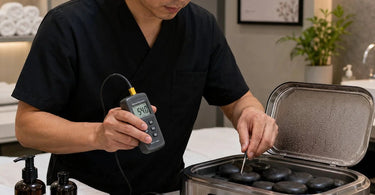
Every great result starts with the right tools... and a little bit of know-how! If you've ever found yourself staring at a digital display on your professional stone heater, wondering if that blinking number is telling the truth or just messing with you, you're not alone. Calibrating the temperature sensor on your stone heater is one of those behind-the-scenes tasks that doesn't get the glory it deserves but is absolutely critical for delivering that perfect, melt-into-the-table experience your clients crave. Think of it like this: you wouldn't trust a mood ring to tell you someone's emotional state, right? So why trust a misaligned sensor to tell you if a stone is ready to soothe or scorch? Let's dive into the 'hot' topic of temperature sensor calibration and make sure your stones are always ready to perform their magic without any unexpected surprises. After all, the only thing that should be 'burning' during a session is your client's love for your services!
Now, let's get down to business. For those of us in the spa, massage, and wellness world, the Hot Stones and Warmers are a staple for deep relaxation and muscle relief. But a heater that doesn't heat accurately is about as useful as a chocolate teapot. Calibration isn't just a fancy term we throw around to sound professional; it's the key to consistent, safe, and effective treatments. When your sensors are off, you risk burning a client (major buzzkill) or giving them a lukewarm rock that's about as relaxing as a cold, wet fish. Neither is a good look. This guide will walk you through the why, when, and how of calibrating temperature sensors on professional stone heaters, ensuring you maintain the highest standard of care and comfort. Because let's be honest, your clients trust you with their relaxation, and a little bit of calibration goes a long way in keeping that trust rock solid.
Why Bother Calibrating? The Sizzling Truth
Let's talk about why calibration is the unsung hero of your treatment room. Think of your stone heater's temperature sensor as the lead singer of a band. If the lead singer is off-key, the whole performance is a disaster. Similarly, if your sensor is reading the temperature incorrectly, your stone temperature is a guessing game. Over time, sensors can drift due to regular use, power surges, or just the general wear and tear of being in a busy spa environment. A sensor that's a few degrees off can be the difference between a client floating out of your room on cloud nine and one who's ready to write a scathing Yelp review about the 'lava rocks of doom'.
Imagine you're giving a hot stone massage. The goal is to provide therapeutic warmth that penetrates deep into the muscles, melting away tension and stress. But if your stone heater is calibrated incorrectly, you could be dealing with stones that are either too hot or not hot enough. Too hot, and you're risking burns and a very unhappy client. Too cool, and you're not delivering the full therapeutic benefits of the treatment. Neither scenario is ideal for your reputation or your client's experience. Calibration ensures that you're hitting that sweet spot every single time, providing consistent, high-quality treatments that keep clients coming back for more.
When to Calibrate: Listening to Your Heater's Cry for Help
Just like your car needs an oil change, your professional stone heater needs regular calibration. But how do you know when it's time? It's not like your heater is going to start speaking to you (unless you've had a very long day). There are a few telltale signs that your sensor might be on the fritz. First, if you notice that your stones are consistently too hot or too cool despite setting the temperature to your usual mark, that's a giant red flag. Second, if you're using a digital heater and the temperature reading seems to fluctuate wildly for no apparent reason, it's time to check the sensor. Third, a physical inspection of the heating unit is a good idea. If you see any damage to the probe or the unit itself, you might be looking at a calibration issue or a bigger problem. As a rule of thumb, calibrating your sensors at least twice a year is a solid plan, but if you use your heater daily, you might want to do it every quarter.
Don't wait until a client tells you the stone feels like it's from the surface of the sun to take action. Being proactive about calibration will save you headaches, money, and potentially a few of your clients' nerve endings. If you're looking for a top-notch heater that makes calibration a breeze, check out the Spa Masters collection. They are known for their durable and reliable equipment, which makes maintenance and calibration a much more straightforward process.
How to Calibrate: A Step-by-Step Guide to Temperature Sensor Calibration
Alright, let's get into the nitty-gritty. The exact process will vary depending on the make and model of your heater, but the underlying principle is the same: you need to ensure the temperature the sensor reads matches the actual temperature of the water or stones. Before you start, it's always a good idea to consult your heater's manual. If you've lost it like most of us (it's probably in that black hole of 'important papers'), you can often find a digital version online or contact the manufacturer for guidance.
Step 1: Gather Your Tools
For this task, you'll need a reliable, accurate thermometer. This is your 'source of truth' for the calibration process. A digital probe thermometer is usually your best bet, as they are generally more accurate than their analog counterparts. You'll also want to have some water on hand, as most calibration methods involve using water as a medium to test the temperature. Think of it as the 'control' in your science experiment.
Step 2: The Water Method
Fill your stone heater with water, just as you would for a normal heating session. Turn on the heater and set it to a specific temperature, say 130°F. Allow the water to heat up and stabilize. This could take a while, so be patient. Rome wasn't built in a day, and your heater won't stabilize in a minute. Once the water has reached a steady state, use your trusty thermometer to measure the water temperature. Don't just dip it in once and call it a day. Take several readings in different spots to ensure the water is evenly heated. You want to be sure the water is at a consistent temperature throughout the unit. Compare the reading on your thermometer with the reading on your heater's display. If they don't match, you have a calibration issue on your hands.
Step 3: The Adjustment
Now for the fun part: making the actual adjustment. Some newer digital heaters, like many of those from Prosana, have a dedicated calibration mode where you can adjust the sensor reading. This typically involves entering a menu and using the '+' and '-' buttons to offset the reading. For example, if your thermometer says 130°F but your heater reads 135°F, you would adjust the offset so that the heater reads 130°F. If your heater doesn't have a calibration mode, you might need to adjust the temperature setting accordingly. For instance, if your heater runs 5°F hot, you would set it 5°F lower to achieve the desired temperature. It's a bit of a workaround, but it gets the job done.
Some heaters use a trimmer potentiometer for calibration. This is a small screw on the circuit board that you can turn with a tiny screwdriver to adjust the setpoint . This is a more manual process and should be done with care, preferably by someone with a bit of technical know-how. If you're not comfortable doing this, don't hesitate to call in a professional. It's better to be safe than sorry, and messing with the internal electronics without the right knowledge can lead to more problems down the road.
Step 4: Verification
After making your adjustments, it's time to verify that everything is working correctly. Repeat the water test to ensure the new reading is accurate. You might need to do a few rounds of testing and adjusting to get it just right. Think of it like tuning a guitar; you might need to tweak a few strings before it sounds perfect. Once you're confident that the sensor is reading accurately, you're good to go. Pat yourself on the back; you've just successfully calibrated your stone heater!
Common Calibration Issues and How to Avoid Them
Even with the best intentions, things can go sideways. One of the most common issues is not letting the water stabilize before taking a reading. Remember, patience is a virtue, especially when it comes to calibration. Another common mistake is using an inaccurate thermometer to calibrate your heater. You need a reliable, high-quality thermometer to serve as your reference point. It's like trying to fix a broken clock with another broken clock; you're not going to get the right time. Investing in a good thermometer is a small price to pay for the peace of mind that comes with accurate temperature control.
Also, be mindful of the environment. If your heater is placed in a drafty area or near a vent, it can affect the temperature reading and the heating process. Try to position your heater in a stable environment for both use and calibration. The Hot Stones and Warmers from Pure Spa Direct are designed with professional use in mind, but even the best equipment needs a little care and attention from its operator.
Beyond Calibration: Keeping Your Heater in Tip-Top Shape
Calibration is just one piece of the puzzle when it comes to maintaining your stone heater. Regular cleaning is crucial. Think about it: you're heating water in that thing day in and day out. Over time, mineral deposits from the water can build up and affect the heater's performance. It's also a prime breeding ground for bacteria if not cleaned properly . Use a professional stone heater cleaner, descale the unit regularly, and ensure you're using clean water each time. An ItalWax - Wax warmer might be a different beast, but the need for cleanliness and regular maintenance is just as important for waxing equipment as it is for stone heaters. A clean heater is a happy heater, and a happy heater makes for happy clients.
Another critical aspect is the quality of the equipment itself. Investing in a high-quality professional stone heater from a reputable brand can save you a ton of maintenance issues in the long run. Brands like Earthlite and Living Earth Crafts are known for their durable and reliable equipment. When you're looking for Top Quality Massage Tables Chairs for Relaxation & Wellness or other equipment, it's important to remember that the quality of your tools directly impacts the quality of your service.
Final Thoughts: The Heat Is On
Calibrating the temperature sensor on your professional stone heater might not be the most glamorous task in your day, but it's undeniably one of the most important. It ensures the safety and comfort of your clients and guarantees that your hot stone massages are consistently top-notch. A well-calibrated heater is the unsung hero of the treatment room, working quietly behind the scenes to deliver those blissful, muscle-melting sessions that keep your clients raving.
So, the next time you fire up your stone heater, take a moment to appreciate the technology at work. And if you notice any signs that your sensor might be off, don't ignore them. Dive in, grab your thermometer, and get calibrating! Your clients will thank you for it, and your reputation will remain as solid as those beautiful basalt stones. Remember, in the world of Professional Massage & Wellness Products, precision is key. Keep it hot, keep it safe, and keep it calibrated.
