
Innovation starts with smart choices, and in the world of beauty, that often means making the most of what you have, especially when what you have is a studio the size of a generous walk-in closet. Let's be real, small salons have a certain charm, but they can also devolve into a chaotic mess of clean towels, dirty towels, and that one rogue spatula that's been missing for three days faster than you can say 'hold the bleach.' We feel you. That frantic dance of trying to keep the clean zone from becoming the dirty zone (and vice versa) is the hidden cardio workout none of us signed up for. So, let's finally crack the code on creating a clean-to-dirty flow so flawless, you'll have more time to focus on what you actually love: making your clients look and feel amazing.
It doesn't matter if your entire empire is a 100-square-foot suite or you have a few stations to manage; a logical flow from clean to dirty is the secret sauce to a calm, efficient, and professional space. When you don't have a back room the size of a football field to hide your sins, you need to be strategic. The goal is to minimize cross-contamination, maximize your precious time, and stop your soul from leaving your body every time you have to search for a clean spatula.
So, grab a coffee (or a glass of wine, no judgment), and let's map out how to create a killer clean-to-dirty flow in your small salon.
Why a Clean-to-Dirty Flow is Your New Best Friend (Besides Your Clients)
In the beauty biz, 'flow' isn't just a buzzword; it's the difference between a serene spa experience and a stressful sprint. A smart, intentional clean-to-dirty flow is the backbone of a professional salon. It protects your clients' health and safety, keeps you sane, and makes you look like the master of all things organized. Let's break it down.
1. Stop Putting Square Pegs in Round Holes: Design Your Workflow First
Before you buy another cute container, stop and think about your service flow. The most effective way to create a better clean-to-dirty flow is to plan your space around your actions, not just your furniture. Map out a typical service, from the moment the client walks in to the moment they leave. Every step should have a designated zone. For example, you'll want a clear path from your Reception Furniture to the service area, then a logical spot for your soiled items, and finally, a place for the clean and ready gear.
Think of it like a tiny kitchen. You wouldn't prep food next to the trash can, right? Same concept applies to your salon. According to experts in small space design, a space that mirrors your service flow feels larger because it eliminates back-tracking and cluttered crossings, which is the equivalent of free square footage without moving a wall . So, grab some graph paper and sketch it out. Where is your entry? Where is your clean linen stored? Where does the dirty linen go? By defining these zones, you automatically create a better clean-to-dirty flow.
2. The Unsung Hero: Your Rolling Trolley
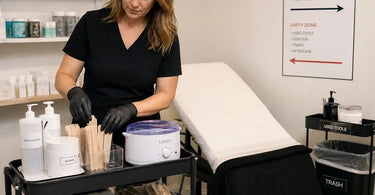
If you don't have a Salon Trolley or two, you are working entirely too hard. A good trolley is a game-changer for a small salon. It brings the 'counter' to you, then rolls out of the way when you need open floor. It's the ultimate tool for a flawless clean-to-dirty flow.
Here's the pro-strategy: get a two-trolley system.
- The Clean Trolley: This cart is your hero. It lives at your working side and holds all the clean tools and products you'll use for your next appointment. Think fresh linens, pre-stripped Soft Strip Wax, clean spatulas, and your favorite Massage Oils, Lotions, and Creams. It's your mobile clean zone.
- The Dirty Trolley: This is where your soiled items go. Use a separate cart (or even a simple basket) to collect used towels, applicators, and empty bottles. As you finish a service, you immediately deposit the dirty items onto this 'dirty' cart. This simple act physically separates your zones and prevents cross-contamination. A similar system of a 'working trolley' and a 'backup trolley' is recommended for small rooms to prevent daily clutter from taking over .
This two-trolley strategy creates a visible, physical barrier between the clean and the dirty, making your workflow infinitely smoother.
3. The Great Linen Debate: Clean vs. Dirty
Linen management is the Mount Everest of the clean-to-dirty challenge. In a small salon, you can't just have a giant pile of towels in the corner. You need a designated spot for clean linens and a separate, clearly marked bin for soiled ones.
First, you need enough inventory to sustain you between laundry days. A good rule of thumb for towel math is to keep at least three days' worth of towels on hand . So, if you see 8 clients a day and use 3 towels per service, you need about 72 towels in rotation. Store your clean towels on open shelving or in a closed cabinet. For your soiled linens, a lidded bin is a must. It looks more professional and keeps the ick factor contained.
To help you keep a perfect inventory of clean towels and other essentials, you can find a wide variety of High-Quality Towels and Professional Cotton, Sponges, and Wipes at Pure Spa Direct to ensure you're never caught short.
4. Vertical Storage: Go Up, Not Out
When floor space is tight, you have to think vertically. Wall-mounted storage is your best friend. It takes advantage of airspace you're not using and keeps counters clear, which immediately makes your clean-to-dirty flow more intuitive .
Install a wall-mounted Hygienic Table Paper dispenser. This keeps your clean roll accessible and out of the way. You can also use wall-mounted shelves for your Premium Skincare Products or a small rack for your Quality Wax Strips & Rolls. Even tools like your Facial Steamers can have a designated spot on a sturdy shelf.
By lifting storage off the floor and into vertical lines, you free up precious circulation space. This makes your salon feel more open and allows for a cleaner, more defined path for your clean-to-dirty flow.
5. Get Your Disposables Game On Point
One of the easiest ways to manage your flow is to not have to clean certain things at all. Embrace high-quality disposables! They are a small salon's secret weapon for a hygienic clean-to-dirty flow.
Think about it: instead of washing and reapplying Professional Wax Spatulas and Applicators, you can use one and toss it. Instead of trying to clean that stubborn mask off a mixing bowl, use a disposable one. Stock up on Professional Cleaners & Disinfectants for your surfaces, but for the tools that touch skin, single-use items can drastically simplify your clean-to-dirty flow.
Have a designated drawer or shelf for all your disposable items, and place it near your work zone. Keep a small trash bin right there as well. The motion becomes: reach for a clean applicator, use it, and toss it in the trash—all within arm's reach. This keeps your flow tight, efficient, and incredibly sanitary.
6. Sanitation is the Heart of Your Flow
Your clean-to-dirty flow is essentially a sanitation highway. It begins with sterilized, clean tools and ends with dirty items being properly cleaned and stored. So, make sure your sanitation station is optimized. Ideally, you have a designated area—a corner of your countertop or a small shelf—with a UV Sterilizer for your tools. This is where your clean implements should live.
After a service, you toss the dirty implements into a container of Professional Cleaners & Disinfectants. Once they're clean and dry, they move back to the UV sterilizer. This creates a clear, cyclical flow that's easy to follow, even when you're running behind schedule.
For those messy, one-use items like wax, consider having a clean area near your Professional Wax Warmers for your Professional Stripless Hard Wax and cartridges . This is also where you can place your Complete Waxing Kits for easy access, and a dirty bin right beside it for used items. Making the dirty bin easily accessible at the point of service is a key to keeping your flow intact.
7. The 'Everything Has a Home' Rule
This is the golden rule of small salon organization. Everything you need for a service should have a designated, logical home. And that home should be near where you use it. This minimizes unnecessary movement and stops clean items from accidentally being placed near dirty areas.
For instance, your brow station should have a drawer dedicated to Lash & Brow Service Supplies. All your Professional Sunless Tanning Products should have a clean spot, separate from your dirty towels. Your Complete Waxing Kits for Salons & Spas can be stored on a clean shelf, and a small bin on the floor can be your designated spot for the used strips.
When you designate a 'home' for items, it's easier to maintain order. You'll know at a glance if something is out of place, which helps you quickly correct any flow issues. You can even color-code your bins: blue for clean, red for dirty. It's a simple visual cue that keeps everyone on the same page.
Conclusion: Your BFF, the Clean-to-Dirty Flow
Creating a better clean-to-dirty flow in a small salon isn't just about being tidy; it's about being smart. It's about making your space work for you, not against you. By following these steps—designing your workflow, using a two-trolley system, managing your linen, going vertical, embracing disposables, and optimizing your sanitation station—you'll transform your small salon into an efficient, peaceful, and professional space. You'll feel calmer, your clients will be more impressed, and you'll have a few extra minutes (and a lot less stress) to focus on the artistry that you love. So go on, get your flow on!
)