
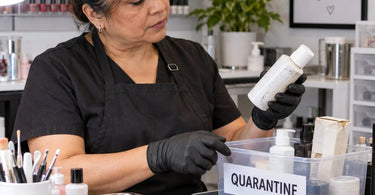
Elevate your work, elevate your results... and sometimes that means knowing exactly what not to put into service. A damaged bottle, leaking pouch, mystery shipment, broken seal, faded label, questionable expiration date, or product that simply looks a little suspicious should never get tossed back onto the shelf with a hopeful shrug. Creating a dedicated quarantine area gives your spa, salon, nail studio, barber shop, waxing business, or wellness facility a simple place to hold questionable inventory while someone determines what happens next, and keeping basics such as Professional Cleaners & Disinfectants for Salons and Spas nearby can help support an orderly professional environment.
Think of product quarantine as inventory time-out. The product is not automatically trash, and it is definitely not cleared for use. It is simply separated from normal stock until somebody with the proper authority can inspect it, check documentation, contact the distributor or manufacturer when appropriate, and decide whether it should be returned, discarded, replaced, or released back into inventory.
Why A Quarantine Area Belongs In A Professional Beauty Business
Professional beauty businesses can go through an astonishing amount of inventory. One busy week may involve skincare, wax, hair color, nail products, massage creams, disposables, retail merchandise, disinfectants, backbar products, and enough bottles to make your storage room look like it has developed its own zip code.
With that much product moving through a business, questionable items occasionally appear. A carton may arrive crushed. A pump may be broken. A cap may have loosened during shipping. An employee may discover an unlabeled bottle in a cabinet. A product might have been stored improperly. Two containers may look almost identical even though one has already been opened. Without a clear process, these items have an unfortunate tendency to migrate back into usable stock.
A quarantine area interrupts that cycle. Instead of asking every employee to remember which bottle had the problem, you create a physical system that communicates one simple message: do not use this until it has been reviewed.
Step 1: Choose A Location Away From Active Inventory
Your quarantine area does not need to be enormous. In a smaller salon, it might be one clearly designated shelf, cabinet, covered tote, or section of a stockroom. Larger spas and multi-room facilities may need an entire shelving unit or secured storage area.
The important part is separation. Questionable inventory should not sit beside ready-to-use products where someone rushing between appointments can accidentally grab it. If your regular backbar products live on one shelving system, put quarantined products somewhere visibly different.
Avoid placing the area where clients are likely to browse. A container labeled with something dramatic like "DO NOT USE - LEAKING" is excellent communication for employees. It is slightly less excellent as reception-area decor.
Step 2: Make The Area Impossible To Confuse With Regular Stock
Clarity beats cleverness. Label the space with straightforward wording such as "QUARANTINE - DO NOT USE" or "PRODUCT HOLD AREA." Every team member should understand immediately that anything placed there is temporarily unavailable for professional services or retail sale.
Consider using bins, trays, or containers that are used only for quarantined inventory. Bottles & Jars may be useful throughout your facility for organized professional storage, but questionable products should remain identifiable in their original packaging whenever possible so important label information is not lost.
The goal is not to create a beautiful display. This is one corner of the business where nobody wins a merchandising award. The goal is to prevent accidental use.
Step 3: Create A Simple Quarantine Label
Every item entering the quarantine area should have enough information attached to explain why it is there. You do not need a twelve-page investigation form and a detective wearing sunglasses. A simple label or log can usually capture what your team needs.
Useful information may include the product name, date placed on hold, employee name or initials, reason for quarantine, invoice or order information when available, lot or batch information when shown on the package, and the person responsible for follow-up.
Reasons might include damaged packaging, broken pump, leaking container, missing label, questionable seal, unexpected texture, unusual odor, shipping damage, suspected contamination, unclear expiration information, incorrect product received, or another condition requiring review.
Do not cover important manufacturer information with your quarantine label. Keep identifying information visible whenever possible.
Step 4: Separate Leaking Products From Everything Else
A crushed carton is one thing. A leaking chemical or professional product requires more careful handling. Do not allow a leaking container to drip onto other quarantined merchandise, shelving, linens, disposable supplies, or neighboring containers.
Follow the product label, safety information, workplace procedures, and applicable requirements for handling spills or damaged chemical containers. Appropriate Protective Gloves & Masks for Salon and Spa Professionals can be part of a properly stocked professional facility when protection is appropriate for the products being handled.
If you cannot safely identify or manage a leaking product, do not improvise. Follow the manufacturer's instructions and your business safety procedures.
Step 5: Establish Clear Reasons For Quarantine
If every employee uses a different definition of "questionable," your quarantine shelf may eventually contain everything from genuinely damaged inventory to a perfectly good bottle somebody simply did not recognize.
Create a short internal list of situations that should trigger a product hold. Examples can include visible container damage, broken or missing seals where a seal is expected, leakage, illegible or missing identification, suspected contamination, unusual product appearance, shipping damage, conflicting inventory information, or uncertainty about whether a product is suitable for use.
Your policy can also tell employees what not to do. They should not smell unknown chemicals to identify them, pour mystery products into another bottle, mix questionable product with fresh product, or quietly return something to the shelf because it "probably looks fine." Probably is not an inventory control system.
Step 6: Keep A Quarantine Log
A log makes the system considerably more useful, especially when several employees receive shipments or manage stock. Your log can be paper, digital, or incorporated into whatever inventory process your business already uses.
Record the date, item, quantity, reason for hold, supplier or order reference when relevant, action taken, and resolution date. This can make it easier to spot recurring issues. If the same type of bottle repeatedly arrives leaking, for example, you have documentation instead of relying on somebody saying, "I swear this happened three times last month."
It also prevents products from becoming permanent residents of quarantine. Without a review process, one lonely jar can sit on a shelf long enough to qualify for employee benefits.
Step 7: Assign Responsibility For Reviewing Held Products
Someone needs ownership of the process. Depending on your business, that might be an owner, manager, inventory coordinator, lead esthetician, salon manager, or another designated team member.
That person can review quarantined products on a regular schedule and determine the appropriate next step. They may check the original order, compare the item with correctly received inventory, review manufacturer instructions, document damage, contact the supplier, or initiate a return according to the applicable process.
Giving one person responsibility does not mean nobody else participates. Any team member should be empowered to remove a questionable item from active inventory. The designated reviewer simply makes sure the story has an ending.
Step 8: Photograph Shipping Damage Before Cleaning Everything Up
When products arrive visibly damaged, documentation can be helpful. Before disposing of packaging or rearranging the shipment, take clear photos showing the shipping carton, affected item, visible damage, product identification, and other relevant details.
Keep the packing slip, invoice, and other order information associated with the questionable merchandise until the issue has been resolved. If a return or damage claim is necessary, having organized documentation is much easier than recreating the scene after the box has already met the recycling bin.
Step 9: Keep Quarantined Retail Products Off The Sales Floor
The same principle applies to retail inventory. If you discover a damaged box, loose cap, questionable seal, or another issue with a retail product, remove it from the client shopping area immediately.
Your Must-Have Spa Retail Products for Enhanced Client Experience should look intentional, fresh, and ready for purchase. A questionable item hiding behind the good inventory is neither a merchandising strategy nor a fun surprise for the person doing checkout.
Step 10: Do Not Turn Quarantine Into A Discount Bin
There is a big difference between cosmetically imperfect outer packaging and a product whose safety, identity, integrity, or suitability is uncertain. Do not assume that slapping a discount sticker on something solves the underlying question.
The entire purpose of quarantine is to pause distribution or use until the product has been evaluated. Decide its disposition first. Pricing decisions come later, and only if the product is actually appropriate to return to sellable inventory under your business policies and applicable requirements.
Build The Process Into Receiving
The easiest questionable product to manage is the one that never reaches general inventory. Train whoever receives deliveries to perform a basic visual inspection before products are shelved.
Compare shipments with the order. Look for obvious leaks, crushed containers, broken closures, missing items, and unexpected products. If everything looks normal, inventory can continue through your standard receiving process. If something raises a question, move it directly into quarantine.
This works particularly well for high-turnover categories such as Waxing Supplies for Professionals, Professional Nail Care Collections, Premium Skincare Products for Spas and Salons, Professional Hair Salon & Barber Shop Supplies, and Professional Massage & Wellness Products. The more inventory your business moves, the more valuable a consistent receiving routine becomes.
Do Not Forget Open Backbar Products
Quarantine is not only for new shipments. Products already in your treatment rooms can become questionable too.
An employee may notice that a jar was left open, a label has become unreadable, a bottle appears different than expected, or a container may have been compromised. Instead of debating the matter at the workstation, move the item out of active service and follow your established review process.
This is also a good reason to keep treatment areas stocked with practical items such as Applicators & Spatulas, Professional Cotton, Sponges, and Wipes for Salons & Spas, and other service supplies that support clean, organized product handling.
Train The Entire Team On One Rule: When In Doubt, Hold It
Your quarantine system only works if employees feel comfortable using it. A newer team member should not feel pressured to use a product simply because they are unsure whether an issue is serious enough to bother a manager.
Make the rule easy: if there is a reasonable question about a product, temporarily remove it from active inventory and flag it for review. The responsible manager can determine the next step.
This approach also reduces improvisation. Instead of employees inventing their own fixes for damaged containers or questionable products, they have a clearly defined place to put the item and a clearly defined person to notify.
Keep The Quarantine Zone Clean And Uncluttered
A quarantine area should not become the final destination for every random object nobody knows where to store. Keep unrelated equipment, personal belongings, seasonal decorations, mystery cords, and the lonely charger that apparently fits nothing out of the area.
Maintain the shelf, bin, or cabinet according to your normal cleaning procedures and the requirements of the products stored there. Storage Bins, labels, gloves, wipes, and appropriate cleaning products can help you create a practical system without turning the stockroom into a warehouse obstacle course.
Create A Final Disposition Process
Every quarantined product eventually needs a documented outcome. Common outcomes may include return to supplier, replacement, disposal according to applicable instructions, correction of an inventory error, or release back into normal stock after the concern has been properly resolved.
Do not return an item to active inventory simply because space is getting tight. Resolution should be intentional. Record what happened and when, then remove the item from the quarantine log.
If disposal is required, follow the product label, manufacturer information, local requirements, and any applicable rules for the type of material involved. Professional chemicals should never be discarded based on guesswork.
Make Quarantine Part Of A Bigger Inventory System
A quarantine shelf works even better when it lives inside a broader inventory routine. Organize products by category, rotate inventory appropriately, keep labels readable, monitor stock levels, and make sure employees know where supplies belong.
You can also designate separate zones for unopened inventory, active backbar stock, retail merchandise, cleaning supplies, and quarantined items. Those boundaries save time because employees do not have to mentally decode the storage room every time they open the door.
For businesses expanding or reorganizing, explore Must-Have Supplies for Salon & Spa Business Success for professional essentials that can help support day-to-day operations.
A Small Area Can Prevent A Big Inventory Headache
Creating a quarantine area for damaged or questionable products is not glamorous, but neither is discovering halfway through a service that the bottle in your hand was the one everyone had been meaning to inspect.
A clearly marked hold area, straightforward labeling system, simple log, designated reviewer, and consistent staff training can make questionable inventory much easier to control. The system can be tiny. The important thing is that everyone knows exactly what it means.
At Pure Spa Direct, we distribute professional supplies across the spa, salon, barber, nail, waxing, massage, skincare, and wellness industries, so we know successful professionals rely on much more than beautiful treatment products. Organization, sanitation supplies, storage essentials, disposables, tools, equipment, and repeatable operating systems all help keep a busy professional environment moving.
Give questionable inventory its own little corner, make the rules obvious, and stop letting the mystery bottle play hide-and-seek with your backbar. Your future self - probably standing between two appointments with exactly thirty-seven seconds to find what she needs - will be very grateful.
