
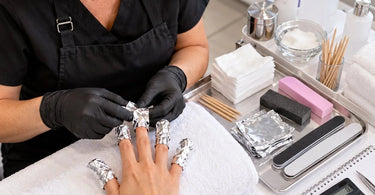
Boost sales, stock this... and stop letting tiny supply expenses quietly nibble away at your nail salon profits! A gel polish removal appointment might look like a simple service, but every cotton pad, foil wrap, drop of acetone, and disposable file contributes to its actual cost. Those little expenses can add up faster than a client deciding she needs just one more shade of pink. Learning how to estimate the supply cost of a gel polish removal appointment helps salon owners and nail technicians establish profitable service prices, manage inventory, and avoid wasting professional products. Whether you offer standalone removals or include them with a fresh manicure, knowing your numbers makes running your nail business a whole lot easier.
At Pure Spa Direct, we understand that professional nail services require more than beautiful colors and a steady hand. Efficient supply purchasing, consistent service procedures, and smart inventory management can make a meaningful difference to your bottom line. Here is how to calculate your actual gel polish removal supply expenses without turning your manicure station into an accounting department.
What Supplies Are Needed for a Professional Gel Polish Removal?
Before calculating costs, identify every product your technicians typically use during a removal appointment. The exact supplies depend on the gel system, removal method, salon procedures, and whether the appointment includes additional nail care.
A standard soak-off gel polish removal service may require:
- Gel polish remover or acetone: A professional removal liquid compatible with the gel system being removed.
- Cotton pads or lint-free wipes: Materials used to hold remover against the nail surface.
- Foil wraps: Disposable wraps that help keep remover-soaked cotton in contact with each nail.
- Nail files: Appropriate files for gently preparing the coating for removal according to product instructions.
- Buffers: Used when appropriate for gentle finishing without unnecessarily thinning the natural nail.
- Cuticle tools: Properly cleaned and disinfected reusable implements or suitable single-use tools for gently removing softened product.
- Disposable gloves: Protective supplies used according to salon procedures and product safety requirements.
- Cuticle oil: A finishing product that helps condition the cuticle area after removal.
- Cleaning and disinfection supplies: Products needed to prepare and maintain a hygienic workstation.
Pure Spa Direct carries professional supply categories including Manicure Essentials, Nail Files & Buffers, Professional Cotton, Sponges, and Wipes, and Cuticle Oil. Building a consistent supply checklist makes it easier to compare purchasing costs and standardize appointments across technicians.
The Simple Formula for Calculating Gel Polish Removal Supply Costs
The easiest approach is to calculate the quantity of each product used during one appointment and multiply that quantity by its purchase cost per unit.
Supply cost per appointment = Total cost of consumable products used + Allocated reusable supply costs + Cleaning and sanitation expenses.
Start with your actual wholesale purchase prices. For products sold by volume, divide the purchase price by the total usable fluid ounces or milliliters. For disposable products sold in packages, divide the package price by the number of usable pieces.
For example, if a package of 500 cotton pads costs $12.50, each pad costs $0.025. Using 10 pads during one service creates a cotton expense of $0.25.
If a box of 100 foil wraps costs $8.00, each wrap costs $0.08. A 10-nail removal using one wrap per nail costs $0.80 in foil wraps.
That is the basic calculation. Nothing mysterious, no complicated accounting software, and definitely no need to interrupt your next client to ask whether she remembers high school algebra.
A Sample Gel Polish Removal Cost Breakdown
Consider a salon performing a standard removal on 10 fingernails. The following figures are hypothetical planning estimates, not current product prices or guaranteed usage amounts. Substitute your own supplier invoices and measured consumption for an accurate calculation.
| Supply | Estimated Cost Per Appointment |
|---|---|
| Professional acetone or gel remover | $0.35 |
| 10 cotton pads | $0.25 |
| 10 disposable foil wraps | $0.80 |
| Allocated nail file expense | $0.30 |
| Allocated buffer expense | $0.20 |
| Disposable protective supplies | $0.20 |
| Cuticle oil | $0.15 |
| Cleaning and sanitation supplies | $0.25 |
| Total Estimated Supply Cost | $2.50 |
Under these assumptions, the salon spends approximately $2.50 on supplies per standard appointment. Actual costs may be higher or lower depending on wholesale pricing, product selection, waste, service complexity, and hygiene requirements.
Remember that the calculation only covers the supplies listed. It does not include technician compensation, rent, utilities, insurance, payment processing, or other operating expenses.
How to Calculate the Cost of Acetone and Gel Polish Remover
Removal liquid is one of the most important products to measure because technicians may use different quantities without realizing it.
Suppose your salon purchases a 32-fluid-ounce container of professional acetone for $14.00. That container contains approximately 946 milliliters.
Cost per milliliter = $14.00 / 946 = approximately $0.0148.
If a technician uses 20 milliliters during a service, the liquid costs approximately $0.30. If the technician uses 35 milliliters, the expense increases to approximately $0.52.
A difference of just $0.22 might seem insignificant. Across 300 monthly removal appointments, however, that represents $66 in additional product consumption.
The goal is not to use too little remover. Insufficient saturation can lead to unsuccessful soaking, repeated applications, and more technician time. Instead, measure the amount needed to perform the manufacturer's recommended procedure effectively.
Browse professional acetone, gel polish remover, and nail polish remover to compare available professional supply options.
Foil Wraps, Cotton, and Disposable Materials: Small Costs That Add Up
Disposable removal supplies are easy to count, making them ideal for developing accurate service cost estimates.
For foil wraps, determine the cost per wrap and multiply it by the number used. The same approach works for cotton pads, lint-free wipes, disposable towels, and other single-use products.
Preassembled removal wraps may cost more per piece than buying cotton and foil separately, but they can simplify workstation preparation and potentially reduce service setup time. The best purchasing decision depends on both material cost and technician efficiency.
Compare gel polish remover wraps, nail foil wraps, and lint-free nail wipes when evaluating your options.
Disposable products should not be reused between clients to save money. Cost control should come from appropriate package sizing, accurate dispensing, thoughtful purchasing, and minimizing unopened product waste rather than compromising hygiene.
Do Nail Files and Buffers Count as Removal Supply Expenses?
Absolutely. Even if a file is inexpensive, it still represents a business expense.
If your salon uses a new disposable file for every client, include the entire purchase cost of that file in the appointment calculation. If an implement is reusable and permitted to be reprocessed under applicable regulations and manufacturer instructions, allocate its purchase cost across its expected usable service life and account for required cleaning and disinfection.
For example, a reusable implement costing $15.00 and providing 150 properly maintained uses would have an allocated purchase expense of $0.10 per service, before reprocessing costs.
Not every nail file or buffer is suitable for reuse. Many porous or absorbent nail products are single-use under applicable salon regulations. Never assume that a file can be reused simply because it still looks clean.
For professional nail preparation and finishing, explore Nail Files & Buffers and Nail Brushes & Tools.
Why Different Gel Systems Change Your Removal Costs
Not all nail coatings remove the same way. A thin soak-off gel polish application may require different supplies and working time than a heavily layered glitter manicure, reinforced gel overlay, or hard gel enhancement.
Some gel systems are designed to soak off with a compatible remover. Others require professional filing rather than soaking. Always identify the product and follow its manufacturer's removal instructions.
Factors that may increase removal costs include:
- Multiple layers of gel polish or decorative topcoats.
- Glitter, encapsulated decorations, or dense nail art.
- Thicker product applications that require additional preparation.
- Coatings that need a second remover application.
- Longer appointment times for more complicated removal procedures.
- Additional finishing supplies requested by the client.
A salon that treats every removal as exactly the same service may underestimate its expenses on more complex appointments. Consider creating separate pricing categories for standard soak-off removal, enhanced or difficult removal, and removal associated with a new service.
If your salon works with multiple gel systems, review the Professional Gel Polish collection along with brands such as Gelish, OPI, and CND for professional nail product options. Confirm the removal procedure for each specific system instead of assuming all formulas behave identically.
How to Account for Waste and Unexpected Product Usage
Even a well-organized salon experiences some variation in supply consumption. A wrap may tear, a cotton pad may need replacing, or a removal may require another application of remover.
One practical budgeting method is to add a modest allowance based on your salon's actual waste history.
For example, if your calculated supply expense is $2.50 and you use a 10% planning allowance, the adjusted budget becomes $2.75 per appointment.
$2.50 x 1.10 = $2.75.
That allowance is not a universal industry standard. It is simply a starting assumption until you have enough appointment data to measure your real consumption.
Track recurring issues such as excessive remover dispensing, torn wraps, damaged inventory, or consistently repeated soak-off applications. Identifying why supplies are being wasted is more productive than asking technicians to somehow make one cotton pad perform the job of three. Cotton is versatile, but it is not magical.
Supply Cost Is Not the Same as Total Appointment Cost
This distinction is essential for profitable salon pricing.
A $2.75 supply budget does not mean that a removal appointment costs your business only $2.75. Your technician's time may represent a much larger expense, and every appointment also uses salon space, utilities, equipment, and administrative resources.
Consider this hypothetical example:
- Adjusted supply cost: $2.75.
- Technician labor cost allocated to a 20-minute service: $8.00.
- Allocated operating overhead: $3.50.
- Estimated total appointment cost: $14.25.
The labor and overhead figures are illustrative. Actual costs depend on compensation arrangements, payroll expenses, appointment duration, location, and your salon's operating structure.
If the salon charges $22.00 for this service, the difference between the service price and the estimated $14.25 cost is $7.75 before any additional expenses not included in the example.
That remaining amount is not automatically net profit. Additional costs such as payment processing fees, marketing, taxes, and other business expenses may still need to be considered.
Should Gel Polish Removal Be Included in a New Manicure?
Many nail salons face the same question: Should removal be offered as a separate service or bundled with a new gel polish application?
Both approaches can work, provided the pricing accounts for the actual resources involved.
Standalone removal: The service price needs to cover its supplies, technician time, overhead, and desired profit contribution.
Removal with a new gel manicure: The combined manicure price should account for both the removal supplies and the new application materials, as well as the total appointment time.
Complimentary removal with another service: The removal still costs money even if it appears as a free line item. Its expense must be supported by the revenue and profitability of the overall appointment.
For example, if your salon provides 250 bundled removals each month at an adjusted supply expense of $2.75, those services consume $687.50 in removal supplies alone. That is money worth including in your manicure pricing model.
Offering removal as a courtesy can be a reasonable client retention strategy, but it should be a deliberate business decision rather than an overlooked cost.
How Wholesale Purchasing Can Improve Removal Service Margins
Buying professional supplies in larger quantities can reduce your cost per usable unit, especially for frequently consumed items such as cotton, wraps, and remover. However, the lowest advertised package price is not always the most economical option.
Compare products using their usable quantity and total landed cost, including applicable shipping charges. Also consider storage conditions, shelf life, packaging design, and how quickly your salon actually uses each product.
A large container that costs less per ounce is only a bargain if your salon can store it safely, dispense it appropriately, and use it before product quality becomes an issue.
At Pure Spa Direct, professional buyers can explore relevant categories such as Professional Nail Care Collections, Protective Gloves & Masks, and Professional Cleaners & Disinfectants.
We distribute professional spa and salon supplies from a variety of brands, helping businesses compare products and organize their purchasing around actual service needs.
Use a Simple Removal Cost Tracking Sheet
You do not need a complicated inventory platform to begin improving your removal appointment calculations. A spreadsheet can provide valuable information.
Create columns for the product name, purchase price, package quantity, cost per usable unit, average units consumed per appointment, and resulting appointment expense.
Then review your calculations monthly or whenever supplier prices change.
For better accuracy, ask technicians to record the actual supplies used during a representative sample of appointments. Include both routine and difficult removals. This helps prevent your budget from being based entirely on an unusually easy service.
After collecting enough information, you can establish a realistic average supply expense and a separate cost estimate for more complex appointments.
If your salon has multiple technicians or locations, use the same recording method across the business. Consistent data makes purchasing and pricing decisions much easier to compare.
Five Practical Ways to Reduce Gel Polish Removal Costs Without Cutting Corners
Controlling supply costs should never require technicians to rush removal, force product off the nail, reuse prohibited disposables, or disregard professional sanitation procedures. Better efficiency comes from eliminating unnecessary waste while maintaining appropriate service standards.
- Standardize your removal procedure. Train technicians to follow the appropriate manufacturer instructions for each gel system. Consistency improves the reliability of your cost estimates.
- Measure remover consumption. Use suitable dispensing methods and monitor average usage without compromising effective product saturation or safe handling.
- Organize individual service supplies. Prepare appropriate quantities of wraps, cotton, and other materials to reduce excess handling and unnecessary waste.
- Review your purchasing costs regularly. Compare package sizes, professional supply options, and actual cost per service instead of judging products only by container price.
- Track repeat removals. If certain gel systems frequently require additional supplies or time, adjust scheduling, procedures, or service pricing accordingly.
Also ensure that acetone and similar products are used and stored according to their labeling, safety information, and applicable workplace requirements. Good ventilation, appropriate chemical handling, and proper sanitation belong in the service plan, not on the optional extras menu.
Frequently Asked Questions About Gel Polish Removal Supply Costs
How much should a salon budget for gel polish removal supplies?
There is no single supply cost that applies to every salon. The hypothetical example in this guide produces an adjusted budget of $2.75 per standard appointment, but your actual cost should be calculated from your wholesale invoices, product consumption, and service procedures.
What is usually the biggest expense in a gel polish removal appointment?
Technician labor may cost more than the consumable supplies. Among materials, the largest expense depends on the products and methods used. Preassembled wraps, remover, single-use files, and other disposable items can all contribute significantly.
Should salons charge extra for difficult gel polish removal?
A separate charge may be appropriate when a service requires additional time, supplies, or specialized techniques. Clearly explain additional pricing before beginning the service so clients understand what is included.
Can reusable removal clips save money?
Reusable clips may reduce the number of disposable wraps purchased, but their purchase cost, suitability for the service, cleaning requirements, and expected lifespan all need to be considered. Follow manufacturer instructions and applicable sanitation regulations when deciding whether a reusable accessory makes financial sense.
Does cuticle oil belong in the removal cost calculation?
Yes, if cuticle oil is routinely applied as part of the service. Even a small amount should be included in your consumable cost estimate. Browse professional cuticle oils and Nail Treatments when evaluating finishing products.
How often should gel polish removal cost estimates be updated?
Review them whenever supplier prices, product packaging, service protocols, or average consumption changes. A monthly review is a practical starting point for busy salons, with a more detailed assessment during regular service pricing evaluations.
Turn Better Supply Tracking Into a More Profitable Nail Service Menu
Estimating the supply cost of a gel polish removal appointment is not about obsessing over every penny. It is about understanding how your professional supplies contribute to the cost of delivering a consistently excellent service.
Once you know your average remover consumption, disposable material expenses, file and buffer costs, and sanitation requirements, you can establish more reliable service budgets. Add labor and overhead, and you have a much stronger foundation for setting prices that support your business.
Whether you operate a boutique nail studio, a busy full-service salon, or multiple manicure locations, accurate supply calculations help you make smarter purchasing decisions without sacrificing the client experience.
Explore Pure Spa Direct's Manicure Essentials, Professional Gel Polish, and Must-Have Supplies for Salon & Spa Business Success to organize your professional inventory and compare supplies for your services.
Because a beautifully finished set of nails deserves a business model that looks just as polished. Your clients get the gorgeous nails, your technicians get a well-stocked workstation, and your profit margins get a little extra love. Now that is a salon makeover worth celebrating!
