
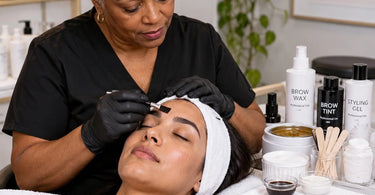
Simplify your path to success by figuring out exactly what your brow services cost before you start celebrating a fully booked appointment calendar. Combining brow waxing supplies, professional tinting products, and finishing essentials into one beautiful eyebrow appointment can be a fantastic way to increase service value. But those perfectly sculpted arches come with a collection of tiny expenses that can quietly nibble away at your profits. From wax and tint to cotton rounds, disposable applicators, and styling gel, knowing your actual supply cost helps you price your services confidently without turning your treatment room into an accounting department.
A brow waxing, tinting, and styling combination service sounds simple enough: remove unwanted hair, enhance the brow color, and create a polished finish. Behind the scenes, however, every product dispensed represents part of your operating expense. The goal is not to use the cheapest products possible. It is to understand what your chosen professional supplies cost per appointment so you can deliver consistent results while protecting your margins.
Why Combined Brow Services Need Their Own Cost Calculation
Many salons calculate the cost of individual services but forget to recalculate when those services are packaged together. A basic brow wax uses one set of supplies. Tinting introduces additional products, preparation steps, and applicators. Styling adds another layer of finishing products and tools.
Bundling these services may reduce certain duplicated expenses because the client is already in your treatment chair. You might need fewer cleansing products, fewer appointment setup steps, or fewer disposable items than you would use during three separate visits. However, the combined service still requires an accurate calculation of everything consumed.
Instead of guessing that the supply cost is probably a few dollars, establish a repeatable service formula. That makes it easier to evaluate promotions, package pricing, employee performance, and changes in wholesale product costs.
Step One: List Every Product Used During Brow Waxing
Begin by documenting the actual supplies required for your standard brow waxing procedure. Your checklist might include:
- Pre-wax cleanser or skin preparation product.
- Professional soft wax or hard wax.
- Disposable wooden applicators.
- Wax strips if your chosen technique requires them.
- Protective gloves.
- Cotton rounds, gauze, or disposable wipes.
- Appropriate post-wax finishing products.
- Disposable treatment table protection.
Explore Professional Stripless Hard Wax and Soft Strip Wax for Effective Salon Hair Removal when comparing supply options for your professional waxing menu.
Remember that different wax systems can have different supply requirements. Hard wax generally eliminates the need for removal strips, while soft wax commonly requires them. The amount of wax used can also vary with brow shape, hair density, and technician technique.
For an accurate calculation, weigh or measure the wax consumed during several typical appointments rather than estimating from the appearance of the wax pot. A wax warmer filled to the brim is not exactly a scientific measuring instrument, no matter how confidently you stare into it.
Step Two: Calculate Your Wax Cost Per Appointment
The most useful formula is straightforward:
Wax cost per service = Container purchase cost divided by usable quantity, multiplied by quantity consumed.
For example, suppose a professional wax container costs $24 and contains 400 grams of product. Your wax costs $0.06 per gram. If a typical eyebrow appointment consumes 12 grams, the wax expense is approximately $0.72.
These figures are hypothetical examples, not current product prices or universal consumption standards. Your actual numbers will depend on the wax brand, container size, purchase price, and technician technique.
Next, add the cost of applicators, strips, cleansing products, and aftercare products. If those items total another $0.95, your estimated waxing supply cost becomes $1.67.
Bulk purchasing can change the equation. Compare individual purchases with Bulk Wax Deals, but calculate the actual cost per usable ounce or gram rather than assuming a larger container automatically offers the best value.
Step Three: Calculate Your Brow Tinting Product Cost
Tinting introduces a different set of product measurements. Depending on the permitted treatment system, your supply list may include a professional brow color product, an approved accompanying component when required by the manufacturer, protective materials, disposable mixing tools, and removal supplies.
Review the manufacturer's complete instructions, ingredient restrictions, and intended-use labeling before selecting any tinting system. In the United States, eyebrow coloring is subject to specific federal color additive requirements, and state licensing rules can impose additional restrictions. A product being sold as professional brow color does not automatically establish that its use is legally permitted in your location.
Professional buyers can explore Professional Lash and Brow Tint for Spas & Salons to research relevant product categories while independently confirming regulatory compliance and professional scope of practice.
For costing purposes, determine the amount of each approved product component that your procedure actually requires. If a product costs $18 for 60 usable units and your approved procedure consumes two units, the product portion equals $0.60. If a separate required component costs $0.15 per treatment, your combined product expense is $0.75 before disposables.
Do not estimate tint yield by assuming that every tube, sachet, or container produces the same number of treatments. Product systems differ in their dispensing methods, preparation requirements, usable quantities, and shelf lives.
Step Four: Include Every Tinting Disposable
Small disposable items are among the easiest expenses to overlook. Consider what your permitted tinting procedure requires:
- Disposable mixing dishes or hygienically reprocessed reusable bowls.
- Microbrushes or suitable applicators.
- Protective materials appropriate to the product instructions.
- Cotton rounds and removal pads.
- Disposable gloves.
- Cleaning and sanitizing supplies.
Professional Lash & Brow Service Supplies and Professional Cotton, Sponges, and Wipes for Salons & Spas provide useful categories to compare when assembling your service inventory.
Imagine your tinting disposables add $0.55 per appointment. Combined with the hypothetical $0.75 product cost, tinting now contributes $1.30 to the overall brow package.
A few pennies here and there might not seem exciting. But multiply those pennies by hundreds of monthly appointments and suddenly the humble cotton round becomes a surprisingly important business character.
Step Five: Account for Brow Styling and Finishing Products
The finishing stage completes the client's transformation and should not disappear from your cost calculation simply because it takes only a few minutes.
Professional brow styling may involve brushing hairs into place, trimming when appropriate, using a finishing gel, applying a suitable conditioning product, or demonstrating home maintenance techniques.
Depending on the service, you might use brow brushes, disposable spoolies, precision scissors, and professional brow styling products.
Calculate the product cost in the same way you calculate wax and tint. Divide the container cost by its usable volume or weight, then multiply by the average quantity dispensed.
For reusable grooming implements, separate the purchase cost from cleaning and maintenance expenses. A durable tool may serve hundreds of clients, but proper reprocessing still requires time, suitable products, and adherence to applicable sanitation requirements.
For example, your styling stage might consume $0.28 in finishing product and $0.17 in disposable supplies. That produces an estimated styling supply cost of $0.45 per appointment.
Step Six: Build a Complete Brow Package Cost Worksheet
Once you have calculated the three service stages, combine them into one easy-to-review worksheet. Here is a hypothetical example for a brow waxing, tinting, and styling appointment:
| Service Component | Estimated Supply Cost |
|---|---|
| Wax and waxing consumables | $1.67 |
| Permitted tinting products and disposables | $1.30 |
| Styling products and disposables | $0.45 |
| Additional sanitation and treatment protection | $0.38 |
| Total direct supply cost | $3.80 |
In this example, the direct supply expense for the complete brow package is $3.80. That gives you a starting point for calculating the actual business cost of delivering the appointment.
Be careful not to count supplies twice. If gloves, cleanser, or treatment paper are already included in one service category, do not automatically charge them again under shared appointment expenses.
The beauty of this worksheet is its flexibility. You can replace every hypothetical value with your own measured costs and immediately see how different products influence your overall service economics.
Step Seven: Add Product Waste and Inventory Loss
Professional product waste is real, even in an exceptionally organized salon. Wax can remain unused at the end of a service. Product may be dispensed in excess of what is needed. Disposable items occasionally become contaminated before use, and certain products must be discarded after opening or after a specified period.
Instead of ignoring these losses, calculate an appropriate waste allowance from your actual records.
For example, adding a hypothetical 10% supply waste allowance to a $3.80 direct supply cost produces an additional $0.38. Your adjusted estimated supply cost becomes $4.18.
Ten percent is only an illustrative assumption. A salon with excellent portion control may experience less waste, while a team learning a new treatment system could experience more.
Measure waste over several weeks to establish a useful baseline. Review expiration dates, dispensing methods, and open-container usage. Your goal is not to pressure technicians to use insufficient product. It is to eliminate unnecessary waste without compromising treatment quality, hygiene, or manufacturer instructions.
Step Eight: Separate Supply Costs From Labor and Overhead
One of the biggest pricing mistakes is confusing product cost with total service cost. Your wax, tint, and styling supplies represent only one part of the expense.
You also need to consider employee compensation, payroll-related expenses, room occupancy, utilities, insurance, administrative costs, equipment depreciation, booking software, laundry, and other operating expenses.
Suppose a combined brow appointment has the following hypothetical costs:
- Adjusted direct supply expense: $4.18.
- Allocated technician labor expense: $18.00.
- Allocated operating overhead: $7.00.
Your estimated total appointment cost becomes $29.18.
If the service sells for $55, the contribution remaining after those allocated expenses is $25.82, or approximately 46.9% of the selling price. This is an illustrative service-level margin, not necessarily your salon's final net profit. Your actual accounting treatment and additional business expenses may change the result.
Knowing both numbers matters. A $4.18 supply cost tells you how efficiently products are being used. A $29.18 total appointment cost tells you much more about whether your service price can support the business.
How to Set a Profitable Price for a Combined Brow Service
Rather than selecting a package price because a nearby salon charges something similar, begin with your actual total cost and your target margin.
A useful pricing formula is:
Required selling price = Total appointment cost divided by (1 minus target margin).
For example, if your complete allocated appointment cost is $29.18 and you want a 45% service-level margin, divide $29.18 by 0.55. The result is approximately $53.05.
That calculation gives you a financial reference point, not an automatic menu price. You should still evaluate local competition, client expectations, treatment duration, staff skill, and the experience your salon provides.
Combined services should deliver a clear benefit to the client. That might be convenient scheduling, coordinated shaping and finishing, or a more complete brow grooming experience.
However, a package discount should never be so aggressive that additional services generate additional work without appropriate compensation. Beautiful brows are wonderful. Beautiful brows that help pay the electric bill are even better.
Should You Use Different Supply Costs for Different Brow Packages?
Absolutely. A salon offering multiple brow service levels should maintain separate cost sheets for each one.
For example, you might offer a basic brow wax and groom, a brow wax with a legally permitted tinting treatment, and a complete brow shaping and styling package. Each service may require a different combination of products and appointment time.
Do not assign one standard supply cost to every brow service merely because the treatments share a category on your menu.
Some clients need additional shaping. Others may require more disposable materials because of their individual service requirements. A premium finishing treatment may consume more styling product than a simple brow brushing.
Track a practical standard cost for each package, then document meaningful variations. This gives your team realistic guidance without forcing every treatment into an identical consumption pattern.
Choose Supplies Based on Cost Per Service, Not Just Purchase Price
A lower wholesale price does not always translate into a lower treatment cost. Product yield, dispensing precision, packaging, shelf life, and the number of disposable accessories required can all affect value.
When comparing Lash & Brow Enhancement Services for Professionals, look beyond the price displayed on the container.
Consider whether the treatment system helps technicians dispense consistent quantities, whether its packaging reduces unnecessary waste, and how many appointments can realistically be performed before the product expires.
For waxing, compare wax consumption along with the costs of strips, applicators, and supporting products. Explore Professional Wax Spatulas and Applicators for Salons & Spas and Pre & Post-Waxing Products when completing your cost calculations.
The least expensive container may not produce the lowest per-appointment expense. Conversely, an expensive product does not automatically provide superior results or better value. Consistent professional performance, appropriate use, and measurable cost efficiency are what matter.
Do Not Let Cost Cutting Compromise Brow Service Safety
Cost control should never involve reusing single-use applicators, skipping appropriate cleaning procedures, reducing required protective supplies, or ignoring manufacturer directions.
Eyebrow coloring deserves particular attention because products applied near the eyes carry specific safety and regulatory considerations. In the United States, federal color additive rules restrict products intended to dye eyebrows and eyelashes. Silver nitrate is permitted only under defined professional-use conditions, and state rules may further limit which licensees can perform the service.
Check current federal and state requirements, confirm your professional license authorizes the intended procedure, and use only appropriately permitted products in accordance with their labeling. Do not substitute ordinary hair dye for an eyebrow coloring product or assume that products marketed internationally are authorized for your local practice.
Review required client screening and any manufacturer-directed testing before the appointment. If a particular coloring procedure is not legally available to your salon, build your service menu around compliant waxing, grooming, and cosmetic brow styling alternatives.
Maintain appropriate sanitation practices using products from categories such as Professional Cleaners & Disinfectants for Salons and Spas where suitable for your equipment and procedures.
A reliable brow service depends on safe practices and consistent professional judgment, not merely efficient product consumption.
How to Reduce Supply Waste Without Sacrificing Results
Once you understand your baseline costs, look for practical improvements that make your everyday workflow more efficient.
- Standardize dispensing: Use consistent measurement methods that follow the product's instructions.
- Organize your station: Keep regularly used supplies accessible so technicians can avoid unnecessary package handling and accidental waste.
- Track open dates: Label products appropriately and follow manufacturer storage and expiration requirements.
- Review inventory weekly: Identify products being consumed faster than expected.
- Train consistently: Teach technicians how to follow a documented service protocol while accommodating individual client needs.
- Compare purchasing options: Evaluate appropriate wholesale pack sizes against realistic appointment volume and shelf life.
For shared supplies, calculate whether reusable implements are more economical after including the required cleaning, disinfection, replacement, and maintenance expenses.
Also consider whether your service station needs better organization. Products from Spa Tools & Implements for Professionals can help you compare suitable workstation essentials for professional use.
Little operational improvements can add up, especially in a busy salon where brow appointments fill multiple time slots each day.
Review Your Brow Supply Costs Every Month
Supply calculations should not be a one-time project that disappears into a forgotten spreadsheet. Wholesale prices, packaging sizes, service popularity, and technician habits can change.
A monthly review provides an opportunity to compare expected product usage with actual inventory consumption.
Start by recording the number of brow appointments performed during the month. Then calculate how much of each key supply was consumed, accounting for deliveries, remaining inventory, and documented waste.
Divide the total relevant consumption cost by the number of services performed, using an appropriate allocation method for products shared among multiple service types.
For example, if a salon records $420 in relevant brow service consumables across 100 comparable appointments, the average supply expense is $4.20 per appointment.
Compare that figure with the standard cost in your worksheet. A noticeable difference might indicate a wholesale price increase, unexpected waste, incorrect portion estimates, or changes in the service mix.
Do not assume that every variance represents a technician problem. Investigate what actually changed before adjusting procedures or performance expectations.
Use Your Cost Data to Build Smarter Brow Promotions
Knowing your supply costs is especially helpful when planning seasonal packages, introductory offers, and client loyalty promotions.
Suppose your standard combined brow appointment sells for $55 and has a total allocated cost of $29.18. A temporary promotional price of $45 would leave approximately $15.82 after those estimated expenses, before any additional unallocated costs.
That may be acceptable for a carefully planned promotion, but it should be an intentional business decision rather than an accidental margin reduction.
You can also evaluate whether combining services creates real efficiencies. A single appointment may share consultation, setup, cleansing, or checkout activities that would otherwise happen separately. Measure those savings instead of assuming they exist.
For each promotion, consider the appointment time required, direct product consumption, expected demand, and potential effect on your regular appointment calendar.
The most successful offers attract clients while preserving enough value to support the team and the business.
Build a Better Brow Service Business With Pure Spa Direct
Estimating the supply cost of brow waxing, tinting, and styling becomes much easier when you break the appointment into measurable components. Calculate your wax usage, document the consumables for any legally permitted brow coloring procedure, account for finishing products, and add an evidence-based allowance for ordinary waste.
Then connect those direct supply costs to labor, overhead, and your desired service margin. The result is a much more useful pricing system than guessing based on what another salon charges.
Pure Spa Direct helps beauty and wellness professionals shop across a broad selection of professional supplies from multiple manufacturers. Browse Lash & Brow Service Supplies, Waxing Supplies for Professionals, and Must-Have Supplies for Salon & Spa Business Success as you organize your treatment room and compare purchasing options.
Great brow services are about precision, thoughtful product selection, and a client experience worth booking again. Combine that artistry with clear cost tracking, and you have a stronger foundation for consistent pricing, confident purchasing, and healthier salon profitability. Because those gorgeous arches deserve an equally gorgeous business plan.
