
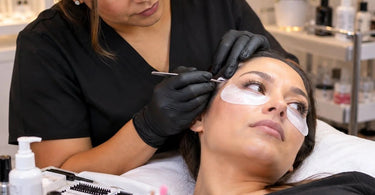
Deliver quality that clients can see... and sometimes that means convincing them to stop turning their heads long enough for you to actually deliver it! Every lash artist and brow professional knows the challenge: you have your tweezers positioned perfectly, your lighting is just right, and suddenly your client turns to answer a question, adjust their shoulders, or tell you a story about their weekend. Your precision work instantly becomes a moving target. While a little movement might seem harmless, repeated head turning during lash or brow services can affect accuracy, interrupt your workflow, increase appointment time, and create genuine safety concerns when sharp implements or professional chemicals are involved. The good news? With a few thoughtful adjustments and some friendly communication, you can keep your clients comfortable without feeling like you are directing an extremely glamorous game of freeze tag.
Whether you specialize in professional lash extensions, brow shaping, tinting, lamination, or lash lifts, maintaining a stable working position is an essential part of delivering beautiful, consistent results. Understanding why clients move, and knowing how to respond without embarrassing them, can make an enormous difference in both service quality and client satisfaction.
Why Clients Keep Turning Their Heads During Lash and Brow Appointments
Before assuming your client is simply incapable of sitting still, consider what might be causing the movement. Most clients are not intentionally making your job difficult. In fact, they may not even realize how frequently they are turning their heads.
Common reasons include:
- Natural conversation habits: Many people instinctively turn toward whoever is speaking, especially when they are answering questions or telling stories.
- Neck or shoulder discomfort: Remaining in one position can become uncomfortable, particularly during longer lash extension appointments.
- Anxiety or unfamiliarity: First-time clients may feel nervous about having someone work near their eyes.
- Trying to see what is happening: During brow services, clients may turn toward mirrors, tools, or the person performing the treatment.
- Phone distractions: A notification, vibrating phone, or irresistible group chat can prompt an unexpected movement.
- Physical limitations: Neck stiffness, back discomfort, breathing concerns, or difficulty remaining in one position can make stillness challenging.
- Reflexive reactions: Ticklish sensations, watering eyes, sneezing, coughing, or unexpected discomfort can cause involuntary movements.
The important distinction is whether the client is moving out of habit, discomfort, or a genuine physical need. Each situation deserves a slightly different solution.
Set Expectations Before You Pick Up Your Tweezers
One of the easiest ways to prevent excessive movement is to explain positioning requirements before the service begins. A brief, friendly conversation can eliminate many interruptions later.
Instead of waiting until the fifth unexpected head turn, introduce the subject during your consultation.
Try saying: “I want your lashes to look absolutely gorgeous, and I will be working very close to your eyes with precision tools. The biggest thing you can do to help me is keep your head resting in one position. If you need to move, just let me know and I will pause first.”
This approach accomplishes several things. It explains why stillness matters, makes the client part of the process, and establishes a safe method for requesting a break.
For longer appointments, explain that clients can request adjustments when necessary. You are asking for cooperation, not challenging them to remain motionless for an unreasonable amount of time.
For lash extension services, remind clients that their eyes need to remain fully closed during application. Talking, laughing, and changing facial expressions can sometimes interfere with eyelid closure or the position of protective pads.
Check the Treatment Bed Before Blaming the Client
Sometimes the problem is not your client's attention span. It is the furniture.
A treatment bed that does not properly support the head, neck, or shoulders can encourage constant repositioning. Even small areas of discomfort can become distracting during a detailed service.
Before beginning, check whether the client's head rests comfortably in a neutral position. Ask whether their neck feels supported and whether they can relax their shoulders without strain.
Professional spa treatment furniture and appropriate positioning accessories can make extended services more comfortable. Depending on the bed design and the client's needs, a suitable massage bolster or head-support accessory may help improve positioning.
A small support adjustment beneath the knees may also reduce lower-back tension for some clients. Always ensure that any support is stable, hygienic, and compatible with the treatment setup.
Do not force the client's neck into a position that feels unnatural or painful. Your ideal working angle should never come at the expense of their physical comfort.
And remember, a client who feels relaxed is generally easier to work with than someone silently wondering whether their neck will ever recover from their beauty appointment.
Use Gentle, Specific Reminders Instead of Repeated Corrections
When a client turns their head, your first response should be calm and matter-of-fact. Avoid sounding irritated or making the client feel as though they have done something terribly wrong.
Instead of saying, “Stop moving your head,” try a more specific instruction:
- “Can you bring your nose back toward the ceiling for me? Perfect!”
- “Keep your head resting right there while I finish this section.”
- “I am going to pause for a second so you can get comfortable.”
- “I love hearing your story! Just keep your head in this position while you tell me.”
- “These little lashes need a steady landing spot, so let me know before you move.”
The most effective reminders are short, positive, and easy to follow. Give clients a simple reference point, such as keeping their nose centered or resting the back of their head against the support.
There is no need for a lengthy lecture every time someone moves. A quick correction followed by a reassuring response usually works better than repeatedly emphasizing the mistake.
Never Continue Precision Work While the Client Is Moving
This is the most important safety principle in the entire discussion: when a client unexpectedly moves during delicate work near the eyes, stop the active application before attempting to reposition or continue.
Lash extension work involves precision lash extension tweezers, adhesives, and extremely small application areas. Brow treatments may involve tinting products, shaping tools, or chemical solutions.
An unexpected movement can increase the possibility of accidental contact with the eye or skin, misplaced adhesive, uneven application, or unnecessary discomfort.
Follow a consistent procedure:
- Stop your current application movement immediately.
- Safely withdraw the implement from the treatment area when possible.
- Ask whether the client needs to adjust their position or take a break.
- Allow the client to reposition themselves comfortably.
- Check that protective pads, tape, and other positioning materials remain correctly placed.
- Resume only when the client is stable and it is safe to proceed.
Never attempt to hold a moving client's head in place, restrain them, or continue applying a product while they are actively turning away.
If the movement happens while a chemical product is processing, follow the product manufacturer's directions for safe handling, removal, and timing. Do not automatically extend processing time to compensate for interruptions.
Adjust Your Conversation Style During Detailed Application Steps
A great conversation can make a salon appointment memorable. Unfortunately, an enthusiastic conversation can also make a client's face surprisingly mobile.
Some clients talk with their entire bodies. They nod for emphasis, turn toward your voice, raise their eyebrows, and laugh with enough enthusiasm to move every muscle in their faces.
There is nothing wrong with friendly conversation, but knowing when to guide the appointment toward a quieter atmosphere is an important professional skill.
During consultation and preparation, encourage questions and conversation. When you reach a particularly delicate application stage, gently shift the focus.
You might say: “I am going into my precision zone for a few minutes, so you can relax while I concentrate on making everything even.”
Soft background music, a comfortable room temperature, and fewer distractions can help create a calmer environment. Avoid setting the music so loudly that clients must turn their heads or raise their voices to communicate.
For clients who prefer to chat, explain that you can catch up between detailed sections. Save the dramatic plot twists for moments when there are no tweezers hovering near an eyelid.
Special Considerations for Lash Extension Appointments
Lash extension applications require exceptional precision because the technician must isolate individual natural lashes and carefully attach extensions while avoiding inappropriate adhesive contact.
Repeated head movement can make isolation more difficult, disrupt placement, and increase the risk of tools or products contacting areas where they do not belong.
Professional lash extension supplies should be selected and used according to the manufacturer's instructions, including requirements for adhesive handling, application technique, and eye protection.
During the appointment, pay particular attention to the following:
- Eyelid closure: Confirm that the client's eyes remain appropriately closed during adhesive application.
- Under-eye protection: Check that under-eye gel pads or other protective materials have not shifted toward the eye.
- Adhesive control: Use the correct amount of adhesive and maintain the application distance required by your product instructions and professional training.
- Tool positioning: Never chase a moving lash with sharp tweezers. Pause and reestablish a safe working position.
- Client feedback: Encourage clients to immediately report stinging, burning, poking sensations, or other discomfort.
If a client reports eye irritation, stop and assess the situation rather than assuming it is normal. Follow the product's safety instructions and applicable emergency procedures. Chemical exposure to the eye requires prompt, appropriate flushing and medical guidance. Persistent pain, redness, or visual changes warrant urgent medical evaluation.
Most importantly, do not treat client stillness as a substitute for proper isolation, sanitation, adhesive control, or safe technique.
Handling Head Movement During Brow Tinting and Lamination
Brow services introduce their own positioning challenges. Clients may naturally turn toward the professional while talking, lift their eyebrows during conversation, or move their heads to look at the mirror.
For precision mapping and shaping, even subtle movement can make it difficult to maintain symmetry.
Before applying products, establish a comfortable head position and explain when the client should remain still.
For brow mapping, ask the client to relax their facial muscles and avoid raising their eyebrows while you assess their natural brow shape. If the client has been smiling or making expressive facial movements, allow their face to return to a relaxed position before checking alignment.
When performing brow lamination, carefully follow the manufacturer's instructions for product placement, processing times, protection, and complete removal. Movement that causes a product to migrate outside its intended application area should be addressed immediately according to the product's safety directions.
For professional lash and brow tinting, use only products appropriate for the specific service and permitted under applicable regulations. Requirements for eyebrow and eyelash coloring products can differ, and not every cosmetic dye is suitable or legally permitted for use around the eyes.
If a client needs to change position during chemical processing, pause any active application and assess whether it is safe to continue. Keep track of processing time and do not improvise chemical exposure durations.
What to Do When a Client Cannot Physically Remain Still
There is a major difference between a client who occasionally turns to chat and someone who genuinely struggles with head or body positioning.
Some clients experience neck pain, muscle tension, tremors, involuntary movements, or other conditions that make sustained stillness difficult. Others may feel anxious or uncomfortable remaining in a reclining position.
Approach these situations respectfully and without assumptions.
Ask practical questions such as: “Would a different head position feel better?” or “Would you prefer a short break before we continue?”
Possible accommodations include adjusting the treatment bed, changing support placement, offering planned breaks, or selecting a shorter service where appropriate.
However, not every service can safely accommodate significant movement. Working near the eyes with sharp implements or active chemical formulations requires a level of stability appropriate to the procedure.
If the client cannot maintain a safe position despite reasonable adjustments, explain the limitation compassionately. You may need to postpone, modify, or discontinue the service rather than risk injury.
A professional boundary is not a rejection of the client. It is a commitment to protecting their well-being.
Prepare Your Workstation to Reduce Unnecessary Interruptions
Efficient workstation organization can help minimize the amount of time a client must remain in a particular position.
Keep frequently used supplies accessible without crowding the treatment area. Depending on the service, these might include:
- Lash extension tweezers and other precision implements.
- Professional lash adhesive appropriate to your application technique.
- Under-eye pads and compatible protective materials.
- Disposable micro brushes for suitable application and cleanup tasks.
- Professional cotton, sponges, and wipes for appropriate treatment preparation and cleanup.
- Magnifying lights or suitable task lighting.
- Professional cleaners and disinfectants for properly maintaining reusable work surfaces and implements according to applicable requirements.
Set up your station before the client settles into the treatment bed. Avoid repeatedly reaching across their face, asking them to turn toward supplies, or making frequent furniture adjustments during detailed application.
Good organization improves more than appointment efficiency. It also helps you remain focused on technique and client comfort.
For salons offering multiple enhancement services, organizing the essentials within your lash and brow service supplies can simplify setup between appointments.
Build Small Movement Breaks Into Longer Services
Extended lash appointments can place physical demands on both the client and the professional. A client who begins comfortably may develop neck stiffness, back tension, or restlessness as time passes.
Rather than expecting uninterrupted stillness regardless of appointment length, consider incorporating brief, planned pauses when the procedure allows.
During an appropriate break, secure your tools, ensure any active products are being managed according to manufacturer directions, and allow the client to adjust comfortably.
A quick check-in can be surprisingly effective: “How is your neck feeling? Do you need to adjust before we finish this side?”
These moments can prevent discomfort from building into constant movement during more delicate stages.
Keep in mind that chemical processing steps cannot always be interrupted safely. Schedule breaks around those steps rather than stopping or extending processing times without manufacturer authorization.
How to Handle a Client Who Repeatedly Ignores Positioning Instructions
Occasionally, a client continues turning their head despite clear explanations and several gentle reminders. At this point, continuing to issue the same instruction may not solve the problem.
Pause the service and explain the concern more directly.
For example: “I want to give you the best possible result, but I am having trouble working safely because your head is moving while I am using these tools near your eyes. Can we find a position that feels comfortable enough for you to stay steady?”
This statement is professional, factual, and focused on safety rather than blame.
If the issue continues, explain the possible consequences, including additional service time, the inability to complete certain details, or the need to stop the appointment.
Do not promise a finished result when safe application conditions cannot be maintained. If discontinuing the service becomes necessary, follow your salon's policies and the relevant product instructions for safely ending the procedure.
Clear expectations help protect both the client relationship and your professional standards.
Use Client Notes to Make Future Appointments Easier
If a client frequently needs positioning adjustments, a brief professional note can help prepare for their next visit.
Document practical information relevant to safe service delivery, such as the head-support setup that worked well, whether planned movement breaks were useful, and which communication cues the client preferred.
A note might read: “Client preferred additional neck support and brief positioning breaks. Reminding client to keep nose centered helped during detailed application.”
Keep notes factual, respectful, and appropriately limited to service needs. Avoid judgmental descriptions or unnecessary medical information.
These records can make repeat appointments more comfortable while improving consistency across team members, subject to your salon's privacy practices.
Frequently Asked Questions About Clients Moving During Lash and Brow Services
Is it normal for clients to move during lash extension appointments?
Yes. Minor movement can happen because of conversation, discomfort, nervousness, or natural reflexes. However, repeated movement during precision work needs to be addressed because sharp tools and adhesive are used close to the eyes.
Should I ask lash extension clients not to talk?
You can encourage quiet relaxation during delicate application stages. Explain that talking and animated facial expressions may interfere with stable positioning or complete eyelid closure. Clients should still feel comfortable speaking up immediately about pain, irritation, or other concerns.
Can I gently hold a client's head to keep it steady?
Do not restrain a client or attempt to physically prevent involuntary movement. Appropriate, consensual, nonrestrictive positioning support may help comfort, but the client must remain free to move and communicate. If safe stability cannot be maintained, pause or discontinue the service.
What if my client keeps moving because their neck hurts?
Pause and assess comfort. Adjust the treatment position or appropriate supports, offer a break, or consider whether the service can safely continue. Never pressure someone to tolerate pain for a cosmetic result.
Does head movement affect lash extension retention?
Movement can interfere with proper isolation and placement, which may contribute to inconsistent application. Retention also depends on adhesive performance, product compatibility, preparation, technique, aftercare, and the natural lash cycle. Do not attribute every retention issue to client movement.
How should I manage movement during brow lamination?
Explain the need for a stable position before product application. Stop active application if the client moves unexpectedly, check for product migration, and follow the manufacturer's processing and removal directions. Do not exceed recommended processing times.
When should I stop a lash or brow appointment?
Stop when you cannot maintain safe application conditions, when unexpected movement creates an immediate hazard, or when a client experiences symptoms requiring attention. Follow relevant safety procedures and refer the client for appropriate medical evaluation when indicated.
Beautiful Results Begin With Comfortable Clients and Clear Communication
Handling a client who keeps turning their head during lash or brow services is less about enforcing perfect stillness and more about creating an environment where safe, precise work is possible.
Start with clear expectations. Make sure your client is comfortable. Use friendly reminders, pause whenever necessary, and never compromise safety to keep an appointment moving.
Thoughtful preparation, supportive furniture, organized supplies, and confident communication can make the entire experience smoother for everyone involved.
At Pure Spa Direct, we know that professional beauty services demand the right combination of skill, client care, and dependable supplies. As a distributor serving spa, salon, and beauty professionals, we help you find the tools and treatment essentials that support your daily work. Explore our Lash & Brow Enhancement Services for Professionals, browse Lash Lift & Perm supplies, or discover professional lash and brow accessories for your treatment room.
Because the only thing you want moving dramatically during a lash appointment is your client's reaction when they finally see the results in the mirror. And even then, perhaps wait until the tweezers are safely put away!
