
Efficiency meets excellence in every treatment room, and nothing derails that faster than a client squirming on your table like they are trying to locate a lost earring with their shoulder blades. You have got the oils warmed, the playlist curated, and your hands ready to work magic, and then you hear those four little words that make every therapist's eye twitch: the table is uncomfortable. Before you panic and start questioning your entire career, take a breath. This is not a crisis. It is a golden opportunity to prove you are the kind of professional who actually listens, and that is the kind of thing clients rave about to their group chats.
Here is the truth nobody tells you in massage school: most clients will lie to your face about being comfortable. They will say "I am fine" while their arms are dangling off the edge like they are trying to catch a cab, or their neck is cranked at an angle that would make a chiropractor wince. Why? Because they do not want to be "difficult." They do not want to interrupt your flow. And honestly, some of them just do not know that asking for an adjustment is even allowed. Your job is to make it safe and easy for them to speak up, and then actually fix the problem.
First, Stop Asking Yes or No Questions
Here is a pro tip that will change your practice forever: when a client is already on the table, half-naked and vulnerable, asking "Is that comfortable?" is basically useless. They will say yes. Always. Even if their face is mashed into the cradle like a pancake and their lower back is screaming for mercy. Why? Because in that moment, you are the expert standing over them, and they are in a compromised position. The path of least resistance is to just say "it is fine" and pray the next fifty minutes go quickly .
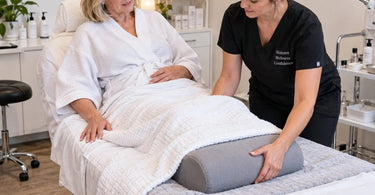
Instead, try this move: do not ask. Just adjust. Say something like, "Let me try something real quick," and then slide a Massage Bolster under their knees or gently reposition their arm. Then ask, "Is that more comfortable?" Now they have a comparison. They know what it felt like before, and they know what it feels like now. You have given them a choice instead of a yes or no trap . This one shift in your communication style will make you look like a genius, and your clients will think you are some kind of comfort whisperer.
The Usual Suspects: Where Discomfort Hides
When a client says the table is uncomfortable, it is usually one of a few predictable culprits. Knowing these ahead of time means you can troubleshoot like a boss instead of standing there awkwardly wondering if you should just pretend you did not hear them.
The Face Cradle Fiasco
This is the number one complaint, and it is almost always a face cradle issue. The angle is wrong, the padding is too thin, or the client is positioned too high or too low so their chin is either digging into the bar or their forehead is taking all the pressure . The fix is usually simple: adjust the height and angle of the cradle, add a small folded towel under the forehead for extra lift, or use a padded Face Cradle Cover for extra cushioning. If you have a client with a larger chest, they might need a Chest Bolster to lift their upper body slightly so their neck is not hyperextended .
The Arms Have Nowhere to Go
You know the look. Arms flopping off the sides, shoulders internally rotating into a position that screams future rotator cuff problem. Some clients do not realize they can rest their arms on their belly or tuck their hands under their hips. Tell them. Give them permission to not lie there like a stiff board. For larger clients, a wider table or a Portable Massage Table with a larger surface area might be the long-term solution, but in the moment, a simple verbal cue or a small pillow under the chest can work wonders .
Lower Back and Hips Doing the Twist
If your client is face down and their lower back is arching like they are trying to touch the ceiling with their lumbar spine, they need support. A Massage Bolster under the ankles takes the pressure off the lower back by tilting the pelvis slightly. If they are face up, a bolster under the knees relaxes the hamstrings and lets the lower back settle into the table . It is a small adjustment that makes a massive difference, and your client will feel it instantly.
The Table Feels Like a Rock
Maybe your table is older, or maybe the padding has compressed over time. If clients keep mentioning that the table is hard, it might be time to look at a Massage Table Warmer and Topper. These add a layer of plush comfort while also keeping your client cozy. A cold table is an uncomfortable table, and a warm one feels like a hug before you even start working . For clients who run cold, this is not a luxury. It is a necessity.
The Equipment Upgrade That Saves Every Session
If you are finding that multiple clients are complaining about table comfort, it might be time for a serious equipment audit. A quality Portable Massage Table with high-density foam and a sturdy frame is the foundation of a comfortable experience. Look for tables with at least two to three inches of padding, and do not skimp on the frame quality. A wobbly table feels unstable, and an unstable table feels uncomfortable no matter how much foam you pile on top .
If you are in a salon or spa setting and space is not an issue, a stationary Massage Table might give you more stability and a plusher surface. And if you offer waxing services, do not forget that comfort matters there too. A client who is tense because the table is cold or the paper is crinkling is a client who is going to flinch during a Soft Strip Wax service, and nobody wants that. Warm up the room, use quality Hygienic Table Paper, and keep a Professional Wax Warmer ready so you are not running back and forth while your client freezes .
Reading Between the Lines (and Under the Sheet)
Sometimes a client will not actually say the table is uncomfortable, but you can tell. They are shifting every few minutes. They keep lifting their head. Their breathing is shallow and tense instead of slow and relaxed. If you notice these signs, do not wait for a verbal complaint. Address it. "I noticed you seem a little restless. Can I adjust something for you? Sometimes a bolster under the knees helps a lot." This proactive approach shows you are paying attention, and it gives them an easy out to ask for what they need.
And here is a bonus tip: always test your own table. Lie on it. Put your face in the cradle. See how it feels after ten minutes. If you are uncomfortable, your clients are definitely uncomfortable. You would be surprised how many therapists have never actually experienced their own treatment room from the client's perspective .
When the Problem Is Bigger Than a Bolster
Occasionally, a client's discomfort is not something you can fix with a pillow. They might have an injury, a chronic pain condition, or a body type that genuinely does not work with your standard table. This is where the Chiropractic Equipment and Supplies or specialty positioning tools come into play. For clients with specific needs, a Massage Bolster in a wedge or half-moon shape can provide targeted support that a standard round pillow cannot .
If you work with clients who are larger-bodied, consider investing in a wider table or a Portable Massage Table designed for greater width. The standard table is usually around thirty inches wide, but you can find tables up to forty inches. Yes, you will have to lean a little further, but your client's comfort is worth it. And honestly, a comfortable client is a returning client, and a returning client is the whole point .
The Art of the Graceful Fix
Here is the thing about handling a client who says the table is uncomfortable: your reaction matters as much as your solution. If you get flustered or defensive, the client feels awkward and the whole vibe goes sideways. If you stay calm and confident and treat it like a normal part of the job, the client relaxes and trusts you more. You are not failing. You are problem-solving. That is literally part of the job description.
Keep a stash of tools within arm's reach: extra pillows, folded towels, a Massage Table Warmer and Topper for chilly clients, and a few different Massage Bolsters in varying shapes and sizes. When you can grab a solution in three seconds flat, the client barely notices there was a problem at all. They just notice that you made them feel good, and that is what they will remember.
Final Thoughts: Comfort Is Not Optional
A comfortable client is a relaxed client. A relaxed client gets more out of their treatment, tips better, and tells their friends. An uncomfortable client spends the whole session thinking about how much their neck hurts and counting the minutes until they can leave. The difference between these two experiences is often just a bolster, a warmer, or a willingness to stop and ask, "Let me try something for you."
So next time a client tells you the table is uncomfortable, smile. You have got this. Grab a pillow, adjust the cradle, and show them that their comfort is your priority. That is how you build a clientele that sticks around for years. And that is how you turn a complaint into a compliment.
Ready to upgrade your treatment room comfort game? Browse our full selection of Massage Tables and Chairs, Massage Bolsters, and Massage Table Warmers at Pure Spa Direct. Your clients (and your tips) will thank you.
)