
Enhance services with this pro favorite... but let's be real for a second. You have probably had that heart-sinking moment where you are holding a Professional Lash and Brow Tint wand, you blink (because you are human), and suddenly your client lets out a yelp. Maybe the Brow Lamination Supplies were a little too juicy, or the tint decided to take a detour south. Accidental tint exposure in the ocular area happens to the best of us. You might be a veteran esthy with ten years under your belt or a fresh-faced waxing wizard, but gravity and client twitches are undefeated. The difference between a pro and a panicked mess is how you handle the split second when that dye hits the bullseye. Here at Pure Spa Direct, we believe in arming you with not just the best Premium Lash Extensions & Supplies for Pros, but the knowledge to save the day when the unexpected happens. So, take a deep breath, put down the cotton round, and let's get your emergency game plan ready.
Accidents are awkward. No one wants to be the technician who explains to a bride-to-be why she looks like she went ten rounds with a Sharpie. But the reality of offering Lash & Brow Enhancement Services is that we work around mucous membranes and tiny, fluttery lids. Professional Lash and Brow Tint for Spas & Salons is generally safe, but chemical compounds—even the gentle ones—do not belong in the eye. Whether you use Intensive Tint, Refectocil Original, or Berrywell Cream Dye, the protocol for exposure is the same: speed, water, and a whole lot of chill.
Why Rushing To Flush Is Your Only Job
When that tint slips past the lash line, the chemistry changes immediately. Most tints contain ingredients like PPD or other aromatic amines that are designed to stain keratin. Your cornea is not keratin; it is a delicate, vascular membrane that does not appreciate being dyed. The moment a client feels that sting, their natural reaction is to squeeze their eyes shut. You have to override that instinct gently but firmly. The single most effective first aid for chemical exposure in the ocular area is immediate and copious irrigation . We are talking water, water, and more water. Do not run for the saline solution (unless it is right there), do not grab a wipe, and for the love of all that is holy, do not listen to the old wives' tale about using milk or eye drops. Cool, clean water is your hero.
You need to flush the eye from the inner corner toward the outer corner. Why? Because you do not want to wash the chemical from the affected eye into the other eye . If you have a helper, this is their time to shine. One of you holds the client's head steady while the other directs the stream. If you are alone, tilt the client's head back and to the side over a bowl or sink. Aim for the bridge of the nose so the water runs across the eye and away. Tell your client, "I know this is annoying, but you are going to thank me when you can still see." A little humor breaks the tension while you save their retinas.
Tools of the Trade: What To Grab (And What Not To)
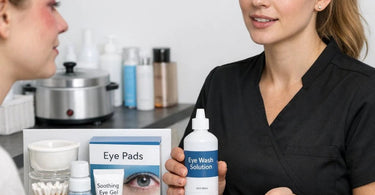
In a perfect Spa Essentials for Professionals kit, you have an emergency eye wash station. If you do not have a plumbed unit, an eye wash bottle is a must-have. However, in the chaotic first ten seconds, you may not have that. An Applicators & Spatulas drawer is not helpful here. You need a steady stream. If your treatment room has a Pedicure Chair with a sprayer, that works at low pressure. The nearest bathroom sink works. Even a Bottles & Jars bottle with a sports cap filled with water is better than nothing. You need to flush for at least 15 minutes . Yes, 15 minutes. It feels like an eternity when you have a schedule to keep, but stopping early is how corneal burns happen.
If the client is wearing contact lenses, you have a dilemma. Do you try to remove them? Standard medical advice says to try and remove them if they haven't already floated out . But if the eye is swelling or the lens is stuck to the cornea due to the chemical reaction, do not claw at it. Flush with the lens in place and let a medical professional remove it . Your priority is dilution of the chemical. Once the flushing is done, and the client is stabilized (and looking like a very sad, wet kitten), you can assess the damage. Do not put any Premium Skincare Products or numbing drops in the eye unless you are a doctor. Just dry the face gently with High-Quality Towels and cover the eye if light sensitivity is present.
The Panic Protocol: Calling For Backup
Flushing fixes most simple spills. But here is the line you do not cross: if the client complains of blurry vision that doesn't clear, intense pain, or if you see a white haze on the cornea, you are looking at a chemical burn . Similarly, if the client has a history of glaucoma, eye surgeries, or uses prescription drops, they are higher risk. You need to send them to the emergency room or an ophthalmologist immediately. Do not let them drive themselves if their vision is compromised. Call them an Uber or have a coworker take them.
When you call for medical backup, you need to be prepared to answer two questions: What chemical was it? And what was the pH? This is why you never throw away the box for your tints. Have the Safety Data Sheet (SDS) accessible. If you are using Intense Brow[n]s or Combinal Cream Dye, know that these often contain hydrogen peroxide developers, which can be particularly irritating . Having that info ready makes you look like the ultimate professional, even while you are internally screaming.
Post-Oopsie: Client Care And Legal Coverage
Congratulations, the crisis is averted. The eye is flushed, the client is (mostly) fine, and you have stopped sweating through your Professional Spa Apparel. Now comes the paperwork. Document everything. Write down exactly what happened, what time the flush started, how long you flushed, and what the client's symptoms were. Note if you referred them to a doctor. Have the client sign an incident report. Even if they say, "Oh, it's fine, don't worry about it," make them sign. The adrenaline dump from a near-miss can make clients forget they promised not to sue you later.
You also need to follow up. Call them the next day. Ask how their eye feels. Ask if they saw a doctor. This turns a traumatic event into a customer service moment. They will remember that you panicked professionally and then cared deeply. It is way better than them remembering that you handed them a tissue and hid in the supply closet.
Prevention: Your Best Defense Against The Dye Monster
Let's be honest—the best way to handle accidental tint exposure is to stop it from happening in the first place. We cannot control the client who sneezes mid-application, but we can control our setup. Are you using too much tint? You only need a thin layer on the lashes or brows. If it is dripping, you are doing it wrong. Secondly, invest in Professional Cotton, Sponges, and Wipes for Salons & Spas. Specifically, under-eye shields or gel pads. Do not just rely on cotton rounds and hope. Use a Hygienic Table Paper strip or a gel patch to protect the lower lid. If you are doing a brow tint, have the client look down and close their eyes tight. Use a magnifying light to see if the tint is migrating into the lash line.
Also, know your ingredients. ViBROWLASH and Le Marque Henna are popular options, but even "natural" henna can be a particulate irritant if it gets in the eye . Always, always perform a patch test 48 hours prior. A client might not be allergic to the dye, but they could be sensitive to the developer or the preservatives. Patch tests are not just a suggestion; they are your insurance policy.
What About The Waxing Side Of The House?
While this blog focuses on tint, we know you are multi-tasking pros. Maybe you are doing a ItalWax - Wax service and a drip of hard wax lands on the eyelid. The protocol is similar but different. Do not flush wax with water—water will just make it harden and stick worse. Wax is hydrophobic. If hot wax gets into the ocular area, do not pull it. You could rip off the corneal epithelium. Instead, apply a cool compress to harden the wax instantly, then use a Professional Wax Remover (oil-based) on a cotton round to gently dissolve the edges. If wax is stuck to the lashes, cut the lash—do not rip the wax.
For those of you offering Lash Lift & Perm services, the chemical risk is even higher than tinting. Lash perm solutions are alkaline and designed to break disulfide bonds. If that gets in the eye, it is a medical emergency. Stick to the same flush protocol but expect a more severe reaction. Keep your UV Sterilizers clean, but keep your eye wash station closer.
Stocking The Ultimate Safety Station
Pure Spa Direct is your wholesale distributor for everything, including the boring but critical safety gear. You can grab Protective Gloves & Masks to keep yourself safe while treating a client (bloodborne pathogens are real, folks). But specifically, you should have a dedicated drawer or cabinet with:
- Sterile eye wash solution or saline bottles.
- A large measuring cup or sterile bowl for pouring water.
- Clean, dry Towels (do not use the same towel you dropped on the floor).
- An incident report template.
- Emergency contact numbers for poison control (1-800-222-1222) .
While you are shopping, grab some Compressed Sponges for general clean-up, but keep them away from the actual eye flush. You do not want fibers in the eye.
Keeping Your Cool When The Heat Is On
Look, we have all been there. You are trying to give someone the perfect Brow Henna stain, and they flinch. The best techs in the world have spilled tint. It is not a mark of shame; it is a mark of experience. The mark of a true professional is the recovery. If you freak out, the client freaks out. If you stay calm, grab the water, and say, "Okay, let's rinse this out. Happens to the best of us, no big deal," the client will trust you. They will trust you even more when you send them a follow-up text the next day asking if they are okay.
So, take a deep breath. Review your first aid protocols. Check your expiration dates on your eye wash. And maybe, just maybe, practice flushing with a training manikin or a very understanding coworker. Being prepared is the only thing standing between a minor slip-up and a major malpractice claim.
Now, go forth and tint those lashes. Just maybe keep the safety goggles on the client next time. Kidding. (Mostly.)
