
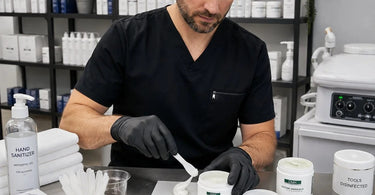
Professional tools for professional results... but even the most professional tools can become a bacterial breeding ground if we don't treat our open product jars with the respect they deserve. Let's be real, we've all been there. You're mid-service, your client is relaxed, and you reach for that jar of luxurious cream or wax, only to realize you've just double-dipped your spatula. Oops. It happens to the best of us. But maintaining impeccable sanitation with open product jars isn't just about avoiding a cringe-worthy moment; it's about protecting your clients' health, safeguarding your professional reputation, and ensuring your premium products stay effective. In this guide, we're diving deep into everything you need to know to keep your open product jars sanitary during every service, from waxing and facials to nail care and massages.
Think about it. Your client trusts you completely. They're placing their skin, their health, and their relaxation in your capable hands. The last thing they're thinking about is whether the cream you just applied came from a jar that's been harboring unseen bacteria. But that's exactly the kind of detail that separates a good professional from a great one. Not only is it a matter of basic hygiene and often state board regulations, but it's also a powerful signal to your clients that you are meticulous, professional, and deeply care about their well-being. A client who notices you using a clean spatula for every scoop is a client who will come back, tell their friends, and trust you with their skin for years to come. Let's face it, a little extra effort in the sanitation department can be a massive boost for your business.
Why Open Product Jars Are a Sanitation Hotspot
Let's get into the nitty-gritty of why those open jars are so tricky. When a jar of skincare, wax, or any other product is opened and exposed to the air, it becomes vulnerable. Every time you dip an applicator, spatula, or (gasp!) your finger into that jar, you're introducing a potential source of contamination. The product itself often contains ingredients that can become a cozy home for bacteria, mold, and yeast if not handled properly. Factors like oxygen exposure, temperature fluctuations in the treatment room, and the introduction of moisture can all accelerate this process.
Now, think about the typical workflow in a busy spa or salon. You might open a jar, scoop out some product, close it quickly, and set it aside. Later, you open it again. Maybe you're using the same spatula to scoop from different jars. This is where cross-contamination often occurs. The danger isn't just from airborne bacteria; it's from the physical transfer of microbes from tools, surfaces, and even your own hands into the product. This is especially critical in services like waxing, where the skin barrier may be compromised, or in dermaplaning, where you are working with micro-exfoliated skin. A contaminated jar of wax or cream can lead to client breakouts, infections, and a whole host of problems you definitely don't want to deal with. This is why we are here to make sure you are armed with the best practices to tackle this issue head-on.
The Golden Rule: Never, Ever Double-Dip
If you take away only one thing from this entire blog, let it be this: never, ever double-dip. This is the absolute cardinal rule when working with open product jars. 'Double-dipping' means taking an applicator, spatula, or any tool, dipping it into a jar to get product, applying it to a client, and then dipping that same used tool back into the jar to get more product. This single action is the fastest way to introduce bacteria, dead skin cells, and other contaminants directly into your pristine product jar.
Imagine you're performing a facial and you use a spatula to scoop out a dollop of exfoliating scrub. You apply it to your client's face and then realize you need a little more for the neck. If you dip that same spatula back into the jar, you're now taking everything from your client's face—which may include makeup residue, natural oils, and dead skin—and putting it back into the jar. That jar is now contaminated for the next client. Instead, follow the proper technique: use a clean, single-use spatula or applicator for every single scoop from the jar. Once product is removed from the jar and placed onto a clean mixing palette, tray, or directly onto your hand, it should never go back into the jar.
Spatula Dos and Don'ts: Your First Line of Defense
Your choice and handling of spatulas are your first line of defense. Opt for professional-grade Professional Wax Spatulas and Applicators for Salons & Spas or disposables. The goal here is to minimize any risk of contamination from the tool itself. Using a clean spatula is non-negotiable, but choosing the right one can make the process smoother. Wooden spatulas are often a great eco-friendly choice for single-use applications, especially in waxing. For creams and serums, small silicone or plastic spatulas that can be easily cleaned and disinfected, or are used once and discarded, are ideal.
Here’s a quick rundown of the dos and don'ts: DO have a fresh supply of spatulas or applicators at your workstation at all times. DON'T use the same spatula for multiple product jars without cleaning it. DO use a clean, separate spatula for each client. DON'T let spatulas sit in a jar of product between uses. DO place used spatulas immediately in a designated 'soiled' container for cleaning or disposal. DON'T ever use your fingers to scoop product out of a jar. The natural bacteria on your hands can rapidly contaminate the product. This is a simple but highly effective habit to develop. It shows clients that you are not only skilled but also deeply committed to their safety. It’s a detail that speaks volumes about your professionalism.
Decanting and Dispensing: A Smarter, Safer Approach
One of the best ways to keep your open product jars sanitary during services is to avoid dipping into them directly during a service altogether. Instead, consider decanting a small, service-sized amount of product into a clean, disposable container or a small mixing bowl before you begin. This is a game-changer for maintaining sanitation and efficiency. By preparing a portion for a single client or a single service, you are creating a 'clean zone' for product use, completely isolating the main jar from any potential contamination. The main jar stays in its clean storage area, and you work exclusively from the decanted portion.
Think about using small ramekins, disposable soufflé cups, or clean Mixing Bowls for this purpose. For services like body wraps or mud masks, mixing a batch for a specific client in a clean bowl ensures the main supply remains untouched. Not only does this method enhance sanitation, but it also helps with portion control, reducing waste. You'll only use what you need for that specific service, and any leftover product that wasn't used can be discarded. This is a far more hygienic and cost-effective approach compared to the 'glug-glug' method of portioning. It ensures your premium Spa Body Treatments stay fresh and free from contamination for longer.
Pump Bottles and Dispensers: Not a Sanitation Free Pass
Now, you might be thinking, 'I use pump bottles, so I'm safe.' While pump bottles and airless dispensers are definitely a step up from open jars when it comes to preventing direct contamination, they are not a hygiene silver bullet. Many professionals fall into a false sense of security, assuming that because the product is dispensed through a pump, it's automatically protected. However, pump outlets, bottles, and nozzles can actually be a potential source of contamination, particularly due to the contents accumulating around the outlet over time .
Research has highlighted that the contact between the product and the inlet valve over time is a known risk factor for contamination and degradation . Every time you use a pump, a small amount of product can remain on the nozzle, which then dries and can become a breeding ground for bacteria. The next time you pump, the fresh product moves past this residue. Also, standard pump systems often have a vent hole to allow air in as the product is dispensed. This vent can allow airborne bacteria, mold spores, and other contaminants into the product inside the bottle . That's why it's important to clean the nozzles of your pumps regularly and to never, ever 'top up' a partially used pump bottle with fresh product . Always wash, sanitize, and dry the bottle thoroughly before refilling it with fresh product. This includes disassembling the pump, washing all parts in soapy water, rinsing, and allowing everything to air dry completely . Taking these extra steps ensures that your pump dispensers are truly a hygienic solution.
Sterilizing Tools and Product Jars: A Full-Circle Approach
Your product jars themselves can also benefit from regular cleaning. While the main jar shouldn't be introduced to the service area, it's still an item that gets touched. A quick wipe down of the exterior of your product jars with a professional-grade disinfectant wipe can help reduce the transfer of germs from your hands to the jar and vice versa. Pay special attention to the lid and the threads where product can sometimes build up.
When it comes to the tools you use with your products, like Applicators & Spatulas or Nail Brushes & Tools, they need a rigorous cleaning routine. The industry standard is a three-step process: clean, disinfect, and dry . Start by thoroughly washing your tools in warm, soapy water to remove all visible debris . Next, immerse the tools in an EPA-registered hospital-grade disinfectant solution . Finally, allow them to air dry completely on a clean, dry towel, as this prevents bacteria regrowth . A common misconception is that just dropping tools into a jar of blue disinfectant is sufficient; in fact, this is only one step in the process . Storing them in a UV Sterilizers can add an extra layer of protection. Always ensure any disinfectant solution you use is fresh and changed according to the manufacturer's instructions. Cloudy or dirty liquid with debris floating in it means it is no longer able to do its job .
Cleaning and Storing Your Jars: A Simple Routine
Maintaining a routine for cleaning and storing your product jars is key to long-term sanitation. After a jar is empty, don't just throw a new product into it. Wash the jar thoroughly with warm, soapy water, rinse it well, and allow it to dry completely. This prevents any residue from the old product from mixing with the new one, which could cause chemical reactions or spoilage. It's also a good practice to occasionally wipe down the exterior of your jars with a sanitizing wipe to keep them looking clean and professional.
Storage is equally important. Keep your product jars in a cool, dry place away from direct sunlight, which can degrade certain ingredients. For products you use most frequently, having a clean, organized station with a designated place for each jar can help streamline your workflow and keep everything tidy. Whether you use Professional Cotton, Sponges, and Wipes around the jars to catch drips or simply organize them neatly on a shelf, the goal is to create an environment that supports sanitation. If you are looking for durable and hygienic storage options, you could consider using Bottles & Jars that have a sleek design and are easy to clean.
A well-organized and clean workstation is a non-negotiable element of a professional service. It signals to your clients that you take hygiene seriously and helps you work more efficiently. It's the small things, like making sure the lid on your Sugar Scrubs is tightly sealed or that your Salt Scrubs are stored in an airtight container, that make a big difference in preserving product integrity. A simple and effective way to keep your station clean is to use Hygienic Table Paper for Waxing, Spa & Massage Tables not just on your tables but as a fresh workspace cover to prevent contamination from the surfaces.
Protecting Your Clients and Your Reputation
Ultimately, maintaining impeccable sanitation with your product jars is about much more than just following rules. It's about showing your clients that you care about them, their health, and their experience. When a client sees you using a fresh spatula, carefully decanting product, or maintaining a spotless workstation, it builds an enormous amount of trust. That trust translates into loyalty, positive reviews, and word-of-mouth recommendations that are the lifeblood of any successful spa or salon business.
Using Professional Cleaners & Disinfectants for Salons and Spas and following best practices for sanitation is an investment in your business. It reduces the risk of product spoilage, meaning less waste and better cost-efficiency. It also protects you from liability issues that could arise from a client developing an infection or a reaction due to contaminated products. A pristine professional environment, where every detail—from the tools you use to how you handle your products—is carefully considered, is what sets you apart as a true professional. Your dedication to safety becomes your unique selling point, helping you build a thriving business that clients trust completely.
So, the next time you're setting up for a service, take a moment to think about your product jars. Implement these best practices, and you'll not only ensure top-tier sanitation but also elevate your entire professional image. Your clients will notice, and your business will thrive.
