
Your journey to excellence starts now, and it begins with a confession: your back room has become a hostage situation. Somewhere between the case of ItalWax you ordered last month and the boxes of Professional Cotton, Sponges, and Wipes that arrived this morning, the packing materials have staged a silent coup. The bubble wrap is breeding. The packing peanuts have formed a union. And that empty box from your last High-Quality Towels shipment is now a permanent architectural feature that you have to walk around every single day. If you have ever opened your back door only to have a cascade of air pillows greet you like an overzealous golden retriever, this one is for you.
Here is the thing nobody tells you when you start ordering wholesale supplies for your salon equipment: the stuff you actually ordered is only half the story. The other half is the mountain of cardboard, foam, and plastic that arrives with it. For every box of Professional Stripless Hard Wax, there is a small forest's worth of packing material that needs a home. And if you do not give it a home, it will make one for itself. Right in the middle of your treatment room floor.
So let us tame this beast together. Because you deserve a back room that does not make you want to cry, and your clients deserve a spa that does not smell faintly of corrugated cardboard.
The Great Packing Material Inventory: What Are You Actually Dealing With?
Before you can organize anything, you need to know your enemy. And in the world of Must-Have Supplies for Salon & Spa Business Success, the packing material enemy comes in several distinct varieties.
First, there are the cardboard boxes. Some are small enough to nest inside each other like a satisfying game of Tetris. Others are large enough to house a Portable Massage Table with room to spare. These boxes are not all created equal. Some are pristine and could absolutely be reused for shipping retail orders or storing seasonal items. Others have been crushed, torn, or have mysterious stains that you do not want to investigate.
Then there is the soft stuff. The bubble wrap. The air pillows. The paper padding. This is the category that tends to multiply when you are not looking. Bubble wrap, in particular, has a way of unrolling itself across your floor like it is auditioning for a role in a mummy movie. And those air pillows? They are basically tiny inflatable roommates that never pay rent and never leave.
Finally, there is the miscellaneous chaos. Packing peanuts that escaped their box and are now living in your corners. Plastic strapping bands from the Bulk Wax Deals shipment. Silica gel packets that you keep meaning to throw away but somehow never do.
Take a moment to actually look at what you have accumulated. Be honest with yourself. Do you really need four hundred bubble mailers when you have never once shipped a product in your life? Probably not.
The One-In, One-Out Rule (That Actually Works When You Remember to Follow It)
Here is a strategy that sounds simple and is, in fact, simple, but requires a level of discipline that rivals sticking to a skincare routine after a long week. The rule is this: for every new piece of packing material that comes into your back room, one piece must leave.
This does not mean you have to throw away something useful. It means you have to be honest about what you will realistically use. That giant box that held your new Pedicure Chairs/Spas? Unless you are planning to ship a human being somewhere, you do not need it. Break it down. Recycle it. Let it go.
The bubble wrap from the last shipment of Premium Skincare Products? Keep a reasonable amount. A reasonable amount is not enough to wrap every bottle in your entire inventory three times over. A reasonable amount is enough to protect the retail orders you actually ship or the fragile items you store in boxes.
The key word here is actually. Not theoretically. Not someday. Actually. If you have not used a particular type of packing material in six months, you are not going to use it. You are just storing it for the pleasure of its company.
Vertical Storage: Your New Best Friend
Floor space in a salon or spa back room is precious. Every square foot that is occupied by a teetering tower of cardboard is a square foot that could be used for something that actually serves your business. This is where vertical storage comes in, and it is a game changer.
Wall-mounted shelving is your first stop. You can install simple, sturdy shelves on the walls of your back room and use them to store flattened boxes, rolls of bubble wrap, and bins of smaller packing materials. The key is to flatten everything that can be flattened. Boxes that are broken down take up a fraction of the space they occupy when they are open and yawning.
If you are feeling fancy, look into a Locker system. Yes, lockers are not just for schools and gyms. A metal locker unit can be a fantastic way to store packing supplies in a contained, organized, and dare we say it, attractive way. Each locker bay can hold a different category of material. One bay for flattened boxes. One for bubble wrap rolls. One for air pillows. One for the miscellaneous chaos that you refuse to throw away. The doors keep everything hidden, which means your back room can look like a professional storage space instead of a recycling center.
For smaller items like packing tape, scissors, and labels, consider a rolling cart or a small storage cabinet. The goal is to keep your packing station mobile and contained. When you need to pack an order or store something for the long haul, you wheel your supplies to where you need them. When you are done, they tuck away neatly.
Designated Zones: Because Chaos Loves a Vacuum
Packing materials need a designated home. If they do not have one, they will find one, and it will be the most inconvenient place possible. This is not a matter of opinion. It is a law of the universe.
Create zones in your back room. One zone for incoming inventory. One zone for current stock. One zone for packing and shipping supplies. One zone for the stuff you are keeping but not using right now.
Your packing material zone should be close to where you actually pack things. If you ship retail orders from your Must-Have Spa Retail Products collection, your packing station should be set up in a way that makes sense. Boxes, tape, labels, and padding all within arm's reach. This is not rocket science, but it is efficiency science, and efficiency science is the difference between a back room that functions and a back room that makes you want to close the door and pretend it does not exist.
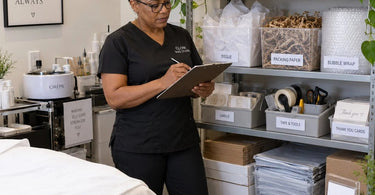
For the packing materials you are storing for future use, use clear bins. Clear bins are a game changer because you can see what is inside without opening them. Label them. A label that says "SMALL BOXES" is infinitely more helpful than a bin that you have to open and dig through every single time. And for the love of all that is holy, do not mix categories. A bin that contains both bubble wrap and packing peanuts is a bin that will make you question every decision you have ever made.
The Great Packing Material Purge: What to Keep and What to Let Go
Not all packing materials are worth keeping. In fact, most of them are not. Here is a quick and dirty guide to what deserves a spot in your back room and what deserves a one-way ticket to the recycling bin.
Keep: Flattened cardboard boxes in standard sizes that you actually use for shipping or storage. Bubble wrap in reasonable quantities. Air pillows if you ship fragile items. Packing paper if you use it for wrapping retail products. Packing tape, scissors, and labels. These are the tools of the trade. They earn their keep.
Toss or recycle: Boxes that are damaged, stained, or oddly sized. Packing peanuts that have escaped and are now living in your corners. Any packing material that you have not used in six months. Plastic strapping bands that you have been saving "just in case." The box from the Hydrodermabrasion machine that you bought two years ago and have not looked at since.
The rule of thumb is this: if you cannot identify a specific, realistic use for a piece of packing material within the next month, you do not need it. Your back room is not a museum of shipping supplies past. It is a functional workspace, and function should always win.
Reusing Packing Materials: The Eco-Friendly Bonus
Here is a little secret that the big beauty brands do not want you to know: reusing packing materials is not just good for the planet. It is good for your bottom line.
If you ship retail orders, you already know that packing supplies cost money. Boxes, tape, bubble wrap, labels, it adds up. By keeping a reasonable stash of packing materials from your wholesale shipments, you can reduce what you have to buy. That box that held your Advanced Facial Treatment Products? It might be the perfect size for shipping a customer order. The bubble wrap from that shipment? It can protect the Cuticle Oil you are sending to a client.
The key is to keep only what you will actually use. A reasonable stash is helpful. A hoard is a problem. The difference is whether you have a designated, organized space for it or whether it is slowly consuming your back room like a very slow-motion monster movie.
The Labeling System That Saves Your Sanity
Labels are not glamorous. Labels are not exciting. But labels are the difference between a back room that works and a back room that makes you want to lie down on the floor and give up.
Invest in a label maker. It is one of the best small purchases you can make for your business. Label your bins. Label your shelves. Label your boxes. Label everything that has a home. When your team knows where things go, they are more likely to put them back. When your team can find things without asking you, you save time and preserve your sanity for things that actually matter, like remembering your client's name or not accidentally waxing your own eyebrow off.
Your labeling system should be consistent and easy to understand. If you use color-coded labels, assign colors to categories. Blue for boxes. Green for padding. Yellow for tape and shipping accessories. Red for the stuff that needs to be dealt with immediately. The system does not have to be complicated. It just has to be used.
When to Call in Reinforcements
Sometimes, the back room is beyond a simple weekend organizing session. Sometimes, you need to bring in the big guns. And the big guns are not a professional organizer who charges by the hour. The big guns are storage furniture that is designed to handle exactly this kind of chaos.
A Locker system is one option. A wall-mounted storage cabinet is another. A rolling cart or a shelving unit can also work wonders. The point is this: if your current storage situation is not working, it is not because you are bad at organizing. It is because you do not have the right tools. A hairdresser would not try to cut hair with dull scissors. Do not try to organize a back room with shelves that are sagging under the weight of three years of accumulated bubble wrap.
Invest in storage that is designed for the volume and variety of materials that a salon or spa actually deals with. Look for sturdy shelving. Look for lockers or cabinets with doors. Look for clear bins that stack. Look for a system that makes it easy to put things away and easy to find them again.
The Bottom Line: Your Back Room Is Not a Landfill
Your back room is a workspace. It is where the magic of your business happens behind the scenes. It is where you store the ItalWax - Pre/Post products that keep your waxing clients comfortable. It is where you keep the High-Quality Towels that make your facials feel luxurious. It is where you stash the Professional Cleaners & Disinfectants that keep everything sanitary and safe.
It is not a landfill. It is not a black hole. It is not a monument to every single shipment you have ever received.
Packing materials have a purpose. That purpose is to protect the products you ordered while they are in transit. Once that job is done, the packing material's job is also done. It has served its purpose. You do not owe it a permanent home in your back room.
Keep what you will actually use. Recycle or toss what you will not. Organize what you keep. And then step back, take a deep breath, and enjoy the fact that you can actually walk through your back room without tripping over a box from a shipment that arrived in 2023.
You have got this. And if you need storage solutions that can actually handle the job, you know where to find us.
)