
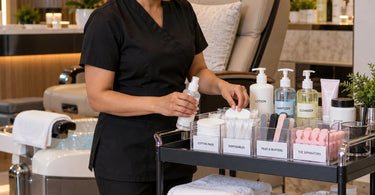
The best tools for the best results... and a pedicure cart that does not look like it just survived a beauty supply tornado! Every busy nail technician knows how quickly a perfectly organized pedicure cart can transform into a mobile collection of half-empty lotion bottles, mystery scrub containers, forgotten nail files, and approximately seventeen things nobody remembers putting there. What started as a convenient workstation suddenly becomes the salon equivalent of that kitchen drawer everyone is afraid to open. The good news? Keeping pedicure carts organized does not require a complete salon makeover or an expensive storage system. A few practical habits, thoughtful supply choices, and a smarter restocking routine can transform cluttered carts into efficient, professional workstations that make every pedicure appointment run more smoothly.
For salon owners, spa managers, and professional nail technicians, cart organization is about much more than appearances. A thoughtfully arranged pedicure station supports efficient services, protects product quality, reduces unnecessary waste, and helps maintain proper sanitation procedures. It also makes the workspace feel calmer, which is especially valuable when the appointment book is packed and the next client arrives five minutes early.
Why Pedicure Carts Become Clutter Magnets
Pedicure carts are designed to keep frequently used products and tools close to the technician. Unfortunately, that convenience also makes them prime real estate for anything that does not have a designated storage location.
During a busy service, a technician may grab an extra bottle of lotion, open a new scrub, add a backup cuticle product, or temporarily place an implement on the cart. Multiply those small decisions by several clients and multiple technicians, and the cart quickly becomes a storage unit with wheels.
Common contributors to pedicure cart clutter include:
- Multiple partially used bottles of the same product.
- Extra scrubs, masks, and lotions brought out for specialty services.
- Disposable supplies stored in unnecessarily large quantities.
- Clean implements mixed into general storage areas.
- Empty containers waiting to be discarded.
- Products that belong in centralized salon inventory.
- Retail items temporarily parked on the workstation.
- Supplies left behind after switching between service menus.
The problem usually is not that nail technicians are naturally messy. It is that the cart has slowly become responsible for too many jobs. A cart should support the current service, not function as the salon's entire supply department.
Give Every Pedicure Cart One Clear Purpose
The easiest way to prevent clutter is to establish a simple rule: the cart holds what is needed for performing pedicure services, while backup inventory stays in designated storage.
This distinction sounds obvious until someone discovers three unopened bottles of foot lotion hiding behind an old container of peppermint scrub.
Start by separating supplies into three categories:
- Daily essentials: Frequently used products and service accessories that technicians need within reach.
- Specialty service supplies: Products used for specific treatments that can be brought out when an appointment requires them.
- Backup inventory: Replacement containers, unopened bulk supplies, and additional stock maintained in a dedicated storage area.
Keeping these categories separate makes carts easier to navigate and inventory easier to control. Explore professional pedicure supplies when standardizing the essential products used at each station.
Use a Simple Three-Zone Cart Organization System
Instead of arranging products wherever they happen to fit, organize each cart according to how technicians actually perform a pedicure.
A practical three-zone system makes supplies easy to locate while reducing unnecessary movement during appointments.
Zone One: Frequently Used Service Products
The most accessible shelf or drawer should contain the products technicians use throughout a standard pedicure service.
Depending on the salon's menu, these may include:
- Foot cleansing products.
- Exfoliating treatments.
- Moisturizing lotions or creams.
- Cuticle Oil.
- Approved service accessories.
- Products needed for the current appointment.
Arrange containers in a consistent order so technicians can find products without searching behind other bottles. Keep containers closed when not actively dispensing, and use dispensing methods that prevent contamination.
Most importantly, limit duplicate containers. If a technician already has an appropriately stored, usable lotion bottle, adding another half-full bottle rarely improves the service experience.
Zone Two: Clean, Protected Single-Use Supplies
Another section of the cart can hold a reasonable working quantity of disposable supplies.
These might include professional cotton, sponges, and wipes, disposable applicators, and individually packaged service accessories.
Store unused supplies in clean, protected containers or compartments appropriate for the materials. Do not allow loose disposable items to mingle with open product containers, used tools, or contaminated surfaces.
For supplies such as Nail Files & Buffers, follow the manufacturer's instructions and applicable state requirements regarding single use, disposal, or permitted reprocessing.
A cart does not need an entire month's supply of cotton rounds. Keep enough for the expected workload and replenish from central inventory as needed.
Zone Three: Clearly Assigned Support Storage
Lower shelves or drawers can hold approved support supplies that are less frequently needed during the treatment.
Examples include unopened specialty products, protected accessories, or designated containers used in the salon's workflow.
However, the lowest shelf should never become a dumping ground for dirty implements. Used tools need a clearly identified collection process separate from clean supplies, and reprocessing should occur in an appropriate designated area according to applicable requirements.
The goal is to make every shelf predictable. If another technician can immediately identify what belongs there, the organizational system is working.
Stop the Half-Used Bottle Collection Before It Starts
Partially used products are one of the biggest reasons pedicure carts become cluttered. Scrubs, lotions, masks, and specialty treatments often accumulate because nobody wants to waste a usable product.
That is understandable. Professional products represent a real operating expense, and responsible inventory management matters.
However, saving every remaining tablespoon in a collection of aging containers is not necessarily economical.
Establish a consistent product rotation system based on manufacturer instructions, expiration dates, opening dates when relevant, and the salon's contamination-prevention procedures.
Consider these practices:
- Use the oldest suitable inventory first, provided it remains within its permitted shelf life.
- Keep original product labels and required identifying information intact.
- Record opening dates when necessary for products with limited after-opening usability.
- Avoid opening duplicate containers when an existing container is still appropriate for use.
- Never combine leftover product from different containers merely to save storage space.
- Do not top off partially used containers unless the manufacturer expressly permits that practice and the required procedure is followed.
- Discard expired, contaminated, improperly stored, or otherwise unsuitable products.
Products that have changed color, consistency, or odor should be evaluated according to manufacturer guidance rather than automatically returned to service.
The objective is not to eliminate every partially used container. It is to ensure that every opened product has a legitimate purpose and is handled appropriately.
Choose Treatment Products That Fit Your Service Volume
One surprisingly effective way to control cart clutter is to reconsider the sizes and formats of products used during pedicure services.
Large professional containers can offer practical advantages for busy salons, but keeping several oversized containers at every workstation may create unnecessary congestion.
For frequently performed services, centralized bulk inventory combined with an approved dispensing system may be more practical than multiple large bottles on each cart.
For occasional specialty pedicures, appropriately packaged single-service products may help reduce the number of partly used containers in circulation.
Explore options within Sugar Scrubs, Salt Scrubs, and Spa Body Treatments to evaluate formats that suit the services offered.
Brands such as Voesh, Avry Beauty, and La Palm offer professional nail and spa care options worth comparing when reviewing a treatment menu.
The right format depends on service volume, product instructions, treatment cost, and the salon's existing sanitation procedures.
Create a One-Open-Container Rule
For many frequently used products, a simple one-open-container rule can dramatically reduce duplicate inventory.
Under this approach, each station generally keeps one active container of a particular standard product. Additional unopened stock remains in the designated inventory area until a replacement is needed.
Exceptions can be made for genuinely different formulations, service-specific products, or situations where more than one container is operationally necessary.
This rule makes it easier to identify what needs replacing and reduces the likelihood of forgotten containers expiring at the back of a drawer.
It also prevents a familiar situation: someone opens a fresh bottle because the original bottle is hiding behind three foot masks and a mysterious plastic lid.
That lid has probably been there since spring. Nobody knows what it belongs to. It is time to investigate.
Build Small Pedicure Service Kits Instead of Stockpiling Supplies
Another practical strategy is to assemble service-specific kits or trays containing the supplies needed for a particular appointment.
For example, a standard pedicure kit might contain the appropriate single-use accessories and prepared materials for the basic service. An upgraded exfoliating pedicure kit could include approved additions for that treatment.
Technicians retrieve the correct kit before the appointment rather than storing every possible treatment combination permanently on the cart.
This works particularly well for salons offering multiple pedicure tiers, seasonal treatments, or specialty spa packages.
When evaluating storage options, consider salon storage containers, Bottles & Jars, and pedicure bowls suited to the intended workflow.
Use only packaging and transfer procedures allowed by the product manufacturer and applicable regulations. Keep product identity, directions, and other required labeling available. Single-service portions should be prepared and handled in a way that prevents contamination, with unused dispensed product discarded rather than returned to the original container.
Keep Clean Supplies and Used Tools Completely Separate
Organization and sanitation are closely connected, but a neat appearance alone does not make a workstation sanitary.
A pedicure cart can look beautiful while still having serious workflow problems if clean implements, used tools, and open products share the same storage space.
Professional salons should establish clearly separate handling procedures for clean and contaminated materials.
Important practices include:
- Store cleaned and properly disinfected reusable implements in clean, protected storage as required by applicable rules.
- Never return used implements directly to clean storage.
- Use designated containers and handling procedures for items awaiting cleaning and disinfection.
- Discard single-use materials after use when required.
- Clean and disinfect reusable equipment and appropriate workstation surfaces according to applicable regulations and product labels.
- Keep clean linens and unused disposable materials protected from contamination.
Stock appropriate Professional Cleaners & Disinfectants for Salons and Spas and follow each product's approved use directions, including required dilution, surface compatibility, and wet contact time.
Pedicure basin cleaning and disinfection procedures must also follow the equipment manufacturer's instructions, disinfectant label, and applicable state board requirements. Organizing the cart does not replace these essential procedures.
Make Restocking a Scheduled Task, Not a Guessing Game
One reason carts become overloaded is that technicians stockpile supplies to avoid running out during busy appointments.
Instead of relying on backup bottles hidden in every drawer, establish a predictable restocking process.
At the start or end of each shift, a designated team member can check whether the station has the expected quantity of essential products and accessories.
A simple restocking checklist might include:
- One suitable active container of each standard treatment product.
- An appropriate working quantity of disposable supplies.
- Required clean and properly stored reusable implements.
- Current specialty products needed for scheduled appointments.
- Necessary protective supplies.
- Confirmation that empty or unsuitable containers have been removed.
Replenishment quantities should reflect actual appointment volume rather than arbitrary maximums.
For example, a station handling six appointments per day may require a different supply quantity than a station handling twelve. Track typical consumption and adjust the stocking level accordingly.
Centralized replenishment also makes it easier to identify purchasing needs before products run out.
Use Labels That Make Sense During a Busy Shift
Labels are not glamorous, but neither is searching through five identical drawers while a client watches.
Clearly labeled shelves, drawers, and organizational bins reduce confusion and help every team member maintain the same layout.
Useful labels might identify categories such as:
- Daily pedicure essentials.
- Unopened disposable supplies.
- Specialty service accessories.
- Clean implements in approved protected storage.
- Restocking checklist and supply records.
For products transferred into permitted secondary containers, follow applicable labeling requirements rather than relying on informal handwritten nicknames.
A container labeled simply as the good-smelling pink stuff is not an acceptable inventory identification system, no matter how accurately the staff understands it.
Design the Cart Around Technician Movement
Good organization should make a pedicure easier to perform, not force technicians to work around a complicated storage system.
Observe the natural sequence of a standard service. Which products are used first? Which implements are needed repeatedly? Which supplies are only necessary near the end?
Position frequently used items within convenient reach without blocking movement, compromising sanitation, or creating spill hazards.
Heavy items should be stored according to the cart manufacturer's load and stability guidelines. Avoid overloading shelves or attaching accessories that interfere with safe movement.
If a technician repeatedly walks across the room for the same essential product, the station setup may need improvement. If the cart holds products that have not been used in weeks, those items may belong elsewhere.
When upgrading equipment, review Stylish and Functional Nail Salon Furniture Essentials and Pedicure Chairs/Spas with the overall workstation layout in mind.
The most useful cart is not necessarily the largest. It is the one that supports the technician's actual workflow.
Introduce a Five-Minute Cart Reset
One of the simplest organization habits is a scheduled cart reset at the end of every shift.
Rather than allowing clutter to accumulate until a major cleaning day, technicians take a few minutes to return the station to its standard arrangement.
A practical reset includes:
- Removing empty packaging and trash.
- Discarding unusable or contaminated products and materials appropriately.
- Sending used reusable implements through the designated reprocessing workflow.
- Returning unnecessary unopened products to approved central storage.
- Checking that product containers are properly closed and stored.
- Cleaning and disinfecting appropriate surfaces according to required procedures.
- Restocking the station for the next shift.
This reset is an organizational routine, not a substitute for cleaning, disinfection, and other procedures required between clients or at specified intervals.
The advantage is consistency. Five minutes of routine attention can prevent a much larger cleanup project later.
Control Inventory With Minimum and Maximum Stock Levels
For salons with multiple pedicure stations, setting minimum and maximum stock quantities can help prevent both shortages and overstocking.
Minimum stock is the quantity at which supplies should be replenished. Maximum stock is the amount normally kept at a station after replenishment.
These levels should be based on product consumption, service volume, delivery schedules, and available storage space.
For example, a station might keep one active lotion container and a defined quantity of disposable accessories, while all additional inventory remains in the stockroom.
Review product usage periodically to determine whether stocking limits remain appropriate.
This approach makes ordering more predictable and reduces the temptation to stash extra supplies wherever there is an empty corner.
Assign Ownership Without Turning Organization Into a Blame Game
Shared pedicure stations can become especially cluttered because several technicians may assume someone else is responsible for organizing them.
The solution is a clear, consistent routine rather than a dramatic investigation into who left the open scrub jar on Tuesday.
Establish written station standards, provide a simple reference photo of the desired layout, and explain which employee is responsible for end-of-shift checks and replenishment.
If technicians share a cart, have each person complete the required service cleanup and leave the workstation ready for the next appointment.
Managers should periodically review whether the system is realistic. If everyone struggles to maintain the same drawer arrangement, the layout itself may need adjustment.
Organization should support the team, not become another source of stress during a demanding workday.
Match the Pedicure Menu to the Supplies on the Cart
A salon that offers a basic pedicure, a deluxe pedicure, a seasonal treatment, and several specialty upgrades may have dozens of professional treatment products available.
That does not mean every product must remain on every pedicure cart.
Review the service menu and determine which products are truly essential for standard appointments.
Specialty products can be maintained in clearly identified central storage or assembled into appointment-specific kits.
If a seasonal pumpkin foot treatment is offered for only a few months, its products do not need to occupy prime cart space throughout the entire year.
The same principle applies when introducing new options from Professional Nail Care Collections or complementary services using Nail Treatments.
Let actual service demand determine the station layout.
Watch for the Warning Signs of Cart Clutter
Pedicure carts rarely become disorganized overnight. The warning signs usually appear gradually.
Pay attention when:
- Technicians regularly open duplicate containers.
- Products disappear behind other supplies.
- Expired or unidentified products are discovered during cleaning.
- Drawers are difficult to close.
- Disposable supplies are stored next to inappropriate materials.
- Different technicians cannot find the same essential items.
- Restocking takes longer because nobody knows what is already available.
- Workstation surfaces are so crowded that proper cleaning becomes difficult.
These are signals that the cart's organization system needs attention.
Rather than adding more baskets every time clutter appears, examine whether unnecessary supplies can be removed or relocated.
Sometimes the best storage solution is simply having fewer things to store.
A Practical Weekly Pedicure Cart Organization Routine
For a busy professional nail salon, a lightweight weekly review can help maintain the improvements made through daily resets.
Monday: Inspect opened product containers, verify suitability for continued use, and check product rotation.
Tuesday: Review disposable supply quantities and compare them with actual service volume.
Wednesday: Check drawer labels, protected storage, and designated locations for clean implements.
Thursday: Evaluate specialty treatment products and remove unnecessary items from everyday cart storage.
Friday: Review the following week's appointment schedule and anticipate supplies needed for specialty pedicures.
Weekend or designated review day: Complete an inventory check, inspect cart condition, and identify any storage problems requiring correction.
These tasks can be combined or assigned differently depending on operating hours and staffing. The important part is establishing a routine that employees can realistically follow.
Why Organized Pedicure Carts Make Business Sense
Better cart organization offers several operational advantages for professional salons.
Less wasted product: Clear product rotation and controlled opening practices can reduce the number of forgotten containers that become unusable.
More efficient appointments: Technicians spend less time searching for supplies and more time concentrating on their work.
Easier inventory management: Consistent station quantities help managers distinguish between genuine purchasing needs and products that are simply misplaced.
Better sanitation workflow: Clearly separated storage makes it easier to support the required handling of clean, used, and disposable materials.
More professional presentation: A clean, uncluttered workstation contributes to an inviting client experience.
Simpler employee training: Standardized cart layouts make it easier for new technicians to learn where supplies belong.
These improvements may seem small individually, but they become meaningful when repeated across multiple stations and hundreds of appointments.
Build a Pedicure Cart Setup Your Team Can Actually Maintain
The secret to keeping pedicure carts organized is not purchasing a complicated collection of drawer organizers or expecting technicians to become professional minimalists overnight.
It is creating a workstation where every product has a purpose, every supply has a designated location, and every employee understands the replenishment process.
Start with a complete cart cleanout. Identify the essentials, relocate backup stock, separate clean and used materials appropriately, and establish realistic quantity limits. Then reinforce the arrangement with clear labels, scheduled restocking, and a short daily reset.
As your salon evaluates equipment and supply needs, Pure Spa Direct offers access to professional Pedicure Supplies, Spa Tools & Implements, Applicators & Spatulas, and other essentials for building a more practical pedicure workstation.
Remember, your pedicure cart is supposed to make your job easier, not become the unofficial retirement home for half-used bottles. Give those products a proper storage plan, keep the essentials within reach, and let your workstation do what it was designed to do: support beautiful, efficient professional pedicure services without the clutter-induced scavenger hunt.
