
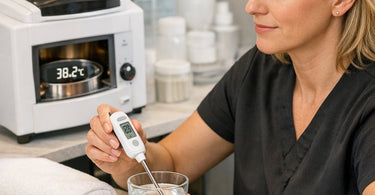
Clients rave about this every visit... until the day the wax feels like molten lava or the paraffin treatment is as useless as a screen door on a submarine. Let's be real, ladies: the silent killer of a flawless spa service isn't a shaky hand or a bad batch of wax; it's a lying thermometer. That innocent-looking digital display on your professional wax warmer or paraffin bath might be gaslighting you harder than a bad date, and honestly, we need to stage an intervention. Whether you run a bustling nail salon, a high-end spa, or a hair salon that offers killer hot oil treatments, an inaccurate thermometer means unhappy clients, potential burns, and a whole lot of liability drama you simply do not need on a Tuesday.
You might think, "Kelly, it's brand new! It came out of the box perfect!" Oh, sweet summer child. Those little devices get jostled in shipping, dropped on the floor, or simply drift over time due to age or extreme temperature swings [citation:1]. If you are trusting your expensive ItalWax warmer or that adorable towel steamer to tell you the truth without verifying it, you are basically playing Russian roulette with your clients' skin. Don't worry, though. Today, we are going to grab a cup of coffee (or a mimosa, I don't judge), roll up our sleeves, and turn you into a calibration wizard. By the time we are done, you will know exactly how to keep your massage therapy stones hot, your wax silky, and your clients coming back for more.
Why Your Thermometer is Lying to You (And How to Catch It)
Before we dive into the nitty-gritty of ice baths and boiling points, we need to understand why this happens. Think of your professional supplies like a car; they need tune-ups. Sensors drift, batteries die, and internal resistors fry. In the spa world, we deal with a lot of gunk—wax residue, skincare oils, and dust. If you aren't cleaning your gear, the gunk acts like a winter coat for your heating element, trapping heat and confusing the thermostat [citation:4].
If you use hard wax or soft wax, the temperature window is tight. Too cold, and the wax is clumpy and rips hair like a cheap lawnmower. Too hot, and you are looking at a liability lawsuit faster than you can say "burn notice." For you nail techs using paraffin wax, the stakes are even higher. That skin on the hands is delicate. You need accuracy, and you need it yesterday.
The Ice Bath Method: The Old Reliable (But Don't Be Lazy)
There are high-tech ways to calibrate, costing thousands of dollars for dry-block calibrators [citation:1]. But for most of us running a spa or barber shop, the "Ice Point" method is your best friend. It is cheap, easy, and surprisingly accurate if you don't cut corners. Do not just throw a few ice cubes in a cup of water and call it a day. We are professionals, people. Here is how to do it right:
What you need: A tall glass, crushed ice, and distilled water (tap water has impurities that mess with the freezing point). Fill the glass with crushed ice. Add just enough distilled water to fill the gaps. Stir it like a martini. Let it sit for about 3-5 minutes to reach thermal equilibrium. The temperature of this glorious slushy mess is exactly 32°F (0°C) [citation:1][citation:5].
Now, insert your digital thermometer probe into the center of the ice bath. Do not let it touch the sides or the bottom—that metal is a different temperature. Wait for the reading to stabilize. If your thermometer reads 32°F, congratulations! You are a rockstar. If it reads 35°F or 28°F, you have a problem. If your device has a calibration nut or a "reset" button, adjust it to 32°F [citation:1]. If it doesn't (and many cheapies don't), you now know it runs "X" degrees hot or cold. Write that offset on a piece of tape stuck to the machine as a reminder.
Boiling Water: High Temp Checks for Wax Warmers
The ice bath checks the low end, but we care about the high end—specifically that 120°F to 160°F range where wax lives. The Boiling Point method checks the top end of the spectrum. Note: Water boils at 212°F (100°C) at sea level. If you live in Denver or another high-altitude location, water boils at a lower temperature (about 202°F). Google your local boiling point first [citation:1].
Boil a pot of distilled water. Insert your probe into the boiling water (again, avoid touching the metal sides of the pot). It should read 212°F (or your local adjusted number). If it doesn't, apply the same offset logic. However, let's be honest: If your wax warmer says it's 130°F but your probe says it is 150°F, you are cooking your clients. That is an immediate "stop using" signal.
This is why we love ItalWax and Berodin warmers. These brands usually have a reliable reset function hidden in their button sequences (hold the + and - keys, friends). If you threw the manual away (we have all been there), look it up on our site at Pure Spa Direct.
The Real-World Fix: Calibrating Your Wax Warmer & Paraffin Bath
Okay, lecture over. Let's get hands-on with the actual wax warmer sitting in your station. This exact process works for paraffan baths and hot stone heaters too.
Step 1: The Cleanse. If your warmer looks like a science experiment gone wrong, clean it first. Old wax and debris act as insulation. You wouldn't wear a parka to a hot yoga class, and your thermometer doesn't want to wear a layer of dead skin cells either.
Step 2: The Wait. Turn your warmer on. Let it run for at least 2 hours. I know you are in a hurry, but trust the process. We need the temperature to stabilize fully. The top layer of wax is always cooler than the bottom, so we need that heat to saturate [citation:4].
Step 3: The Stir. Grab a clean, disposable wooden spatula (we sell them by the box, so no excuses). Stir the wax vigorously for about 10 seconds. This mixes the hot bottom with the cooler top to create one uniform temperature.
Step 4: The Read. Immediately stick your calibrated probe thermometer into the center of the wax. Don't touch the bottom! Watch the numbers. If your warmer's LED says 130°F but your probe says 120°F... Houston, we have a problem.
Step 5: The Adjust. Most digital units allow an offset adjustment. If the machine thinks it's 130 but it's actually 120, you need to tell it to add 10 degrees. Go into the calibration menu (check your specific wax warmer manual). Set the offset to +10. Wait 30 minutes. Stir and test again. Repeat until the machine agrees with your probe within 1 degree.
Infrared Thermometers: The Cool Kids' Tool
If you are doing lash extensions, dermaplaning, or hydrodermabrasion, you might use an infrared (IR) thermometer to check skin surface temps or equipment surfaces. These are finicky little divas. You cannot just point and shoot from across the room.
First, your IR thermometer hates dirt. If the lens is smudged with cuticle oil or dust, it's lying [citation:3][citation:6]. Second, distance matters. If you are too far away, you are reading a giant circle that includes the cold wall behind the machine. Get close. Third, let the device acclimate to the room temp for 30 minutes. Don't keep it in your cold car and then expect it to work perfectly in your 75°F salon [citation:3][citation:6].
When to Throw in the Towel (Or the Warmer)
Sometimes, it's not you; it's them. If you follow all these steps and your wax warmer still reads 140°F when the wax is smoking, the heating element or sensor is fried. If you smell burning wax (that acrid, sharp smell), turn it off immediately. You cannot fix a fried motherboard with a spatula. Do not risk burning a client because you are too cheap to replace a $100 machine. Your client's skin is worth more than that. Browse our selection of Starpil, Cirepil, or Waxness warmers for an upgrade that will make your life infinitely easier.
Keeping the Calibration Locked In (The Maintenance Routine)
Consistency is key, babe. Set a calendar reminder on your phone for the first of every month. Label it "Calibration Day." This 5-minute routine will save you from a 1-star Yelp review.
- Daily: Wipe down the rim. Don't let wax crust build up on the heating elements or thermostat probe [citation:7].
- Monthly: Do the Ice Bath and the Stir & Scan test on your warmers.
- Every 6 Months: Re-calibrate your reference probe thermometer. If you use a master reference, send it out for professional certification [citation:5][citation:8].
Remember, you are the boss of your spa retail and service business. Don't let a little piece of electronics tell you what to do. Master your tools, master your temperatures, and watch your clients relax into the safest, most luxurious service of their lives. Now go forth and calibrate!
)