
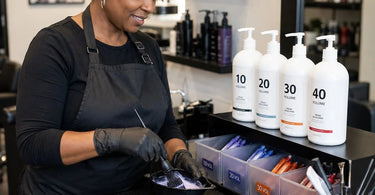
Clients notice this quality every visit, even if they can't quite put their finger on it. There's a certain confidence you exude when you reach for exactly the right bottle of 20-volume developer without a second thought, or when you whisk together a custom color blend with the efficiency of a Michelin-starred chef. But let's be real, for every one of those graceful moments, there's a secret life behind the salon curtain where we're playing a frantic game of hide-and-seek with our supplies. If you've ever found yourself elbow-deep in a drawer, muttering sweet nothings (or not-so-sweet expletives) while hunting for the right developer in the middle of a busy Saturday, this post is for you. Today, we are going to tame that beast and talk about how to organize developer volumes for faster color mixing, because your time (and your sanity) is too valuable to waste on a scavenger hunt.
Let's be honest: your color bar is the heart of your salon. It's where the magic happens, where dreams become reality, and where, if we're being completely transparent, a surprising amount of chaos can erupt. The average professional hair salon or barber shop relies on a multitude of developer volumes—10, 20, 30, and 40—and that's before we even get into the different sizes and brands. Keeping them straight isn't just about being a neat freak; it's about speed, accuracy, and ensuring your color results are spot-on every single time. When your developers are a disorganized mess, you're not just losing time; you're risking dilution mistakes, grabbing the wrong strength, and creating a workflow that feels more like a roadblock than a runway.
Think of your developer organization as the foundation of your color services. A solid foundation means faster mixing, less stress, and a much happier you. And a happier you means happier clients, which is the whole point, right? So, let's dive into creating a color station that is so well-organized, it will make your fellow stylists weep with envy.
Why Disorganized Developers Are Your Arch-Nemesis
Before we get into the 'how,' let's take a moment to really appreciate the 'why.' A disorganized hair color station is more than just an eyesore. It's a productivity killer. Every single time you have to pause, search, or double-check a bottle, you're losing precious minutes. In a high-volume salon, those minutes add up to lost revenue and frazzled nerves. Plus, there's the very real risk of grabbing the wrong developer. Imagine accidentally using 40-volume when you meant to use 20-volume. That's a recipe for disaster, a chemical cut, and a very unhappy client. Trust me, that's not a conversation anyone wants to have.
Furthermore, a chaotic space creates a chaotic mind. When your surroundings are cluttered and disorganized, it's harder to focus on the art of color. That zen-like state where you're completely in tune with the hair and the color? It's much harder to achieve when you're mentally cursing the person who put the 30-volume developer in the wrong spot. Organizing your developers is an act of self-care for you and your team. It's about creating a workspace that allows you to work your magic with ease and confidence.
Step 1: The Great Developer Audit
The first step in any organizational overhaul is to take stock. This is where you channel your inner Marie Kondo and tackle your color inventory. You can't organize what you don't know you have. It's time to pull out every single bottle, tube, and container of developer you own. I know, it might be painful, but it's for the greater good.
Start by categorizing everything by volume. Put all your 10 volumes together, all your 20 volumes together, and so on. This is the moment of truth. You'll likely find some dusty soldiers at the back, a half-empty bottle of something from a brand you don't even use anymore, and maybe even a bottle that expired when disco was still popular. Be ruthless. Consolidate your supplies and toss any expired or nearly empty bottles. Once you have your piles, it's time to assess your usage. Which volume do you go through the fastest? Which one seems to gather dust? This little exercise will also help you with future purchasing decisions. Knowing exactly what you have and what you use is the first step to a beautifully organized station.
Step 2: Labeling is Your New Best Friend
I cannot stress this enough: label everything. And I mean everything. In the heat of the moment, when you're mixing a complex formulation, you don't want to second-guess a bottle. A clear, readable label is your insurance policy against color catastrophes. You don't need anything fancy; a simple label maker or even some masking tape and a sharpie will work wonders.
Label the volume strength prominently. Add the brand name if you use multiple lines, and don't forget to mark the size. Some containers can look deceptively similar, so having that extra bit of information at a glance can save you from a major headache. You can also use color-coded stickers to add an extra layer of visual organization. For instance, put a green dot on all 10-volume, blue on 20-volume, and so on. This way, even from across the room, you know exactly which one you need. This simple step of labeling your applicators and tools and supplies is a total game-changer for efficiency.
Step 3: Choosing the Right Storage Solutions for Your Color Bar
This is where you can really have some fun. Your storage solutions should fit the flow of your salon. If you have limited space, you might need to get creative with vertical storage. Wall-mounted racks or tiered shelving can be a lifesaver. If you have more counter space, a set of clear, stackable bins can keep everything visible and within reach. The goal is to create a dedicated spot for each developer volume.
One of the most effective and popular methods is to assign a specific shelf or container for each volume. For example, the top shelf might be reserved for your most-used 20-volume developer, the second shelf for 30-volume, and so on. This way, you train your brain (and your team's brains) to go to a specific zone for a specific need. It's like muscle memory for your color bar. For smaller spaces, a lazy susan or a turntable is an excellent way to keep all your developers accessible without taking up a ton of real estate.
You can also use a tiered spice rack to display your bottles, making it easy to see the labels at a glance. The key is to think about your workflow. Where do you do most of your mixing? Your storage should be as close to that spot as possible. Having to walk across the room to grab your developer is a waste of movement, and in a busy salon, every step counts. Remember to also keep your mixing bowls and color brushes in the same zone to create an efficient color-mixing hub.
Step 4: The Zero-Waste Strategy
We all know the heartbreak of throwing away unused color. But did you know a chaotic developer station can contribute to that waste? When you're in a rush and grab a large bottle of 30-volume when you only need a tiny amount, you're setting yourself up for waste. This is where a well-organized system can save you money and help the planet.
One of the best ways to minimize waste is to stock a range of sizes. Keep a stash of smaller bottles for touch-ups and root retouches, and reserve the larger bottles for big jobs like global lightening. Another genius hack is to decant your most-used developers into smaller, refillable squeeze bottles. Not only does this save space, but it also makes pouring and measuring much more accurate. You can label these bottles with the volume and the date you filled them to ensure freshness. Plus, using smaller, controlled bottles encourages a more precise pour, which means less product is wasted overall. This is a small change that makes a huge difference.
Step 5: Make It a Team Effort
An organized color bar is a team responsibility. It only takes one person not following the system to throw the whole thing into chaos. So, once you've created your beautiful, organized masterpiece, make sure your entire team is on board. Show them the new system, explain the logic behind it, and make it a standard practice in your salon.
Consider creating a simple checklist or a visual guide that shows exactly where each volume belongs. You can even have a little laminated card on the color bar as a reminder. When everyone is invested in maintaining the organization, it becomes a habit rather than a chore. Encourage your team to speak up if they notice supplies running low or if the system isn't working for them. The best system is one that works for everyone, and a little open communication goes a long way. This kind of teamwork is what separates a good salon from a great one.
Pro Tips: Beyond the Bottles
Organizing your developer volumes is just the tip of the iceberg. Once you have your system in place, you can apply these same principles to the rest of your color supplies. Group your hair bleaches and lighteners by lift power. Keep your premium hair care products and color additives in their own designated area. And don't forget about those professional hair brushes and combs—they deserve a tidy home too!
Think of your color bar as a cockpit. Everything you need should be right at your fingertips. You wouldn't see a pilot rummaging through a glove compartment for the landing gear, and your clients shouldn't see you rummaging for the right developer. A well-organized space isn't just efficient; it's a powerful professional statement. It tells your clients that you are detail-oriented, prepared, and take your craft seriously. It builds trust and confidence before you even touch their hair.
To keep your system fresh, schedule a quick 'color bar reset' at the end of each week. Spend five minutes wiping down the shelves, checking your inventory, and returning any stray bottles to their proper place. This small investment of time will save you hours in the long run and ensure your color bar is always ready for battle on Monday morning. And remember, if you're running low on any supplies, it's the perfect time to stock up through Pure Spa Direct.
So, there you have it. The secret to faster, more efficient color mixing isn't really a secret at all—it's just good old-fashioned organization. By taking the time to audit, label, and store your developer volumes strategically, you're setting yourself up for success. You're eliminating stress, saving time, and creating a workspace where you can truly focus on the art of color. Now, go forth and organize! Your color bar (and your sanity) will thank you.
)