
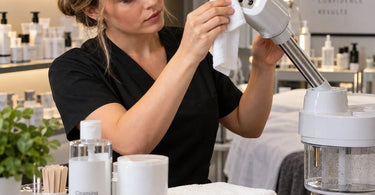
Your work deserves the best tools, and nobody knows that better than you do. You have spent years perfecting your craft, building a clientele that trusts you with their skin, and investing in professional equipment that makes your treatments shine. But here is the dirty little secret nobody talks about in esthetics school: your Facial Steamer is quietly plotting against you. Not in a dramatic, soap-opera villain kind of way, but in a slow, crusty, white-flake-drifting-out-of-the-nozzle kind of way that makes you question your life choices mid-treatment. Let us fix that.
If you have ever stared at the tiny holes on your steamer nozzle wondering why the mist looks more like a sad sigh than a luxurious cloud, you are not alone. Product buildup around facial steamer nozzles is the unglamorous reality of professional skincare work. The good news? It is completely preventable with a few simple habits that take less time than your morning coffee order. And your clients will never know about the crusty nozzle incident that almost happened. We will keep that between us.
Wait, Is It Product Buildup or Something Else?
Here is the plot twist that makes every esthetician groan: that white, chalky residue around your nozzle is probably not product buildup at all. It is mineral scale, also known as limescale or calcium carbonate deposits. When tap water heats up inside your steamer, the dissolved minerals in that water precipitate out of solution and stick to every surface they touch, including the tiny nozzle holes . Over time, those deposits build up layer by layer until your steamer starts sputtering like a car that skipped its last three oil changes.
Now, that is not to say actual product residue never happens. If you are using a steamer with an aromatherapy function or if you have ever been tempted to add a drop of essential oil directly into the water tank (we see you), you are inviting a different kind of gunk into the party. Oil and water do not mix, and in a heated environment, they create a sticky, smelly mess that clings to nozzle interiors and internal seals . So the first step in prevention is knowing your enemy.
The One Habit That Changes Everything
If you take nothing else from this blog post, take this: use distilled water. Not filtered. Not bottled spring water. Distilled. Every single time .
Distilled water has had its minerals removed through the distillation process, which means there is nothing left to precipitate out and crust up your heating element or nozzle. Yes, it costs a little more than filling up from the tap. But it costs a whole lot less than replacing a steamer that died an early death from mineral suffocation. Think of it as a tiny investment in your equipment's longevity. Your Facial Steamers will thank you by actually producing steam when you need it most.
The Daily Ritual: Empty, Dry, Repeat
You would not leave yesterday's mask sitting in your mixing bowl, right? The same logic applies to your steamer's water reservoir. Leaving water sitting in the tank overnight is an open invitation for bacteria and mold to move in and set up a cozy little commune . That musty smell that occasionally wafts out of a neglected steamer? That is the scent of biofilm, a slimy microbial layer that forms on wet surfaces and can aerosolize directly onto your client's freshly cleansed skin . Not exactly the luxury experience you are advertising.
The routine is simple. After your last steaming service of the day, unplug the unit, let it cool, and empty every drop of water from the reservoir. Then leave the cap off and let the tank air-dry completely. This ten-second habit is the difference between a steamer that serves you faithfully for years and one that starts making weird noises and questionable smells within months.
The Monthly Deep Clean: Vinegar Is Your Best Friend
Even with distilled water, some residue can accumulate over time. Once a month, give your steamer a proper deep clean. The professionals' choice is plain white vinegar, which is acidic enough to dissolve mineral deposits without damaging your equipment .
Mix equal parts white vinegar and distilled water, fill the reservoir, and run the steamer for five to ten minutes. Do this in a well-ventilated area because vinegar steam is pungent, to say the least. Then turn it off and let the solution sit for another twenty to thirty minutes to tackle any stubborn spots. After that, empty the tank completely, refill with pure distilled water, and run another cycle to flush out every trace of vinegar. Repeat the rinse cycle if you can still smell it, because you definitely do not want vinegar mist hitting your client's face .
If the nozzle itself looks visibly crusty, you can remove the nozzle cap (check your manual first) and soak it in undiluted white vinegar for fifteen to thirty minutes. A cotton swab dipped in vinegar can gently clean individual holes without scratching the openings, which would only make future clogs worse .
The Aromatherapy Trap (We Know It Is Tempting)
That little herbal aroma compartment on your steamer? It is there for a reason, and it is not the water tank. If you are lucky enough to have a steamer with a dedicated aromatherapy function, like the Meishida Aroma Ion Facial Steamer, use the designated cotton pad slot for your essential oils. Never, ever pour oils directly into the water reservoir .
Oil in the water tank does not create a spa-like experience. It creates a clogged nozzle, degraded internal seals, and a steamer that spits hot oil-infused water instead of producing a clean, even mist. It is the kind of mistake you only make once, usually in front of a client, usually on a busy Saturday. Save yourself the trauma.
Why This Matters More Than You Think
An unmaintained steamer is not just an inconvenience. It is a hygiene risk . When mineral scale and biofilm accumulate inside the reservoir and nozzle, they can harbor bacteria that get aerosolized and delivered directly onto your client's skin. That is the opposite of the deep-cleansing, purifying experience you promised when you sold them the treatment.
Beyond client safety, there is the financial reality. A clogged steamer produces weak, inconsistent steam, which makes your treatments less effective. Extractions take longer. Pores do not soften as well. The whole flow of your service suffers. And eventually, the heating element gives out entirely from working too hard to push steam through a blocked pathway . Replacing a professional-grade Advanced Spa Equipment unit because of preventable neglect is the kind of expensive mistake that makes you want to cry into a High-Quality Towels.
Quick Maintenance Cheat Sheet
To keep it all straight, here is your quick-reference guide:
Every single use: Empty the water tank. Wipe down the seal and exterior. Leave the cap off to air-dry.
Once a week: Wipe down the nozzle and control surfaces with a disinfectant wipe. Check for visible crusties .
Once a month: Run the vinegar descaling cycle. Rinse thoroughly with distilled water. Soak removable nozzle parts if needed.
Always: Use distilled water. Never add oils to the tank. Never leave standing water overnight.
When to Call It: Signs Your Steamer Needs Help
If your steamer is producing weak steam, sputtering, making alarming noises, or emitting an off smell that no amount of vinegar seems to fix, it may be time for professional repair or replacement. Some mineral damage is reversible with diligent descaling. Some is not. Know the difference before you serve weak steam to a paying client and pretend it is normal.
Investing in quality equipment is part of being a professional. Maintaining it is what separates the estheticians who build lasting businesses from those who burn through tools and clients alike. Your Spa Tools & Implements for Professionals are an extension of your hands and your reputation. Treat them like it.
And if you are in the market for a steamer that is worth all this TLC, browse our full selection of Facial Steamers and Ozone Steamers. Your clients will never know about the crusty nozzle incident that almost was. But they will absolutely notice the difference clean, well-maintained steam makes in their treatment results.
)