
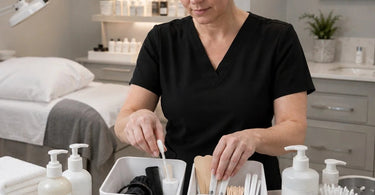
Quality drives repeat business, but in a beauty school or busy training environment, maintaining that quality starts long before a student touches a client. It begins with a simple yet surprisingly chaotic challenge: keeping personal supplies from getting cozy with shared ones. We've all seen it happen. One moment, you have a beautifully organized station with clearly marked items, and the next, you find a student's favorite Cuticle Oil being used as a communal hand lotion, or worse, their personal wax spatula doing double duty across several mannequin heads. It's a recipe for disaster, wasted product, and some very awkward conversations. But don't worry, we have the ultimate survival guide to keep your beauty school or training facility running smoother than a fresh pot of ItalWax Pre/Post lotion. This blog is your roadmap to preventing product pandemonium and teaching students the professional habits that will set them up for a stellar career.
Let's be honest, the beauty industry is built on trust and sanitation. If students can't keep their own supplies straight, how can we expect them to maintain the rigorous standards needed when they're working on paying clients? Mixing personal and shared supplies isn't just a minor inconvenience; it's a hygiene faux pas that can lead to cross-contamination, unhappy clients, and a permanent stain on a professional reputation. According to state regulations like the Michigan Administrative Code, students and licensees must use clean tools and supplies on patrons, with single-use items being disposed of after each use . This starts in the classroom. Setting clear boundaries between what is "mine" and what is "ours" is the first crucial step in building a professional mindset. Plus, it saves you from the headache of constantly replacing products that have mysteriously evaporated into the communal abyss.
Why Personal and Shared Supplies Turn Into a Hot Mess
Before we dive into solutions, it's worth understanding why this mix-up is so common. In a bustling educational environment, it's easy for lines to blur. Students are excited, stressed, and often in a rush. A shared bottle of toner looks just like the one in their personal kit, and before you know it, it's being used by multiple people. This creates a few key problems. First, there's the issue of infection control. Sharing items that come into contact with skin—like Tweezers or wax applicators—without proper sanitation is a major no-no and a clear violation of professional health codes . Second, it's a logistical nightmare for budgeting. When personal products become de facto community supplies, you'll find yourself reordering Professional Cotton and Protective Gloves far more often than planned. Finally, it fosters a lack of personal accountability. Students won't learn to care for their own tools and manage their kit if they're always dipping into a communal pot. It's a bit like being in a group project where only one person does the work—except in this case, everyone is using your expensive ItalWax!
Mastering the "Mine vs. Ours" System: Essential Strategies for Success
So, how do we prevent this beautiful chaos? It requires a two-pronged approach: a foolproof organizational system and crystal-clear communication. Here are some strategies that actually work, helping you maintain sanity and a sanitary environment.
1. Label Like a Boss (and Make It Stick)
The simplest, most effective weapon in the fight against supply mixing is the humble label. In a study of classroom management, labeling items with a student's name or a unique identifier was shown to prevent mix-ups and reduce arguments . But you can't just use a piece of masking tape and a sharpie and call it a day. In a salon environment, your supplies come into contact with oils, waxes, and solvents. Waterproof, durable labels are your best friend. Clearly mark everything—from large items like Professional Wax Warmers for Salons & Spas and Towel Steamers to tiny Applicators & Spatulas. Use a color-coding system, like red labels for personal items and blue for shared supplies, to create an instant visual cue. This not only keeps things separate but also teaches students to be detail-oriented, a skill that's invaluable when dealing with client files or precise tint ratios.
2. Designate Personal Space (Even in a Shared Environment)
Every student needs a designated home base. This could be a specific drawer, a labeled shelf in a common cabinet, or even their own portable Training Manikins caddy. The goal is to give them a sanctuary for their personal kit. If you're working with limited space, consider investing in rolling Salon Storage Cabinets or mobile utility carts that can be assigned to each student . As one source noted, having a personal supply box is a game-changer for keeping materials separate . When students have a defined area for their personal Massage Oils and Premium Skincare Products, it drastically reduces the chance of them accidentally walking off with someone else's gear. It also teaches them the importance of a clean, organized workspace, which will serve them well when they're setting up their own treatment room or salon station.
3. Create a Central Command for Shared Supplies
While personal supplies are kept private, shared items should be as organized and inviting as a well-stocked Reception Furniture display. Set up a central, clearly labeled station for all communal items. This could include bulk Cotton Rounds, large bottles of Professional Cleaners & Disinfectants, and shared equipment like high-frequency machines. Make it a rule that no one takes from this station without permission, and ensure it's kept stocked and tidy. Using clear containers or labeled bins helps everyone see what's available and where it belongs. This reduces the chance of a student grabbing a communal bottle of toner when they meant to grab their own. Think of it as the "supply store" of your training facility, complete with its own rules and inventory management.
4. The Buddy System (For Sanitation, Not Sharing)
Here's a novel idea: assign students a "supply buddy." Instead of sharing products directly, two students can work together to ensure their Professional Wax Spatulas and Applicators are properly sanitized or that their kits are complete at the end of the day. This builds teamwork and peer accountability. It also means there's someone to double-check the Hygienic Table Paper has been changed or the UV Sterilizers are still running. For example, one student can be responsible for checking that all personal Nail Files & Buffers are back in their correct cases, while the other ensures the shared Mixing Bowls are clean. It turns a chore into a collaborative effort and cuts down on mix-ups significantly.
5. Develop a "Sanitation Station" Habit
One of the most important lessons any student can learn is the discipline of sanitation. Set up a dedicated sanitation station where students are required to start and end their day. This station would contain all the essentials: EPA Disinfectant, hand sanitizer, and a place to drop off soiled tools. As highlighted in a lab safety program, students should be responsible for cleaning their workbenches and tools at the beginning and end of each session . Make it a non-negotiable part of the routine. By forcing students to physically go to a station, sanitize their tools, and check that they have their own supplies, you create a mental barrier against mixing. They see what's theirs and what's communal, and they learn to respect both.
6. Communicate Clearly and Use Visual Aids
Don't just tell students to keep supplies separate; show them why it matters. As one educational resource put it, visual reminders like signs for masks or where to stand are now crucial in educational settings . Apply this logic to your supply management. Put up posters or charts that clearly outline what items are personal and what is shared, perhaps with accompanying images of a Starpil Wax pot and a student's personal Wax Applicator. Use color-coded bins with pictures to indicate the type of item inside. This removes any ambiguity and is particularly helpful for students who are visual learners. Clear communication up front prevents confusion and frustration down the line.
Level Up: Professional-Grade Solutions for Your School or Training Facility
Once the basic systems are in place, consider upgrading to professional tools that make organization even easier. A well-equipped school is a sign of a top-tier program.
- Invest in Individual Kits: Instead of just issuing supplies, create personalized student kits that are completely self-contained. This might be a rolling case or a sturdy bag . Each kit could include a small Professional Wax Warmer and a set of tools that belong solely to that student. This is the nuclear option for preventing mix-ups, as the kit travels with the student.
- Upgrade Your Sanitation Equipment: Having the right tools for the job makes sanitation less of a chore and more of a professional standard. Consider high-quality UV Sterilizers, Professional Wax Warmers that are easy to clean, and sturdy Hygienic Table Paper to protect surfaces. This sets a professional tone from day one.
- Create a Well-Stocked Dispensary: According to regulations for cosmetic art schools, maintaining a dispensary of supplies for student use is a key requirement . This central hub can be the heart of your supply management system, where students check out items or where new supplies are distributed. Having a dedicated, organized dispensary encourages students to think of supplies as a valuable asset, not just free-for-all consumables.
Wrapping Up: The Ultimate Goal Is Professionalism
Ultimately, the battle against mixing personal and shared supplies isn't just about organization—it's about instilling a professional mindset. By implementing these clear systems, you're teaching students that their tools are an extension of their professional identity. You're showing them that hygiene is non-negotiable and that respecting products and clients is the foundation of a successful career. Think of it as a rite of passage; one that will ensure they graduate not just with skills, but with impeccable habits that will make them the most sought-after talent in the industry. So, equip your students with the knowledge, the systems, and the high-quality supplies from Pure Spa Direct to become the organized, sanitary, and successful professionals they are destined to be.
)