
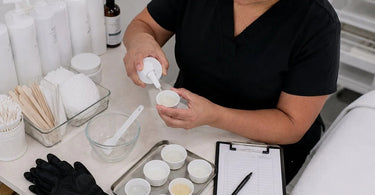
Achieve your goals faster... by turning your biggest training headaches into your biggest profit centers. Let's be honest, the moment you hire fresh talent, a mix of excitement and dread washes over you. You're thrilled to grow your team, but you can already see it: the new esthetician using half a bottle of your premium Massage Oil on a single client, or the budding waxer going through ItalWax like it's going out of style. Training days are essential, but they can also be a silent profit killer, turning your hard-earned inventory into a free-for-all. It's time to reclaim your back bar from the chaos of onboarding and turn those clumsy first days into lessons in efficiency, not extravagance.
This blog is your survival guide. We are going to dive deep into the specific strategies that keep your product costs in check while your new team members learn the ropes. We'll cover everything from smart organizational systems to fun, engaging training techniques that will have your staff respecting every last drop of Cuticle Oil and every gram of Hard Wax. So, take a deep breath, put down the spill kit, and let's get your training program and your back bar working in perfect harmony.
Understanding the 'Training Tax': Why Onboarding Costs So Much
Think of the first few weeks of a new hire's journey as an investment, but let's be real, it's an investment that can come with a hefty 'training tax.' This isn't about blaming the newbie; it's about acknowledging the natural learning curve. When someone is new, they lack the muscle memory and the 'feel' for products that a seasoned pro has. They pour too much, they pump twice when once is enough, and they may reach for the wrong product in a pinch, leading to contamination or waste.
Industry data suggests that spas can lose a significant amount of product to this kind of waste, with some salons wasting between 25% and 40% of the mixed product during training scenarios due to overmixing and lack of portion control . This doesn't just hurt your bottom line; it can also skew your inventory data. You start ordering based on usage that is artificially high, leading to overstocking and even more potential waste. It's a vicious cycle. But it doesn't have to be this way. By implementing a structured training plan and smart back bar organization, you can dramatically reduce this "training tax" and turn a cost center into a well-oiled machine.
The "Goldilocks" Method: Creating Portion Standards for Everything
One of the primary culprits of waste, especially during training, is the eyeball method. "Just pour enough" is a recipe for disaster. The key is to create 'Goldilocks' portion standards for every single service you offer. What is the 'just right' amount of Sugar Scrub for a back treatment? How many pumps of Biotone lotion are needed for a 60-minute massage?
Work with your senior staff to document these standards. Make it a collaborative and fun exercise! Take photos of the perfect dollop or the exact number of pumps. Post a "Portion Cheat Sheet" near the prep area. For liquids like shampoo or body wash, fit pumps on the bottles and teach the exact dose per service: short hair gets one pump, long hair gets two to three . This removes all guesswork for a trainee. Instead of focusing on how much to use, they can focus on the technique, knowing they are using the right amount. This small step can save you a fortune in wasted back bar product.
Color-Coding: The Visual Language of a Wasteless Back Bar
Imagine a world where a trainee doesn't have to read every tiny label to find a product. A world where they instinctively know which mask is for sensitive skin and which cleanser is for oily complexions. That world is created through color-coding. This is one of the most powerful tools in your arsenal to prevent waste and speed up training . It is the universal language of your treatment room.
You can categorize your products by skin type (Blue for dry, Green for oily, Pink for sensitive) or by function (Red for cleansers, Orange for exfoliants, Yellow for massage mediums). Use colored labels, tape, or even designated bins. For instance, all products for your hydrating facial could have a gold dot, while the products for your purifying facial have a black stripe. This makes kit assembly lightning-fast and virtually error-proof. When every bottle has a designated home and color, guesswork vanishes. A new esthetician can grab the correct product instantly, dramatically reducing the costly mistakes of grabbing the wrong thing and risking contamination or wasting product on the wrong skin type .
FIFO (First In, First Out): A Simple Rule That Saves Thousands
Out of sight, out of mind—this is the mantra of a wasteful back bar. Products get pushed to the back of the shelf and forgotten until they expire. This is where the FIFO rule comes in, and it is non-negotiable. FIFO stands for First In, First Out. When you receive a new shipment, move the older products to the front of the shelf and place the new products behind them .
This simple rotation ensures that you are always using the oldest product first, dramatically reducing the amount of product that expires and gets thrown away. It sounds obvious, but it is shocking how few salons do it consistently. Make it a habit. During training, make sure every new staff member understands this rule and why it exists. It's not just about being tidy; it's about respect for the inventory and the business's bottom line.
Invest in Waste-Fighting Tools: Dispensers, Spatulas, and More
Your tools are your first line of defense against over-pouring. An open bottle of massage cream is an open invitation for a heavy-handed rookie to glug out way too much. Fight back with smart dispensing equipment! Wall-mounted dispensers for hand sanitizer and soaps are great for common areas, but for your back bar, you need precision .
Use pump bottles for your main lubricants and lotions. A single pump can be your standard unit of measure. For waxing, ensure you have plenty of Professional Wax Spatulas and Applicators on hand. These are crucial for training a new waxer on the "less is more" principle. A thin, even application is what you're after, not a thick glob of wax that removes layers of skin or wastes product. Also, ensure your wax warmers have proper temperature control to prevent burning and degrading the wax, which often leads to the whole pot being tossed .
Make It a Game: Engaging Staff in the Fight Against Waste
Finally, and most importantly, don't make waste prevention a chore. If you present it as a lecture, you'll lose them. Instead, make it a fun, engaging, and collaborative challenge. Think of your back bar like a fancy cocktail bar. A top bartender doesn't free-pour the 25-year-old Scotch; they use a jigger. Why? Because precision ensures consistency, maximizes yield, and respects the value of the product .
Start a "Waste Watch" challenge. At the end of each week, review a log where staff note any significant product waste and the reason. "Spilled bottle of nail treatment due to loose cap," or "Over-poured soft wax for a full leg, estimated 2oz extra." This isn't about blame, but awareness. You'll quickly spot patterns . Is a certain product consistently overused? Is a specific service a waste hotspot? Celebrate the wins! If your team reduces product waste by 10% in a month, throw a pizza party or buy them a new Towel Steamer for the breakroom. When your team sees the direct impact of their efforts, they will become your most passionate defenders of the back bar. And that, my friends, is how you prevent training days from wasting product and start building a more profitable, sustainable business.
)