
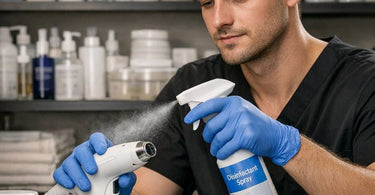
Your next profit boost starts here...and honestly, it starts with a clean laser handpiece. Let's be real for a second: no client ever walked out of a laser hair removal session raving about how much fun it was, but they will absolutely walk out (and tell their friends on Yelp) if they suspect your equipment isn't squeaky clean. In the world of professional laser services, proper sanitization isn't just a 'nice-to-have' or a suggestion from the back of the manual; it is the invisible shield that protects your reputation, your clients' safety, and the lifespan of that very expensive piece of tech you invested in. We know you love your lasers, and we love that you love them, so lets dive into the sudsy (but mostly chemical) details of keeping those handpieces pristine without accidentally breaking the bank or the machine.
First things first, take a deep breath. Cleaning a professional laser handpiece can sound like rocket science if you listen to the rumors. But we are going to turn that panic into pure, organized power. The goal here is to eliminate every last microbe and bit of gunk from previous treatments without damaging the delicate optics inside. Because unlike that stubborn coffee mug stain in the breakroom, these handpieces require a little more finesse than just a scrub daddy and some elbow grease. The golden rule, echoed by manufacturers like Biolase and others, is that cleaning must happen within one hour of the procedure . Letting bioburden dry on the handpiece is like letting cement harden on a trowel, it is a nightmare to get off and compromises the sterilization later on.
Step 1: The Pre-Clean (Dont Get Lazy Here!)
Before you even think about the autoclave or high-level disinfectants, you have to do the 'pre-clean.' This is the manual removal of all the gross stuff. Think of it as taking a shower before you go for a swim in a chlorinated pool; you wouldn't just hop in without rinsing off, right? The same logic applies here. Start by disconnecting the handpiece from the fiber optic cable, but leave the tip on for now . Whatever you do, do not just spray liquid directly onto the whole handpiece like you are watering a plant. Liquids love to sneak inside those tiny crevices and absolutely destroy the internal optical components, and fixing those costs as much as a nice used car .
Use a soft-bristled brush (not the one you use to clean your exfoliating mitts, get a dedicated one) dipped in a neutral pH enzymatic cleaning solution. We are talking about a surgical-grade detergent, not the dish soap from the back sink. Gently but thoroughly wipe down the exterior, paying special attention to the tip ferrule and any textured areas where skin cells and gel residue love to hide . Rinse it under lukewarm running water for about 10 seconds. Not hot water, hot water can cook the proteins onto the surface, and not cold water, as cold can coagulate fats. Lukewarm is your best friend here. After rinsing, pat it dry with a lint-free cloth, because regular terry cloth towels leave fibers behind, and those fibers can burn when hit by a laser beam, causing focal spot contamination. Gross, right?
Step 2: The Deep Disinfectant Soak
Now that the handpiece looks clean to the naked eye, we have to make it clean on a microscopic level. Depending on your device's classification (non-critical, semi-critical, or critical), you will need either an intermediate-level or high-level disinfectant. For items that touch intact skin but not mucous membranes, an EPA-registered hospital-grade disinfectant is usually sufficient. However, if that handpiece tip ever comes into contact with broken skin or bodily fluids (hey, it happens during some treatments), you need to step up your game to a high-level disinfectant like PREempt CS20 or a similar product that kills everything from Hepatitis to HIV .
Always check your specific laser manufacturer's guidelines because using the wrong chemical can void your warranty faster than you can say 'laser induced damage.' Many facilities use a pre-soaked wipe or a chemical bath. If you are using a soak, ensure the solution is mixed fresh daily because old disinfectant is just expensive, smelly water . Let the handpiece sit for the recommended 'contact time.' This is crucial; do not dunk it and pull it out five seconds later because you are in a rush for your lunch break. Most disinfectants need a solid 10 to 20 minutes of wet contact time to actually kill the spores and viruses . During this time, go update your Instagram, check your waxing supplies inventory, or refill the towel steamer. Use the downtime wisely.
Step 3: Autoclave Sterilization (The Final Boss)
For reusable tips and handpiece components that are designed to withstand high heat, an autoclave is the gold standard. This is the big step that actually sterilizes, not just disinfects. Sterilization means killing every single living microorganism, including bacterial spores. But here is where the 'oops' moments happen. First, remove any protective caps or plugs from the handpiece ports so that steam can actually reach the internal channels . If you leave the plugs in, you are just steaming the outside, which is like showering with a raincoat on; it just doesn't work.
Wrap the handpiece in a sterilization pouch (the kind with the internal and external indicators so you know the steam got inside). Place it in the autoclave. For most dynamic-air-removal (pre-vacuum) sterilizers, you are looking at a temperature of 132°C (270°F) for about 4 minutes, or 134°C (273°F) for 3 minutes . Do not stack other heavy instruments on top of the pouch; you want the steam to circulate freely, not compress the pouch into a plastic pancake. After the cycle, allow the pouch to dry inside the chamber for 20-30 minutes. If you pull it out wet, the moisture wicks bacteria from the air right back into the package through the paper backing, completely defeating the purpose of your hard work.
One huge word of caution: check the manufacturer's specs on how many times you can autoclave your specific tips. Some can handle up to 100 cycles, while others, like whitening accessories or certain disposable tips, cannot be autoclaved at all . Autoclaving a non-autoclavable tip is a great way to melt it into a tiny, expensive blob of sadness. If the instruction manual says 'single-use,' throw it away in a sharps container. Do not try to 'save money' by reusing disposables. That is how you get complaints, infections, and lawsuits, and we are pretty sure fighting a lawsuit is way more expensive than buying new tips.
The 'Sapphire Window' Situation
If you are using a diode laser (often used for hair removal), you are dealing with a sapphire contact cooling window. This little piece of crystal is what keeps your client from screaming during their Brazilian laser session. It needs to be cleaned before every single patient, but you cannot treat it like a dirty frying pan. Use 70% isopropyl alcohol and a lint-free, non-abrasive wipe . Never use acetone, bleach, or an ultrasonic cleaner. Those chemicals will strip the anti-reflective coating off the sapphire, leaving it hazy. A hazy sapphire window is a disaster; it reduces the laser's fluence (power) by up to 40% and creates painful 'hot spots' that can burn the client. A quick gentle wipe between clients keeps them comfortable and the machine effective.
Storing Your Sanitized Tools
Congratulations, your handpiece is now cleaner than a surgeon's conscience. But if you throw it into a dusty drawer or leave it on the counter next to where you mix hair color, you might as well not have cleaned it at all. Store the sterilized handpiece in its sealed pouch in a clean, dry, closed cabinet until the next use . Keep it away from chemical fumes, excessive humidity, and sticky fingers. Also, protect the fiber optic cable; do not bend it at sharp angles or step on it with your professional spa clogs. A damaged cable means the laser energy doesn't transmit properly, leading to inconsistent results and frustrated clients.
Don't Forget the Extras (The Non-Laser Stuff)
While you are in sanitation mode, do not forget the rest of the room. Hygiene is a holistic experience. The magnifying lamp arm, the treatment bed switches, and the door handles all need a wipe down . Your clients notice if the room smells like bleach but looks dusty. Make sure you are using fresh linens and table paper for every single body. And for the love of all that is holy, change your gloves between cleaning the machine and touching a new client. Cross-contamination is the silent killer of spa reputations.
Pure Spa Direct Has Your Back (And Your Cleaning Supplies)
Look, we know you didn't get into the beauty industry because you love reading Material Safety Data Sheets or scrubbing tiny metal tips. You got into it to make people feel beautiful and confident. But the reality of running a successful spa or salon is that the boring stuff, the cleaning, the restocking, the compliance, is what allows the magic to happen. When you need high-quality disinfectants, reliable gloves, lint-free wipes, and of course, top-of-the-line laser equipment and accessories, Pure Spa Direct is your distributor. We are the ones loading the truck so you dont have to run around town looking for that specific enzymatic spray.
We carry the brands you trust and the safety gear you need to pass those surprise health inspections with flying colors. So, take a deep breath, set a timer for that contact time, and know that you are providing a safe, professional environment that keeps clients coming back. Because a clean laser is a happy laser, and a happy laser means a happy bottom line. Now go forth and sanitize like the boss you are!
)