
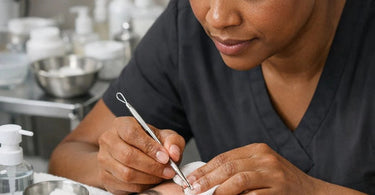
Quality matters - here’s why you can’t just grab any metal stick and go digging for treasure in your client’s pores. Professional comedone extractors are the unsung heroes of the facial room, yet they get treated like the rusty paperclip you found in the junk drawer. It hurts our souls. We see you, talented esthetician, hovering over a client’s nose with a tool that looks like it survived the Civil War, and we have to intervene. Before you assault another pore, let’s talk about how to wield this magnificent metal loop like the skincare wizard you claim to be. We promise, by the end of this, you will not only be extracting blackheads like a boss, but you will also understand why your state board inspector deserves a box of chocolates instead of a migraine.
Listen, we get it. You are busy. Your Advanced Facial Treatment schedule is packed, your Facial Steamer is billowing away, and Mrs. Patterson in room one has a T-zone that looks like a strawberry poppy seed muffin. The temptation to just squeeze with your fingers is real, but that’s how lawsuits happen. That is also how broken capillaries and scarring happen, and frankly, nobody looks good with a fingerprint bruise on their forehead. So, take a deep breath, put down the unsterilized bobby pin, and let’s get professional. We are Pure Spa Direct, your friendly neighborhood distributors of sanity-saving Spa Tools & Implements for Professionals, and we are about to drop some knowledge that will make your clients weep with joy (and clear pores).
What Even Is a Comedone and Why Is It Ruining Lives?
Let’s start with the basics so we are all on the same page. A comedone (pronounced com-ee-dough-knee, not com-a-dome, you heathen) is basically a fancy word for a clogged hair follicle. You’ve got two main types: the blackhead (open comedone) and the whitehead (closed comedone) . The blackhead gets its dark color from oxidation, not dirt. I know, shocking. You can scrub a nose until it turns red, but that blackhead is laughing at you because it’s just sebum and dead skin cells reacting with the air. The whitehead is the same situation, but a thin layer of skin has grown over the top, trapping the gunk inside like a tiny, beige time capsule of horror.
As a professional, your job is not to wage war on these little bumps with your fingernails. Your job is to be a surgical strike artist. Using a proper comedone extractor allows you to apply even, controlled pressure around the lesion without turning the surrounding tissue into ground beef. It is the difference between using a scalpel and a butter knife. One is elegant; the other just makes a mess. We stock Premium Skincare Products for Spas and Salons to complement your extraction skills, but the tool itself is the star of this show.
Before You Touch That Face: Prep Work is Not Optional
Alright, Rambo, put the extractor down. You don’t just walk into battle without stretching first, do you? (If you do, please stop. Your hamstrings will thank me). Prepping the skin is 90% of the success. Trying to extract a dry, cold blackhead is like trying to dig a fossil out of concrete. You will hurt the client, you will hurt the skin, and you will look like an amateur.
Step one is to soften the skin and open those pores. This is where your Facial Steamer earns its counter space. A good 5-10 minutes of gentle steam will turn that concrete into warm butter. No steamer? No problem. You can use a warm, damp towel held against the area. While that’s happening, cleanse the skin thoroughly. You want a clean canvas. We recommend a gentle enzyme exfoliant or a Hydrodermabrasion treatment to loosen the top layer of dead cells so that little comedone has nowhere to hide.
Do not skip this. I will know if you skip this. I will haunt your dreams with images of dry, flaky skin tearing under your extractor. Be better than that. Use your Vacuum and Spray Machines to clear the surface debris first. Clean skin is happy skin. Happy skin tips well.
The Main Event: How to Use That Little Metal Loop of Justice
Here we are. The moment you have been waiting for. You have your sterile, beautiful comedone extractor (more on how we got it sterile in a minute), your client is relaxed, and that blackhead is practically waving a white flag. Let’s do this.
Step 1: Choose Your Weapon
Most professional extractors have two ends: a small loop and a large loop. The large loop is for those juicy, open comedones (blackheads). It surrounds the plug and distributes pressure evenly. The small loop is for the closed comedones (whiteheads) or very small pinpoint lesions . Do not use the large loop on a tiny whitehead; you’ll just mash the surrounding skin. That’s not extraction; that’s assault.
Step 2: Positioning is Key
Hold the extractor like a pencil, not like a caveman holding a club. You want control, not power. Center the chosen loop directly over the comedone. The lesion should be sitting right in the middle of the hole. If you are off-center, you are just going to dig a trench into healthy skin. Dr. Pimple Popper herself would frown upon this.
Step 3: The Pressure (Gentle, You Animal)
Here is where the magic happens. Press down evenly and firmly, but do not go bananas. You are not trying to touch the back of their skull. Press straight down, then roll or drag the loop slightly to the side to lift the contents out . If it doesn’t come out on the first gentle press, do not keep squeezing harder. That means either the skin isn’t prepped enough, or it’s not ready to come out. If it doesn't come out easily, stop. Forcing it will cause trauma, scabbing, and a very angry client. As the experts say, know when to POP and know when to STOP . For those stubborn whiteheads, you may need to use a sterile lancet to create a tiny opening first . Yes, a Dermaplaning blade also works wonders for removing the vellus hair and dead skin barrier before extractions.
Step 4: Clean as You Go
After each extraction, wipe the debris off your tool onto a gauze pad. Do not fling it across the room. Do not wipe it on your apron. Do not lick it clean (I shouldn’t have to say that, but here we are). Keep a clean cotton square or sponge handy to wipe the area and the tool.
The Scary Part: Sanitation (Or, Why You Still Have a License)
Alright, I’m putting my foot down. If you are using a professional comedone extractor without reading this section, you are a menace to society. We need to talk about the "S" word: Sterilization. Not just "I sprayed it with alcohol" cleaning. Real, honest-to-goodness, state-board-approved sterilization .
Did you know that in states like Indiana and Iowa, comedone extractors are legally required to be sterilized prior to use on a customer ? Texas requires it . This isn’t a suggestion to sell more autoclaves. It is the law. A comedone extractor touches bodily fluids. If you break the skin even microscopically, you are looking at potential cross-contamination. Hepatitis and staph infections do not care how cute your Instagram filter is.
Here is your new ritual. Say it with me:
- Pre-Clean: Immediately after use, scrub that tool with warm water and a low-residue detergent to remove the organic gunk .
- The Bubble Bath: Wash it thoroughly. Rinse it until it squeaks.
- Disinfect/Sterilize: Depending on your state board, you need either an EPA-registered, bactericidal, virucidal, and fungicidal disinfectant (soak for the full contact time) OR a UV Sterilizer, dry heat sterilizer, or steam autoclave . In Indiana, they specify a dry heat sterilizer for two hours at 340 degrees Fahrenheit . Two. Hours. Do not short the time.
- Rinse and Dry: If using chemicals, rinse with sterile water or alcohol. Air-dry completely. Wet tools are bacteria hotels .
Putting a dirty tool in a drawer is a war crime. Hygienic Table Paper is for tables, not for wrapping dirty tools. Store your clean, dry extractors in a sealed, clean container. Invest in a good Professional Cleaner and Disinfectant. Your future self, and your clients’ faces, will thank you.
Why You Need a Quality Tool (Not That Cheap Amazon Junk)
Have you ever bought a cheap extractor online, and the first time you used it, the metal bent? Or worse, the edges were so sharp they cut the client’s skin? That is because cheap tools are made by people who hate estheticians. High-quality stainless steel is non-porous, resists rust, and maintains its shape under pressure . It also cleans up like a dream. Brands we trust, like Spa Masters and Prosana, ensure that your tools are an extension of your professional hands, not a hazardous weapon.
Think of your comedone extractor as an investment in your reputation. Using a flimsy tool tells your client you cut corners. Using a heavy, well-balanced, surgical-grade steel tool tells them you are an artist who respects their skin. We don’t sell junk. We sell the good stuff. We also sell the stuff to clean the good stuff, like Mixing Bowls for your disinfectant and Protective Gloves & Masks to keep your own hands safe from the chemicals.
After the Pop: Post-Extraction Care is Crucial
Congratulations! You have successfully evicted the tenants from the pores. Now what? You can’t just send them out the door with a red, angry nose. You have to soothe the battlefield. Apply an antiseptic or astringent to the area to kill any lingering bacteria . Follow up with a calming, anti-inflammatory serum or mask. A little High Frequency Machine action over the area will zap any remaining bacteria and speed up healing. Trust me, it’s like magic.
Instruct your client not to touch their face. Seriously. Tell them to put their hands in their pockets. They just paid you good money to clean out their pores; they shouldn’t go home and rub their dirty phone screen all over it. Recommend a gentle, non-comedogenic moisturizer. If you have retail products like Tuel Skincare, now is the time to upsell. “This will help keep those pores clear between visits, Karen.” (Be nice about it, though. Karen tips well if you don’t judge her nose).
Tools of the Trade: Expanding Your Extraction Arsenal
While the manual comedone extractor is a staple, sometimes you need to call in the big guns. Have you ever used a Vacuum and Spray Machine? These little gadgets are like a miniature vacuum cleaner for the pores . They use suction to draw impurities out of the follicles. It is deeply satisfying for you, generally painless for the client, and incredibly efficient for oily skin types. Usually, you would use the vacuum after a Desincrustation solution to really liquefy that sebum, and then go in with the manual extractor for the stubborn little suckers that refuse to leave .
We also love pairing extraction with a good Ultrasonic Skin Scrubber. These use high-frequency vibrations to liquefy debris and make extractions 1,000 times easier. It’s like using a jackhammer versus a pickaxe. Why are you still using a pickaxe? Come on. Upgrade your life. We have all the Top-Quality Equipment & Furniture to make your extraction game unbeatable.
Common Mistakes That Make Me Want to Throw a Towel at You
Let’s play a game called “Don’t Do That.”
- Mistake #1: Using too much pressure. If the skin is blanching white, you are cutting off circulation and about to cause a bruise. Ease up, Hercules.
- Mistake #2: Using the wrong angle. Poking straight down into the pore with the edge of the loop. You are not stabbing a vampire. You are coaxing out sebum. Angle the tool so the skin is stretched slightly.
- Mistake #3: Not using gloves. Ew. Seriously. Ew. Get some gloves. Your fingernails harbor more bacteria than a public toilet seat. Don’t touch the freshly opened pore with those grubby fingers.
- Mistake #4: Extracting acne. If it is red, angry, and pustular, DO NOT EXTRACT IT. That is inflammatory acne, and squeezing it will spread the infection and cause scarring. Stick to non-inflamed comedones. Send the acne clients to a dermatologist or use your Light Therapy Devices to kill the bacteria instead.
Conclusion: Go Forth and Extract (Safely)
Look, we love a good satisfying extraction video as much as the next person. There is something deeply, primally satisfying about watching that little plug of oil and dead skin pop out of a pore. But we love happy, healthy clients and repeat business even more. Using a professional comedone extractor correctly is the hallmark of a skilled esthetician. It requires patience, technique, and a borderline obsessive commitment to sanitation.
Don’t be the salon that gives everyone a staph infection because you thought soaking a tool in water was “good enough.” Be the expert. Invest in the right tools. Clean them like your career depends on it (because it does). And for the love of all that is holy, use a little steam first. Your clients will leave looking like a glazed donut (in a good way, smooth and shiny), and they will book their next appointment before they even get to the front desk.
Ready to upgrade your kit? We have everything you need. From ItalWax for your waxing services to High-Quality Towels for cleanup and Complete Waxing Kits, we are your one-stop shop for Must-Have Supplies for Salon & Spa Business Success. Now, go make some pores cry for mercy. You’ve got this.
