
Unlock your business's potential by mastering the art of safe stretching for hypermobile clients. We all love a client who walks in feeling as flexible as a gymnast, but as spa and massage professionals, we know that bendiness isn't always a blessing. In fact, stretching a hypermobile client the wrong way is like adding gas to a fire—it might feel good for a second, but boom, you have an instability explosion on your hands. That's why we at Pure Spa Direct are here to help you swap the old-school 'no pain, no gain' mentality for a smarter, safer, and frankly, more effective approach to bodywork.
Let's be real: we've all had that moment where a client shows off their ability to fold into a pretzel, and our initial instinct is to think, 'Wow, that's impressive.' But as experts, we know that joint hypermobility often comes with a secret sidekick: chronic pain, fatigue, and a feeling of being 'loose' rather than limber. If you use traditional passive stretching on these folks, you aren't helping them; you are confirming their worst fear—that their body is a wobbly mess. So, grab your favorite massage lotion, settle into your Portable Massage Table, and let's turn that instability into pure, unshakable strength.
Understanding the Hypermobile Paradox: Why 'Tight' Doesn't Mean 'Short'
First things first, we need to diagnose the problem before we prescribe a solution. Hypermobility is a bit of a trickster. While the joints are super loose, the muscles surrounding them are often screaming in a state of constant tension. Why? Because the ligaments and tendons (the passive structures) are too lax to hold the skeleton together, so the muscles go into permanent guard dog mode—clenching tight to prevent the joints from sliding off the rails .
This is what I call the 'tight but wobbly' paradox. When a hypermobile client says, 'My back is so stiff,' they aren't necessarily lacking flexibility. They are likely suffering from muscle fatigue due to overwork. If you grab that tight muscle and yank it into a deep stretch, you are essentially yelling at the security guard (the muscle) to stand down, leaving the bank vault (the joint) completely unprotected. As research suggests, overstretching can tear or weaken tissue, turning that muscle into an 'overused rubber band' . We don't want rubber bands; we want strong, resilient cables.
The Golden Rule: Active Over Passive (Ditch the 'Hold and Hope')
Alright, let's get into the nitty-gritty of how we actually do this on the table. The absolute golden rule for hypermobile clients is to ditch the passive 'hold and hope' stretching. You know the one—where you lift their leg, hold it at end-range, and tell them to relax. For a hypermobile client, this is a one-way ticket to Dislocation-ville.
Instead, we use active stretching, sometimes called 'engaged elongation.' Think of it like a cat waking up from a nap. A cat doesn't just hang limp; it contracts its muscles as it arches its back and extends its claws . We want that same principle. You want the client to use their own muscle strength to move into the stretch while you provide resistance or guidance. This sends a powerful signal to the nervous system: 'We are moving into this space because we choose to, not because we are falling apart.' This technique builds proprioception (body awareness) and teaches the brain to trust the joint's new position.
Isometric Stretching: Your Secret Weapon for Stability
If active stretching is the rule, isometric stretching is the magic wand. Isometrics involve contracting a muscle without changing its length. Why does this work wonders for hypermobility? Because it builds strength inside the stretch. It tells the nervous system, 'We are strong here, we are safe here.'
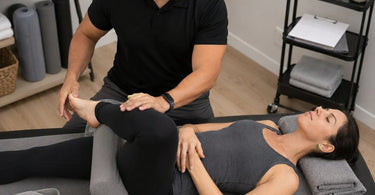
For example, if a client has hypermobile hamstrings (they can bend way past 90 degrees), do not push the leg higher. Keep the range short—mid-range where the joint is safest. Ask them to gently push their heel down into your hand (which is supporting the leg) while you resist the movement. That isometric contraction fires up the stabilizer muscles. It creates what I like to call an 'internal hug' for the joint . Instead of relying on wobbly ligaments, they are using their own muscle power to lock the joint in place. Pair this with the comfort of a Massage Table Warmer to keep those tight muscles relaxed while they work on stability.
The 'Don't Go There' Rule: Respecting the End Range
As professionals, we are often trained to take a joint to its 'end feel.' For most people, that end feel is a hard stop. For the hypermobile client, there is no stop. Their end range is often beyond where their joint should physiologically be. This is dangerous territory.
You must teach your clients (and remind yourself) that flexibility is not a competition. Just because they can touch their forearm to their bicep doesn't mean they should. In your treatment room, you need to be the voice of reason. Use tactile cues like a rolled towel to block the joint from moving past 90% of its safe range. When performing joint mobilizations, stay away from the end range where micro-tearing usually occurs . The goal isn't to see how far they can go; it's to see how well they can control the range they already have.
Reading the Room: Pain vs. 'The Stretch'
Here is where we need to get honest with our clients. Because their pain receptors are often a little... delayed. A hypermobile client might feel no pain during a stretch (because their tissues are stretchy), but they will feel significant pain and inflammation 24 to 48 hours later. This is the dreaded 'flare-up.'
When working on these clients, use their feedback carefully. Don't rely on 'Does this hurt?' because the answer is usually 'No' until it's too late. Rely on visual cues. Are they holding their breath? Is their jaw clenched? Are they gripping the sides of the Massage Table? If yes, you have pushed too far. Back off. We want a yawn, not a wince. We want a release of tension, not a gripping spasm.
Equipment That Helps (Not Hinders) the Process
To perform these safe stretching techniques, you need the right tools. You don't need a fancy rehab gym; you need smart accessories that provide support without forcing the joint open. Here are a few of my favorite things to keep in the treatment room:
- Massage Bolsters: These are gold. Use bolsters under the knees to take the tension off the lower back in supine positions, or behind the neck to prevent cervical hyperextension. They provide passive support so the muscles can stop guarding and start relaxing.
- Resistance Bands: While we often use our hands, bands are excellent for active stretching. They provide tension that invites the client to pull against them, reinforcing that 'internal hug' we talked about .
- Cupping Therapy: Cupping can be a fantastic adjunct because it lifts the superficial fascia without mechanically yanking on the joint capsule. It helps relieve that 'tight skin' feeling many hypermobile clients experience without compromising the ligamentous stability.
Putting It All Together: A Sample Routine for Legs
Let's walk through a practical example. You have a client with generalized joint hypermobility who complains of 'tight hips.' Don't grab the leg for a passive Figure-4 stretch! Here is the Pure Spa Direct safe protocol:
Step 1: The Setup
Ensure the client is warm. Use a Towel Steamer to apply a warm compress to the hip flexors and quads. Cold muscles on hypermobile joints are a recipe for tears.
Step 2: Isometric Hip Holds
Place the client supine. Put one hand on their thigh. Ask them to gently press their knee up into your hand (hip flexion). Hold for 5 seconds, relax. Repeat 5 times. This 'wakes up' the deep hip stabilizers.
Step 3: Active Hamstring Release
Instead of pushing the straight leg raise, ask the client to lift their own leg. As they fatigue, offer gentle assistance, not resistance. If they feel a 'nervous system jitter' (shaking), that is good! That is the muscle learning to control the load. Stop if the shaking turns into clunking or pain.
Step 4: Soothe and Support
Finish with broad, slow effleurage strokes using a high-quality massage cream like Biotone to calm the nervous system. Do not dig in with elbows. We want to signal safety to the parasympathetic nervous system, not provoke a guarding response.
When to Say 'No' (And Offer Something Better)
Lastly, we need to talk about contraindications. As much as we want to help everyone, there are times when traditional stretching (and even deep tissue work) is an absolute no-go. Clients with Ehlers-Danlos Syndrome (EDS) or severe Marfan Syndrome have significantly different collagen structures. For them, a stretch that feels like a '2' out of 10 to a normal person is actually tearing tissue.
If a client has these conditions, put the stretching on hold entirely. Focus instead on muscle stimulation or very gentle, rhythmic rocking to release tension without lengthening the joint capsule. As one source notes, if a hypermobile client has a true range of motion deficit (which is rare), it is likely due to muscle tone, not a short muscle belly . Don't chase the end range.
Serving the hypermobile population isn't about being a hero who 'fixes' their looseness. It is about being the trusted professional who says, 'Stop. You are flexible enough. Let's work on strength.' When you shift the focus from flexibility to stability, you shift your client from a cycle of pain and injury to a lifetime of resilient, joyful movement. Now go grab those gloves, warm up that table, and show your clients what true body awareness looks like. You've got this!
