
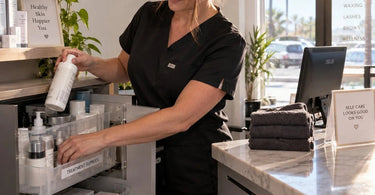
Clients notice this quality every visit. They might not say it out loud, but they feel it when the wax goes on smooth instead of snagging, when the lash adhesive holds without a single stubborn fan, and when the massage oil glides like silk instead of turning into some weird, separated science experiment. Your products are the silent stars of every service you offer. And here is the thing nobody tells you during a heat wave: extreme heat does not just make your treatment room feel like a sauna. It actively ruins your inventory. Wax beads fuse into one giant, unusable brick. Gel polish turns stringy. Lash adhesive cures before you can even pick up a fan. Massage oil goes rancid faster than a carton of milk left on a dashboard. If you have ever opened a fresh bag of ItalWax beads only to find they have become a solid lump of sadness, you know the pain. So let us talk about how to store professional supplies during extreme heat without losing your mind, your money, or your cool.
This is not about being fussy. It is about protecting the investment you made in your business. A salon or spa runs on tight margins, and every product that goes bad because it sat in a hot car or a stuffy back room is money straight out of your pocket. The good news is that a little strategy goes a long way. You do not need a walk-in cooler or a climate-controlled vault. You need to understand what heat does to different types of products and then make a few smart, simple changes to where and how you store them.
Why Extreme Heat Is the Enemy of Professional Beauty Supplies
Let us get one thing straight: products do not just "get a little warm" and then go back to normal. Heat causes chemical reactions. It breaks down preservatives, alters viscosity, and accelerates oxidation. For products that are supposed to have a stable shelf life, extreme heat is like throwing a wrench into a finely tuned machine.
According to industry guidance, the ideal storage range for most professional beauty products is between 15 degrees Celsius and 25 degrees Celsius, which is roughly 60 to 77 degrees Fahrenheit . When temperatures climb above that, things start to go sideways. Wax softens and re-solidifies into clumps. Adhesives cure prematurely or lose their bonding strength. Oils oxidize and turn rancid. Gel polishes thicken or separate. Aerosol cans build up pressure and become genuine safety hazards .
The problem is that many salons and spas do not have dedicated climate-controlled storage. You might be using a back closet, a garage, a shed, or a corner of the break room. Those spaces can easily hit 90 degrees or higher during a summer heat wave. And if you are a mobile professional, your car becomes a rolling oven that can destroy your entire kit before you even reach your first client .
Wax: The Goldilocks of Salon Products
If there is one product that throws a tantrum in the heat, it is wax. Whether you work with soft strip wax or stripless hard wax, the rules are the same. Wax beads and blocks are designed to melt at specific temperatures, which means they are inherently sensitive to warmth.
When wax gets warm and then cools down, it does not just go back to being perfect little beads. It fuses together. The technical term is temperature fluctuation, but the practical result is a clump that requires a chisel to break apart . If humidity is also high, the wax can absorb moisture and become sticky and unusable. This is not just annoying. It affects application, which affects client comfort, which affects whether that client comes back.
So what is the solution? First, find the coolest, driest, darkest spot you can. A climate-controlled stockroom is ideal, but if you do not have one, a closed cabinet away from windows and heat sources is your next best bet. Keep the temperature between 60 and 75 degrees Fahrenheit if possible . Second, store your wax in sealed, airtight containers. The original packaging is fine as long as it is sealed properly. Third, if you are a mobile waxer, invest in a cooler bag. A simple insulated bag with a cool pack (wrapped in a towel, not placed directly against the wax) can keep your beads stable during transport .
And if your wax has already clumped? Do not panic. You can freeze the sealed bag for a couple of hours, then drop it on a hard floor to break the clump apart. The cold makes the wax brittle and easier to separate . It is not ideal, but it beats throwing away a hundred dollars worth of product.
Nail Products: Gels, Polish, and the Acetone Problem
Nail technicians, this section is for you. Your products are some of the most heat-sensitive items in the entire salon. Gel polish, builder gel, base coats, and top coats are formulated to perform within a specific temperature range, usually around 18 to 22 degrees Celsius . When it gets hotter, the consistency changes. Gels become more fluid, which means they flood the nail and the skin. That increases the risk of overexposure and allergic reactions. Liquid and powder monomer polymerizes faster, making it harder to control. The product can set before you are ready, leading to uneven results and lifting .
Storage is your first line of defense. Keep your Professional Gel Polish and acrylic nail supplies in a cool, dark drawer or cabinet. Away from windows. Away from your UV and LED curing lamps. Away from any heat source. The bottles should be stored upright, tightly closed, and wiped clean around the neck after each use . If gel has become stringy, unusually thick, grainy, or separated, do not use it on a client. It is compromised.
Then there is the acetone and monomer situation. These are flammable liquids. Acetone, nail polish remover, alcohol-based cleansers, and spray disinfectants produce flammable vapors. In high heat, those vapors build up faster, and the risk of fire or explosion increases . The rule from safety professionals is clear: store flammable liquids in suitable fire-resistant cabinets or bins, away from work areas and ignition sources. Keep only the working quantity at your nail desk. Bulk quantities should be stored properly .
If you are a mobile nail tech, this is even more critical. Do not leave your kit in the car. Do not store products near car windows. Use a cool bag with a cool block wrapped in a towel. Let your products stabilize at room temperature before you start working .
Lash Adhesive: The Diva of the Beauty World
Lash adhesive is a special kind of high-maintenance. It is sensitive to temperature, humidity, and light. In extreme heat, the consistency thins, the drying time accelerates, and the ingredients separate more easily. You pick up less glue on the lash than you think, which leads to poor retention. Your client comes back in a week with a mess of fan-less lashes, and you have to explain that the heat is the culprit .
Proper storage is non-negotiable. Store your adhesive in a cool, dark place where the temperature does not fluctuate. An airtight container with silica gel packets is a smart investment. It controls humidity and keeps the adhesive stable . Unopened adhesive can be stored in a fridge between 2 and 10 degrees Celsius, but once it is opened, it should be kept in that airtight container at room temperature . Do not store adhesive with other products that contain alcohol, as the fumes can affect the glue quality .
If you are struggling with retention in the summer, consider switching to a slower adhesive. The heat will make it dry faster anyway, so a slower formula gives you a bit more working time . And always, always shake your adhesive vigorously before use. The heat makes the ingredients harder to mix, and if you skip the shake, the second half of the bottle will be useless .
Massage Oils, Lotions, and Skincare: When Good Products Go Bad
Massage therapists and estheticians, your products are not immune to the heat either. Oils, lotions, creams, and serums are susceptible to oxidation and degradation when exposed to high temperatures. Temperature is one of the most critical factors affecting shelf life. Prolonged exposure to extreme heat can ruin a product and subvert its expected lifespan .
Light also plays a role. Too much light can reduce shelf life, especially for products containing essential oils. Citrus oils, in particular, oxidize quickly and can become skin sensitizing if they go off . This is why storing your massage oils, lotions, and creams in a cool, dark place is essential. A closed cabinet in a climate-controlled room is ideal. If you do not have that, at least keep them away from windows and direct sunlight.
Your premium skincare products are particularly vulnerable. Vitamin C, retinoids, acids, and antioxidant serums are heat-sensitive. Heat and light can destabilize them, making them less effective or even irritating to the skin . Follow the manufacturer's storage instructions. If they say store below 30 degrees Celsius, take that seriously. A small thermometer in your stock area is a cheap and easy way to monitor conditions .
Hair Color, Bleach, and Peroxide: The Hidden Dangers
Colorists, your products have their own set of rules. Professional hair color and hair bleaches and lighteners are generally stable when stored properly, but heat can cause problems. Developer can expand. Peroxide can degrade. Powdered bleach can become unstable .
If you are storing leftover color next to a towel steamer or on a shelf above a hot styling tool, you are asking for trouble. Heat from styling tools and steamers can activate ingredients before you are ready to use them, or worse, cause containers to rupture . Store your color and bleach in a dedicated cabinet away from windows, hot tools, and steamers. Keep containers tightly closed. Never store any tint, lightener, or bleach powder after it has been mixed with developer. The container may rupture .
Aerosol Cans: The Pressurized Problem
Let us talk about the cans that can turn into projectiles. Aerosol products like hairspray, dry shampoo, spray tan solution, and some cleaning supplies are pressurized. When the temperature rises, the gas inside expands, and the pressure builds. If it gets too high, the can can rupture, leak, or even explode .
Manufacturers typically warn against storing aerosol cans at temperatures exceeding 120 degrees Fahrenheit. The inside of a parked car on a 90-degree day can hit that in ten minutes and climb to over 140 degrees . Your salon's storage room, especially if it lacks air conditioning, can also become a pressure cooker.
Store aerosol cans in a cool, dry place, out of direct sunlight, away from heat sources like towel steamers and facial steamers. Keep them away from ignition sources. And never, ever leave them in a parked car .
Creating a Heat-Proof Storage Strategy for Your Salon or Spa
Okay, so we know what goes wrong. How do we fix it? Here is a practical action plan for keeping your supplies safe during extreme heat.
First, do a heat audit. Walk through your salon or spa and identify the hot spots. Where does the afternoon sun hit? Which closets or back rooms get stuffy? Where are your heat-generating equipment like professional wax warmers, towel steamers, and blow dryers? Anything stored near those spots is at risk .
Second, relocate your sensitive products. Move wax, adhesives, gel polish, massage oils, and skincare to the coolest, darkest place you have. A closed cabinet in an air-conditioned room is ideal. If you do not have air conditioning, at least choose a spot away from windows and equipment that generates heat.
Third, invest in a few simple tools. A small room thermometer will tell you exactly how hot your storage area gets. An airtight container with silica gel packets will protect your lash adhesive and other moisture-sensitive products. A cooler bag with a cool pack will keep your mobile kit stable during transport .
Fourth, do a daily check. At the start and end of every hot day, check that lids are tightly closed, pumps are locked, and bottles are upright. Look for any signs of change: unusual smell, color, separation, swelling, or leaking. If something looks off, quarantine it. Do not use it on a client .
Fifth, rotate your stock. Use the oldest products first. This is called FIFO, first in first out. It ensures that nothing sits in storage long enough to go bad .
Mobile Professionals: Your Car Is Not a Storage Unit
If you are a mobile massage therapist, waxer, nail tech, or lash artist, you face an extra challenge. Your car is your storage room, and in the summer, it is a death trap for products. Temperatures inside a parked car can exceed 140 degrees Fahrenheit, which is enough to ruin almost anything .
Here is what you do. Never leave your kit in the car overnight or during appointments. Carry it with you. Use a cooler bag for temperature-sensitive items. Keep your products in the air-conditioned cabin while you are driving, not in the trunk. When you arrive at a client's home, do not set up in a sunroom or a hot conservatory. Find the coolest room available. If the client does not have air conditioning and the room is sweltering, your products will suffer, and so will your results .
The Bottom Line: A Little Effort Saves a Lot of Money
Storing professional supplies during extreme heat is not glamorous. It is not the fun part of running a salon or spa. But it is one of those behind-the-scenes habits that separates a professional who is constantly replacing ruined products from one who gets the most out of every bottle, jar, and bag.
Your clients may never see your storage room. They may never know that you kept your wax in a cool, dark cabinet or that you stored your lash adhesive with silica packets. But they will feel the difference. They will feel it in the smooth application, the consistent results, and the comfort of a service that is not fighting against compromised products.
So do yourself a favor. Go check your storage situation today. Find the hot spots. Move the sensitive stuff. Grab a thermometer and an airtight container. Your products will thank you. Your wallet will thank you. And honestly, your sanity will thank you too. Because there is nothing quite as satisfying as opening a fresh bag of wax beads and finding actual beads, not a sad, melted clump of regret.
%20From%20Melting)