
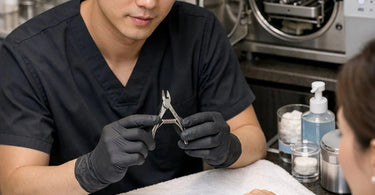
Elevate services with this game-changer now... Let's talk about the unsung hero of your nail table: the tiny, mighty spring inside your professional nipper. That little coil is the difference between a flawless, satisfying snip and that awkward moment when you have to squeeze three times just to get through a single hangnail. But here is the million-dollar question for every busy nail tech and spa owner: Is your beloved autoclave, the very machine keeping you compliant and your clients safe, secretly staging a rebellion against your favorite cuticle nippers? Ladies, let's pour a little disinfectant and dive into the steamy, scientific, and slightly shocking relationship between high-heat sterilization and the longevity of your most prized tools. Spoiler alert: It involves metal fatigue, a dash of physics, and the eternal quest for that perfect 'click'.
Let's face it, the professional nail care world runs on two things: caffeine and autoclaves. We trust that shiny metal box to obliterate any and all unwanted microbes from our nail files and buffers and, most critically, our nail brushes and tools. But while the autoclave is a hero for hygiene, its intense heat and pressure can be a bit of a frenemy to the delicate mechanics of your cuticle nipper. We aren't talking about the blades getting dull (though that happens too), we are talking about the spring—that magical tension mechanism that gives you the perfect bounce-back and control. When that spring gets tired, your wrist gets a workout, and precision goes out the window.
The Hidden Struggle Inside Your Sterilizer Pouch
Think of your autoclave as a sauna for your tools. A very, very aggressive sauna that uses steam reaching 270°F to 275°F. Now, think of your nipper spring as a tiny acrobat. It spends its days flexing, releasing, and snapping back into shape. That is its job. But when you toss it into the autoclave, you are essentially asking that acrobat to do a high-intensity workout in a boiling hot, humid room. Over time, this repetitive stress—combined with the extreme thermal expansion and contraction—leads to what engineers call 'metal fatigue.'
According to industry research on metal instruments, while dry heat sterilization is often gentler on the actual sharpness of a blade because it doesn't involve moisture, the autoclave's wet environment can be a silent killer for moving parts . However, modern high-quality stainless steel alloys used in professional tools are designed to withstand this torture, but the spring? That is a different story. The spring is tempered specifically for tension. High heat can slightly alter the crystalline structure of the metal wire, especially in lower-quality nippers, causing the spring to either become too loose (losing that snappy return) or, in some cases, too stiff .
When 'Sterilized' Turns Into 'Stressed'
How do you know if the heat is winning the war against your tools? You will feel it. That smooth, buttery action of a high-end Tuel Skincare manicure setup suddenly feels gritty or heavy. You might notice the jaws aren't closing as tightly, leaving a ragged edge on the cuticle oil prep you just perfected. In severe cases, you might even open the pouch to find the spring has snapped entirely. Nothing ruins a Monday morning flow quite like a rogue spring flying across the nail tables and manicure stations.
But wait, isn't everything supposed to be autoclavable? Yes and no. Manufacturers like Staleks and Tweezerman specifically design their implements to handle the heat, using high-alloy stainless steel and polished joints . Yet, even the best have limits. The specific type of spring matters immensely. Those encapsulated or double-spring mechanisms found in premium brands often fare much better than single, exposed springs because they are shielded from direct steam blasts and have more robust metal tolerances .
How to Keep Your Springs Snappy (Without Compromising Safety)
Alright, we aren't suggesting you skip sterilization—please don't send me angry emails, State Board! But we do need to be smarter about how we treat our metal babies. Here is the battle plan for every pedicure chairs/ spas station to extend the life of those nippers.
Lube is not just for gossip. Before you run the autoclave cycle, you need to lubricate the joints and the spring mechanism. High-temperature instrument lubricant is a game-changer. It protects the metal from the oxidative stress of the steam and keeps the hinge moving like butter. Think of it as SPF for your nippers. Many technicians skip this step, and it is the number one reason springs seize up or become brittle .
Leave the gate open. Never close or lock your nippers when you put them in the autoclave pouch. The 'open' position allows the steam to actually sterilize the contact points, sure, but it also relieves tension on the spring. If you store or sterilize the tool in a closed position, the spring remains under stress 24/7. Over a year of daily cycles, that constant tension plus the heat is a recipe for a loose, floppy nipper that can't grip a hangnail to save its life.
Know when to let go. No tool lasts forever, and that is okay. If you are using a budget-friendly wax nipper for hard wax removal or an entry-level cuticle clipper, the spring might only last 6-12 months of heavy daily use. Investing in higher-end brands like ItalWax precision instruments or CND implements usually means better metal tempering and longer spring life, but they still require replacement eventually.
Alternatives to the Steam Clean Cycle
If you find yourself replacing nippers every other month because the springs are shot, it might be time to look at your sterilization methods. While autoclaves are the gold standard for medical-grade sterilization, hair salon and barber shop supplies and nail salons sometimes opt for dry heat sterilizers or UV sterilizers for specific tools . Dry heat doesn't introduce moisture, which significantly reduces the rust and fatigue on springs. However, it takes longer and isn't suitable for all plastics or compressed sponges. Always check the manufacturer's guidelines.
For tools that don't break the skin, high-level disinfection (HLD) via chemical baths can also give your autoclave a break. Rotating between a few pairs of nippers so each set gets sterilized less frequently (while still maintaining sanitation standards) is a pro-level move. Have Monday/Wednesday nippers and Tuesday/Thursday nippers. This rotation allows the metal to rest and drastically improves the quality wax strips and rolls of your work—wait, I mean the longevity of your tools.
Real Talk: Does Heat Ruin EVERY Spring?
Let's look at the science. In orthodontic studies (yes, dentists worry about this too!), researchers found that autoclaving Ni-Ti (nickel-titanium) springs actually *increased* the force levels initially, while thermocycling (repeated heating/cooling) eventually decreased the forces . For our purposes, that means your nipper might feel super tight and perfect right after a cycle, but over the lifespan of the tool, that yo-yo effect of expanding and contracting wears out the molecular structure of the steel.
Essentially, the autoclave isn't evil. It is just intense. It is asking a lot of a 2-centimeter piece of coiled wire to go from room temperature to boiling hot, get blasted with pressure, and then cool down, multiple times a day, five days a week. The fact that our professional gel polish and nipper brands engineer them to last as long as they do is a miracle of modern manufacturing.
Extending the Life of Your Investment
Beyond the basics, proper drying is key. Leaving nippers wet inside a closed pouch invites corrosion. Make sure your cycle completes fully, and allow the instruments to dry inside the sterile pouch before you store them. Moisture is the enemy of tension. Also, consider your water quality. Hard water mineral deposits inside the autoclave can shoot microscopic particles into the hinge mechanism, acting like sand in a engine. Regular descaling of your autoclave saves your tools .
For my waxing babes using professional stripless hard wax and metal spatulas, this also applies to your waxing tweezers. If you use high-tension tweezers for brow shaping or ingrown hair removal, the same rules apply: lubricate, open the hinge, and rotate your tools. A dull or loose spring in tweezers means you are gripping harder, which leads to hand cramps. Ain't nobody got time for carpal tunnel because of a lazy spring.
Conclusion: Love Your Tools, Love Your Springs
The UV sterilizers and autoclaves are non-negotiable. We love them, we need them, and they keep our professional wax warmers for salons and spas and tables safe. But we need to respect the enemy within: heat fatigue. By implementing a strict lubrication schedule, storing tools open, and recognizing the signs of a dying spring (snap, crackle, pop—specifically the lack of 'snap'), you can add months or even years to the life of a high-quality nipper.
Next time you pull your manicure essentials out of the bag, give that handle a squeeze. Listen to the spring. Does it sing? Or does it groan? Your clients deserve the precision of a sharp, responsive tool, and your hands deserve not having to overcompensate for loose hardware. Keep them clean, keep them hot, but for the love of all things holy, keep them lubricated. Your wrists will thank you during the holiday rush.
)