
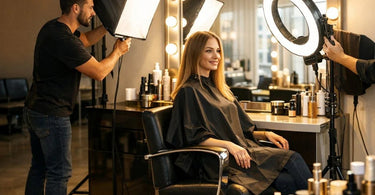
Work smarter, not harder... isn't that what we all whisper to ourselves while contorting a ring light with one hand and holding a mascara wand with the other? You spend forever perfecting a brow lamination or a set of Gelish claws, only to snap a photo that makes it look like you did it in a cave. We've all been there. The good news? You don't need a Hollywood soundstage to get those drool-worthy before-and-after shots. You just need to outsmart your salon's lighting situation. And honestly, nailing your salon lighting is half the battle to making your work look like the certified masterpiece it is. Let's flip the switch on blah photos, shall we?
Think about it: your clients are scrolling Instagram, double-tapping images that practically glow. That's not just good work; that's good lighting. It's the difference between a "nice job" and a "OMG WHERE DO YOU WORK?!" comment section. And since we're in the business of making people feel beautiful, our photos should reflect that same level of care and precision. So, grab your favorite professional salon equipment and let's get your lighting game on point.
Why Your Salon Lighting is Sabotaging Your 'Gram (and Your Business)
First, let's have a little heart-to-heart about the enemy: bad lighting. You know the culprits. There's the dreaded overhead fluorescent, casting shadows under every lash line and making even the most flawless facial treatment look like a crime scene. Then there's the "mixed lighting" menace—warm vanity lights clashing with cool ceiling lights, creating a weird yellow-blue situation on your client's skin. Your professional hair color might be a 10, but in that lighting, it photographs like a 5. We are not here for that. We are here for consistent, flattering light that makes your waxing supplies work look as smooth as it feels.
The Golden Rules of Before/After Lighting
Consistency is Queen
This is the non-negotiable, the holy grail, the secret sauce. Your "before" photo and your "after" photo must be taken in the exact same lighting conditions. Same spot. Same angle. Same light intensity. If your before photo is in dim light and your after is blasting a ring light, your results will look fake and exaggerated. Clients want to see the real transformation, not a magic trick. So pick your "photo spot" and commit to it. Whether it's a specific chair under your favorite magnifying lights or a corner bathed in soft natural light, make it your studio.
Color Temperature Matters
Light bulbs have a color temperature, measured in Kelvins (K). It's not just about being "bright." For skin and hair, you generally want to aim for daylight-balanced bulbs, which are around 5000K to 5500K. These are "cool" or "neutral" white and mimic natural daylight. They won't add a weird yellow (warm) or blue (cool) cast to your work. This is especially crucial when you're showing off the subtle tones in a brow henna application or the shimmer on nail art rhinestones. Swap out those old bulbs in your key fixtures for some consistent, daylight-balanced ones. Your future self (and your camera roll) will thank you.
Your Budget-Friendly Lighting Setup: Tools of the Trade
You don't need to break the bank to get great photos. In fact, you probably already own half of this stuff.
- The Natural Light MVP: A spot near a north-facing window is pure gold. It offers soft, diffused light that wraps around the face beautifully. No harsh shadows. Just pure, flattering glow. Perfect for snapping that radiant skin after a hydrodermabrasion treatment.
- The Ring Light (or Two): A classic for a reason. A ring light placed directly behind your phone or camera gives that signature catchlight in the eyes and smooth, even light on the face. For even more dimension, add a second light from a 45-degree angle to reduce flatness. This setup is chef's kiss for premium lash extensions and lash and brow close-ups.
- The Humble Diffuser: Direct light can be harsh. If your light source is a bare bulb, grab a diffuser. It can be a fancy photography one, or honestly, a white shower curtain from a discount store clipped over a stand. It scatters the light, making it soft and forgiving—ideal for capturing the smooth results of ingrown hair products after a wax.
-
Lighting for Different Services:
- For Waxing & Sugaring: You need clear, shadow-free light to show the clean removal. A light on either side of the bed works wonders.
- For Nails: Detail is everything. A small, adjustable LED lamp you can move right over the hand is a game-changer for showing off that perfect gel polish application.
- For Hair Color: You need to show dimension. Side lighting can create highlights and shadows that reveal the true depth and shine of your Wella or Clairol color work.
Beyond the Lights: The Setup Extras
Okay, you've got your lights sorted. Now let's talk about the supporting cast that makes your photos pop.
- The Background: A clean, clutter-free background is non-negotiable. Nobody wants to see your extra cotton rolls or a half-empty cup of coffee in the shot. Invest in a simple backdrop. A plain wall, a seamless paper roll in white or gray, or even a piece of fabric works perfectly. This is especially important for product shots of things like salt scrubs or sugar scrubs you might be selling.
- Small Details, Big Impact: Before the client sits, do a quick tidy-up of your station. Make sure your hygienic table paper is fresh and clean. Have your tools looking sharp. That little bottle of cuticle oil or that sleek wax warmer in the background can add to the professional vibe, as long as it's tidy.
- Camera Ready: Use your phone's gridlines to keep your shots straight and level. Tap the screen to focus on the area you want to highlight—like that perfectly sculpted brow after using Le Marque Henna. Adjust the exposure by sliding your finger up or down on the sun icon. It's that easy.
Common Lighting Fails and How to Fix Them
- Problem: Harsh shadows under the chin or eyes. Fix: Move your light source higher and more frontal, or add a second light from the opposite side to fill in those shadows.
- Problem: Skin looks oily or over-shiny. Fix: Diffuse your light! It softens the highlights and reduces glare on the skin. Also, a quick blot with tissue before the photo helps.
- Problem: Colors look washed out. Fix: Check your white balance settings on your phone/camera, or shoot in RAW format if you have a fancier setup. Good, consistent lighting bulbs are the first step here.
- Problem: Inconsistent before/after photos. Fix: Put a piece of tape on the floor marking where you and the client stand. Use the same light settings every single time. Be ruthless about this.
Let's Get This Light: Your Action Plan
Alright, friend, here's your homework. This week, pick one spot in your salon to become your official "photo studio." Clean it up, assess the Silhouet-Tone or Earthlite equipment you have there, and take a test shot. Play with your magnifying lights or grab that ring light from home. See what a difference it makes. Your work deserves to be seen in its best light (pun very much intended).
And when you're ready to stock up on all the goodies that make those results possible—from the ItalWax that creates the smooth canvas to the CND polishes that add the perfect pop—you know where to find us. Now go forth and light up your 'gram! And hey, if you set up a killer photo station, tag us. We'd love to see it.
)