
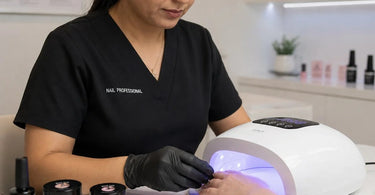
Maximize impact with this smart buy: if your builder gel is wrinkling, lifting, or causing unexplained breakouts (on your clients' nails, not your face, though we don't judge a good skincare routine), your LED Lamp might be speaking a different language than your gel. We see it all the time in the nail salon world: a tech buys the most expensive builder gel on the market, pairs it with a random lamp from an online mega-store, and then wants to throw hands when the manicure fails. Here is the tea (and we are spilling it all over our professional nail care station). The secret to a rock-hard, shiny, and safe set of nails isn't just in your application technique; it is entirely dependent on the light spectrum. You need to match the photoinitiators in the bottle to the nanometers coming out of the bulb. Let's get nerdy for a second (I promise to keep the physics jokes to a minimum, but no promises about the puns).
Think of Builder Gel as a picky houseplant. You wouldn't give a succulent ten gallons of water a day, and you wouldn't put a fern in a dark closet. Similarly, your gel needs a specific type of \"sunlight\" to harden. That sunlight is measured in nanometers (nm). If you use the wrong wavelength, your gel will either stay sticky (uncured), shrink away from the edges, or worse, cause heat spikes that make your client jump out of the chair. Since we at Pure Spa Direct are your wholesale fairy godmothers for everything from Pedicure Chairs/Spas to Nail Art Rhinestones, we want to make sure the literal lightbulb over your head (or rather, the lightbulb over your client's hand) is the right one.
The Science of the Shine: UV vs. LED vs. Your Sanity
First, let's clear up a massive confusion point. For years, we had \"UV Lamps\" and \"LED Lamps.\" Many people think LED lamps are \"safer\" or \"better.\" In reality, both usually emit ultraviolet light in the 320-405 nm range; LED lamps just do it faster and without needing to replace bulbs as often. The real difference isn't UV vs. LED; it is about the specific nanometer output. Traditional broad-spectrum UV bulbs throw out a wide party of light waves (everything from 300 to 450 nm), hoping something sticks. Modern LED Nail Lamps are snipers. They shoot a very specific, narrow bandwidth. This is great for speed, but terrible if your sniper is shooting 365nm and your gel is only listening for 405nm.
This is where the rubber meets the road (or the gel meets the nail plate). If you are using Professional Gel Polish or thick viscosities of Builder Gel, you absolutely need a lamp that emits a dual spectrum or matches your specific brand's chemistry. The industry standard for curing deeper layers of builder gel revolves around three key numbers: 365nm, 395nm, and 405nm.
Wavelength Deep Dive: 365nm, 395nm, and 405nm
Let's decode what these numbers actually mean for your daily grind at the nail table.
The 365nm Spectrum (The Deep Cure): This is your heavy lifter. Wavelengths around 365nm penetrate deeper into the pigmented or thick layers of builder gel. If you are doing extensions or hard gel overlays, you need a lamp with significant power at this range. However, here is the catch: many cheaper lamps claim 365nm output, but if you test them, the power is pathetic. You need intensity (measured in mW/cm²) as well as the correct wavelength. A weak 365nm lamp will leave you with a \"shell\" of cured gel hiding a liquid, uncooked center. Gross, right?
The 395nm and 405nm Spectrum (The Surface Set): These are your surface finishers. Most modern color gels and top coats are formulated to cure beautifully at 395nm or 405nm. This is the sweet spot for gel polish because it cures the surface quickly without generating excessive heat. If you have ever seen a \"wrinkle\" in a gel top coat, it is usually because the surface cured too fast (due to 405nm light) while the layer underneath was still shifting (because the 365nm light was missing or weak).
The magic happens when you have a lamp that combines these. This is why you see \"Dual Light Source 365+405nm\" on high-quality professional equipment. It ensures that the bottom of the builder gel cures solidly while the top of the color gel cures smoothly.
Why Incomplete Curing is a Horror Story
Let's get real about the consequences. I know you are busy stocking up on Professional Cotton and setting up your Nail Tables and Manicure Stations, but ignoring your lamp is a liability. When builder gel isn't cured properly due to the wrong light spectrum, several bad things happen.
1. The Chemical Leaching: Those un-cured photoinitiators and monomers have to go somewhere. When a client goes home, they leak out of the hard shell and onto the nail bed. This is the number one cause of \"Nail Product Dermatitis\" (allergies). Once a client develops an allergy to acrylates, they can't even get dental fillings or medical glue safely anymore.
2. The Lifting Nightmare: You did an amazing Dipping Powder or builder application, but two days later it pops off like a press-on. Why? The gel didn't bond molecularly to the nail plate because the cure was incomplete. You might blame your primer, but the lamp is the real culprit.
3. The Heat Spike: This is painful for the client. When the photoinitiators panic because they are getting the wrong signal (or too much scattered light), they burn off energy as heat. That sudden burning sensation on the nail bed is the gel trying to cure and failing.
Don't Buy a $20 Lamp from a Mystery Brand
I know, I know. You saw a lamp on a discount site for the price of a pizza, and it had 80,000 five-star reviews. Here is the dirty secret of the beauty supply world: many of those lamps are lying. They print \"365nm+405nm\" on the box, but when you put a spectrometer on it, the actual output is scattered junk. They use low-quality diodes that drift in wavelength as they heat up.
At Pure Spa Direct, we are distributors, not manufacturers, which means we get to pick and choose the best tech from brands that actually test their gear. Investing in a professional lamp from a reputable brand (like those found in our LED Bright Lamps collection) ensures that your Acrylic Nail Supplies and gels harden as intended. We sell the equipment that salons and barbers rely on to keep their reputation flawless.
How to Match Your Lamp to Your Builder Gel
So, you have a brand new client in your Stylish Salon & Barber Furniture chair, and you are ready to build. How do you ensure spectrum compatibility?
Step 1: Read the Gel Bottle (Yes, the fine print). Most reputable brands like CND, OPI, or Gelish will list the required nm range. If it says \"Cures under UV/LED,\" you need a broad-spectrum lamp or a dual 365/405 lamp. If it specifies \"405nm LED only,\" you can use a narrower spectrum lamp.
Step 2: Check the Wattage (Sort of). Wattage isn't everything. A 48W lamp with optimized reflectors can cure better than a 168W lamp with cheap LEDs. However, generally, for builder gel (which is thicker), you want at least 36W to 48W of actual power, not just marketing fluff.
Step 3: The Pinch Test. After curing, try to dent the gel with your thumbnail. If it leaves a mark, it is under-cured. Also, look at the \"inhibition layer\" (the sticky residue). While some stickiness is normal, if it is gummy and thick, your spectrum is mismatched.
Tools of the Trade for the Modern Nail Tech
While you are upgrading your light spectrum game, don't forget the other essentials that make the service profitable. You need the right Nail Brushes & Tools for application. You need high-quality Nail Files & Buffers to shape that rock-hard builder gel after it is perfectly cured. And for the love of a clean workspace, stock up on Protective Gloves & Masks to keep the dust from inhaled polymers out of your lungs.
If you are a multi-tech salon, standardization is key. Ensure every Professional Salon Equipment station has the exact same lamp model. If one station has Lamp A and another has Lamp B, your results will never be consistent. Standardization saves your sanity and ensures that whether Professional Spa Apparel wearer Rachel is working or Sarah is working, the Longwear Nail Polish cures the same way.
The Future is Bright (And Fast)
As LED technology evolves, we are seeing more \"dual-cure\" and \"low-heat\" lamps entering the market. These are fantastic for Nail Treatments for Healthy Nails because they reduce the risk of burning sensitive nail beds. However, the golden rule remains: match the spectrum to the product.
Don't be the tech who blames the gel. Check your lamp. Upgrade your lamp. Your clients will notice the difference when their nails last four weeks without lifting or yellowing. And you will notice the difference when you aren't doing free fill-ins because of technical failures.
Ready to upgrade your curing game? Explore our collection of Bulbs & Replacement Parts for Spa and Salon Equipment or grab a brand new state-of-the-art UV Sterilizers (for your tools, not your gels!) while you are at it. We have everything you need to keep your business glowing.
