
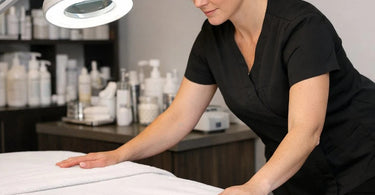
Quality you’ll stock again and again... but let's be real, honey, you can't stock what you can't see. And if you've ever leaned in so close to a client's face that you accidentally fogged up their glasses with your breath, you know exactly what I mean. Welcome to the wonderful, magnified world of professional skin analysis, where the difference between spotting a clogged pore and declaring a new life form living on someone's nose comes down to one very specific number: the diopter of your trusty magnifying lamp. Here at Pure Spa Direct, we talk to estheticians, waxing wizards, lash queens, and skincare sleuths every single day who are absolutely crushing their craft, but they often get tripped up by the simplest piece of equipment in their studio. That little lens on an arm could be your best friend or the thing that makes you feel like you're looking through a funhouse mirror. So, grab your favorite beverage (mine's a triple espresso because, well, have you met my schedule?), and let's break down the geeky, glorious science of magnification without, you know, actually having to do math in public.
We have all been there. A client points to a tiny bump on their forehead that they swear is a wart, a cyst, and probably a sign of a gluten allergy all rolled into one. You whip out your Magnifying Lamp, lean in, and... wait. Is that a blackhead? A sebaceous filament? Or did that speck of dirt from your lunch break just land on her face at the worst possible moment? The struggle is real, people. The difference between a professional diagnosis and a wild guess isn't your skill level (you're a rockstar), it's the tool. Using the wrong diopter is like trying to read a map through a telescope. You might see a lot, but you aren't seeing what actually matters. Today, we are going to dissect the lens, demystify the numbers, and make damn sure your next Advanced Facial Treatment reveals every beautiful detail so you can treat it right the first time.
What The Heck Is A Diopter Anyway? (And Why Should You Care)
Let's get the boring science out of the way so we can get back to talking about how cute your new Professional Spa Apparel looks. A diopter is simply a unit of measurement that defines the magnifying power of a lens. The higher the diopter, the larger the object appears, and the closer you have to get to said object to see it clearly. Think of it like this: low diopter is like standing in the back row of a concert. You see the band, sure, but you can't tell if the lead singer is wearing leather pants or just really shiny denim. High diopter is like shoving your face against the stage monitor. You see every guitar string, every drop of sweat, and yes, unfortunately, that one missed spot shaving his chin. For the average esthetician working in a Luxury Spa Furniture setting, you rarely need to see someone's pores on a molecular level. You need to see the landscape of the skin clearly enough to map out your attack plan for extractions, Hydrodermabrasion, or product application. Generally, we play in the sandbox of 3x to 10x. Anything higher than that, and you're basically looking for alien life forms in a blackhead, which is fun on a Tuesday night but not necessarily efficient for a 2 PM lash fill.
The Lowdown On Low Diopters (3x-5x): The Social Butterfly Of Lenses
If your magnifying lamp has a diopter of 3x or 5x, you have what I lovingly call the 'Hey girl, hey' lens. This is the lens you use when you are doing full-face waxing, checking overall skin tone, or performing a general Premium Skincare consultation. At this range, you aren't hunting blackheads; you're surveying the land. You can see the big picture: areas of erythema, large patches of dehydration, or whether that ItalWax application was as smooth as you thought it was. The beauty of a 3x or 5x lamp is that you have a wide field of view and decent working distance. You aren't breathing on the client. You can move your tools around, chat about their vacation, and still have enough room to operate a Facial Steamer without bumping your head. However, low diopters are terrible for detail work. If you try to do Dermaplaning with a 3x lens, you're going to miss that patch of peach fuzz right under the jawline. I promise you, the client will find it later in their car mirror, and they will call you. Don't be that esthetician. Use the right zoom for the right job.
The Middle Child Magic (6x-8x): The Workhorse Of The Waxing Room
Okay, listen up, all you Lash & Brow Enhancement pros and hard wax enthusiasts. The 6x to 8x diopter range is your sweet spot. This is where the magic happens. This is where you turn from 'a person who puts goop on faces' into 'a skin wizard who finds the tiniest ingrown hair like a treasure hunter finding gold.' At 6x, you can finally see the individual hairs. You can see exactly which direction they are growing when you're using Professional Stripless Hard Wax. You can spot the beginning of a breakout that the client didn't even know was there. This is the lens of truth. It is also the lens that will humble you. You will see the tiny dry patch you missed during your Pre & Post-Waxing prep. You will see the little smear of brow tint on the temple. It's a cruel mistress, but she is an honest one. For Brow Lamination and intricate tinting, 6x is your best friend. You get enough magnification to be precise but enough distance to actually work without cross-eyeing yourself. Pro tip: If you are over 40 like me, and your arms are suddenly too short to read the fine print on a Refectocil bottle, 6x is where you live now. Welcome home.
The Zoom Zoom Zoom (10x And Above): CSI: Skin Analysis Unit
Alright, Dr. Pimple Popper, put down the extraction tool and step away from the lens. 10x diopter and above is for the serious hardcore skin nerds among us. This is the level where you are analyzing the texture of the stratum corneum. You are looking at the angle of hair follicles. You are trying to decide if that freckle is a freckle or a tiny asteroid that landed on their cheek in 1987. Using a 10x lens for a full facial is exhausting. It's like trying to drive a car while looking through a microscope. You move two inches, and the whole world shifts. That said, there is a time and a place. A 10x or 12x Magnifying Lights setup is absolutely essential for Premium Lash Extensions application. You need to isolate that natural lash like a bomb squad tech disarming a device. You need precision. You also need it for deep, deep Wood's Lamp analysis if you are doing medical-grade skincare. But for the love of all that is holy, do not try to wax a lip with a 10x lens. You will see the peach fuzz, yes, but you will also see the pores screaming, and you will get dizzy and fall off your rolling stool. Ask me how I know. Just trust me. High diopters are for stationary, intricate work. Low diopters are for movement. Respect the zoom.
How To Balance Light, Distance, And Your Own Bad Eyesight
Here is the dirty little secret that nobody tells you when you buy that shiny new Professional Salon Equipment: Magnification is useless if you don't have the right light. A high diopter lens eats light for breakfast. It's hungry. If your LED ring isn't bright enough, looking through a 10x lens is like staring into a cave. You need a lamp with adjustable brightness and a high Color Rendering Index (CRI). You want to see the skin as it is, not as a washed-out zombie version. We carry incredible LED Bright Lamps that don't flicker and don't turn everyone into a Simpson character. Furthermore, consider your working distance. If you wear glasses (hello, my four-eyed friends), a 3x or 5x diopter usually works fine over your specs. But once you hit 8x or 10x, you might need to take them off and let the magnifying lens do the heavy lifting. It takes practice. You will bump your forehead into the lamp at least three times. We've all been there. The bruise is a rite of passage, like your first wax spill or accidentally throwing a Towel Steamer lid across the room because you didn't check the latch.
Practical Application: Which Diopter For Which Service?
Let's make a cheat sheet because your brain is full of appointment reminders, product inventory numbers, and the lyrics to that Sabrina Carpenter song. Keep this handy. For full body massage and checking for moles or bruises before a deep tissue session? Stick to 3x. You don't need to see their cuticles. You need to see the big muscle groups. For a standard European facial where you are doing High Frequency Machines and light extractions? 5x is your jam. It gives you a beautiful view of the T-zone without making you feel like you're performing brain surgery. For Waxing Supplies and ingrown hair detection? 6x to 8x. Specifically, if you are using Lycon or Starpil wax, you want to see every single hair bend so you can apply the strip (or hard wax) in the correct direction. For brows and lashes? 10x is the industry standard. If you are tinting with Intensive Tint, you need to see that you aren't painting their actual eyelid. Trust me, a green eyelid is not a good look for anyone. For Nail Art Supplies and Acrylic Nail Supplies? Detail work on a tip? Go high. 10x or even 12x for those little hand-painted flowers that make you an Instagram legend.
The Equipment Matters: Don't Buy Cheap Glass
I am going to get on my soapbox for just a second. I'm stepping off my Top Quality Massage Tables to yell this from the rooftop. Do not buy a $20 magnifying lamp from a big box store. I don't care how cute the color is. Cheap lenses have distortion, usually at the edges. That means you look at a pore in the center of the lens, and it's a crater, but you slide the view to the cheek, and suddenly everything is wavy and weird. That distortion messes with your depth perception. You will jab a client with a Professional Wax Spatula because you thought the skin was two inches to the left. Buy a quality lamp with a glass lens, not acrylic. Acrylic scratches. It fogs. It ghosts. Glass is heavier, sure, but your arm will get stronger, I promise. Look for brands like Spa Masters or Prosana that specifically build optics for the beauty industry. We aren't jewelers; we are skin experts. We need clarity that shows hydration levels and erythema, not just sparkle factor. You invest in ItalWax and CND products because they work. Invest in your eyeballs, too. You only get two of them, and they have to last through thousands of Brazilians and blemish extractions.
Setting Up Your Station For Success (And Sanity)
Okay, you've bought the perfect Magnifying Lights fixture. Now where do you put the darn thing? Placement is everything. You want the lamp to hover over your client's face without you having to become a contortionist to see through it. The arm should be flexible but tight enough that it doesn't droop like a sad flower when you let go. Always position the lamp between you and the client, slightly to your dominant side. If you're right-handed, lamp on the right. Left-handed, left. This keeps your tools from banging into the stem. And for the love of hygiene, wipe that lens down! Use a proper cleaner, not your apron or the client's towel. A dirty lens is just as bad as a cheap lens. You think you see a blackhead? No, honey, that's last Tuesday's Hygienic Table Paper dust. Gross. Keep it clean. Keep it bright. And keep your sense of humor when you accidentally zoom in too far on a chin hair and scream. It happens.
The Final Verdict: You Probably Need Two Lamps
I know, I know. You wanted me to tell you one magic number. But like choosing between Berodin and Cirepil, it depends on the day and the face. If you run a high-volume Waxing Supplies studio where you are doing speed Brazilians and quick lip waxes, a 5x diopter floor lamp is your workhorse. It covers ground fast. If you run a luxury Spa Body Treatments and facial studio where you are doing $300 enzyme peels, you need a 3x for the consultation and an 8x for the extractions. Honestly? Buy a clamp-on 10x for your lash/brow station and a rolling 5x for your waxing/facial station. Your back will thank me. Your eyes will thank me. And your clients will stop asking, 'What are you looking for?' because they will be too relaxed to care. The key takeaway here is that Selecting The Proper Diopter For Magnifying Lamps In Skin Analysis isn't about finding the 'best' number; it's about finding the right tool for the task at hand. You wouldn't use a sledgehammer to hang a picture, and you shouldn't use a 10x lens to check if a Complete Waxing Kits application is dry. Match the zoom to the job, and watch your service game level up instantly.
Now, go forth and magnify with confidence. And the next time you see a tiny, suspicious speck on a client's nose, just remember: With the right diopter, that speck is just a sebaceous filament begging for a little Professional Cleaners love, not a reason to panic. You've got this. And if you forget everything I just said, just come back to Pure Spa Direct and ask us. We'll point you to the right lens. We might even throw in a Compressed Sponges sample to wipe the tears of laughter from your eyes when you inevitably bonk your forehead. Happy zooming, beauties!
)