
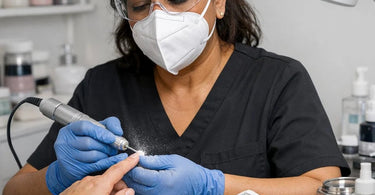
Small steps lead to big success. Especially when that small step involves putting a piece of high-tech fabric over your face so you don't wake up ten years from now coughing up clouds that look suspiciously like your favorite shade of pink acrylic. Look, we get it. You went into the nail game because you love color theory, shaping perfect apexes, and the joy of a client seeing their new set for the first time—not because you wanted to look like a surgeon prepping for battle. But here at Pure Spa Direct, we have to have a little heart-to-heart about the cloud of doom floating around your nail table right now. That dust isn't just confetti celebrating your killer filing skills; it's a respiratory hazard with a grudge. Let's talk about Selecting The Right Type Of Mask For Techs During Acrylic Filing because your lungs deserve a raise and a vacation.
If you have been in this industry for more than five minutes, you know the struggle. You finish a flawless set of acrylics or a hard gel fill, and suddenly you look like you just did a line of enchanted glitter. That dust is insidious. It gets in your hair, your coffee (gross), and deep into your respiratory tract. We aren't just being dramatic here. Unlike a sugar scrub that dissolves, acrylic dust is essentially tiny shards of plastic. It doesn't break down. It just sits there in your lungs, throwing a permanent party you definitely did not RSVP for. So, before we dive into the nitty-gritty of mask ratings and why your basic drugstore mask is lying to you, take a deep breath. Or, try to. If that was hard, keep reading.
Why Your Fancy Fashion Mask Isn't Cutting It (Literally)
Let's roast the elephant in the room. That cute cloth mask with the sequins or the leopard print? It is a fabulous fashion accessory. I love your style. But is it saving your lungs? Absolutely not. Protective masks are tools, not t-shirts. We need to stop buying them for looks and start buying them for science. When you are using an e-file or even a hand file on acrylic nail supplies, you are generating particulate matter so small that it floats in the air for hours. A cloth mask stops a gnat. It does not stop a microscopic shard of polymer. You need a respirator-rated mask. Think of it like sunscreen: SPF 15 is better than nothing, but if you are lying on a beach in July, you want the heavy-duty SPF 50. In nail world, SPF 50 is an N95 or higher.
Decoding the Alphabet Soup: N95, KN95, and Surgical Masks
Heading to the supply closet or shopping on Graham Beauty page can feel like reading a foreign medical textbook. What is the difference? Let's break it down without the boring jargon.
The Basic Surgical Mask: You see these everywhere. They are the loose, pleated paper rectangles. Here is the brutal truth: These are designed to stop spit and splashes going out, not dust coming in. If you are wearing a surgical mask while filing acrylics, you are essentially wearing a raincoat in a dust storm. It offers very low filtration efficiency for the super fine particles created by electric files. They protect your client from your sneeze, but they don't protect you from the acrylic cloud. Studies show surgical masks have a significantly lower filtration efficiency (around 76%) for these tiny particles compared to higher-grade options . They are great for skincare applications or waxing where you are worried about fluids, but for dust? Hard pass.
The N95 Respirator: This is your new best friend. The "95" means it filters out 95% of airborne particles. The "N" means it is Not resistant to oil (which is fine, your acrylic dust isn't oily). These bad boys create a seal around your nose and mouth. They force the air to go *through* the filter, not *around* it. For nail techs, this is the gold standard. They are designed to stop the exact size of particles created when you drill into polymers. They are a little warmer, a little more snug, and a thousand times safer.
The KN95: Similar to the N95, but meets Chinese standards instead of US (NIOSH) standards. In practical terms for a nail salon, they perform very similarly. Research indicates KN95 masks can achieve filtration efficiencies of 78% or higher, and in some controlled settings, even higher, making them a solid contender for Selecting The Right Type Of Mask For Techs During Acrylic Filing . The key difference is the fit and the strap quality. N95s usually have thicker elastic bands that hold tighter. For heavy filing days, we prefer the security of the N95.
The Heavy Hitters: Half-Facepiece Elastomeric Respirators
Okay, now we are getting serious. If you are a high-volume tech doing back-to-back sculpted acrylics or heavy fills all day long, you might want to look like Bane from Batman (but, you know, cuter). Half-facepiece respirators are the tanks of the mask world. They have a rubber or silicone body that seals perfectly to your face, and they use replaceable cartridges or pink P100 filters. A P100 filter blocks 99.97% of particles. That is HEPA level filtration. Yes, they look industrial. But they are actually more comfortable for long periods because the filter is usually bulky and off to the side, meaning the air you breathe in is actually cooler and easier to pull than through a stuffy N95. Plus, you just wipe the mask down with a disinfectant wipe at the end of the day, swap the filter every few months, and you are golden. It is an investment in your wellness that pays off every single breath.
Don't Forget the Fumes: VOCs and Your Nose
We talked a lot about dust, but what about the smell? Acrylic liquid (monomer) stinks. And it's not just stinky; it is a volatile organic compound (VOC). A dust mask like an N95 does *nothing* for vapors and fumes. Zero. Zilch. If you can smell your monomer through your mask, that means the gas molecules are passing right through the filter. To stop fumes, you need a respirator with a "cartridge" specifically rated for organic vapors (usually a charcoal filter). These are usually black or gray boxes attached to the sides of a rubber mask. If you find yourself getting dizzy, headaches, or that weird "foggy" feeling during a busy shift, you are reacting to the fumes, not the dust. Upgrade to a vapor cartridge respirator, and make sure you have proper ventilation. Run your ventilation and keep air moving.
The Seal of Approval: Fit Testing and Comfort Hacks
A $50 N95 mask is worthless if it is hanging off one ear and leaking air through your nose bridge. You have to get a good seal. This is called "fit testing." Put the mask on. Put your hands over the front and exhale sharply. Do you feel air rushing out near your eyes or cheeks? Fail. You need to adjust the nose wire (always use the metal pinch strip!) or tighten the straps. Ladies with petite faces, look for "small" or "universal fit" options. Men with beards? Sorry, friend, but facial hair breaks the seal. You might need to go for a full face shield/helmet system if you can't shave the scruff. Comfort is also key. If you hate how it feels, you won't wear it. Look for masks with "cool flow" valves. These valves let your hot, humid breath out without letting dust in. This keeps you from feeling like you are breathing into a wet plastic bag. Just remember, valved masks protect *you*, but they don't filter your exhaled air for the client. If you are sick or want to be extra courteous to immune-compromised clients, use a non-valved mask so you aren't hot-boxing them with your coffee breath.
Don't Rely Solely on the Mask: The Magic of Source Capture
Here is a pro tip even your high school health teacher might not know: The best mask is the one where you don't need a mask. You should be using dust control systems. We are talking about nail dust collectors—those little fans with a filter that sit on your table right next to the client's hand. When you file, the dust gets sucked into the fan before it ever reaches your face. This is called "source capture." Using a dust collector in tandem with a high-quality N95 mask reduces your exposure by like 99%. You will literally see the difference. Your desk stays cleaner, your lungs stay happier, and your sinuses stop looking like a construction zone. Pair your mask with a good dust collector, and you have created a force field of safety.
Building Your Ultimate Safety Station at Pure Spa Direct
Look, we aren't just trying to sell you stuff. We are distributors, but we are also humans who have seen techs burn out because they couldn't breathe by age 40. When you are building your cart at Pure Spa Direct, don't just grab the pretty polishes (okay, grab those too, we love OPI and CND). Add a box of NIOSH-approved N95 masks to the cart. If you want to look like a sci-fi hero, grab a half-face respirator with P100 filters. And for the love of glitter, pick up some disposable compressed sponges to wipe down your station, because cleaning up that dust is a whole other workout. You work hard. Your tools work hard. Your body works the hardest. Don't sell yourself short by breathing in yesterday's nail art. Stay safe, breathe easy, and keep slaying those apexes.
