
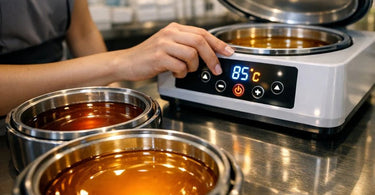
Better solutions for better outcomes... starting with banishing the twin terrors of every waxing pro: wax that's too runny and wax that's too thick. If your digital wax warmer is showing a perfect 125°F but your hard wax is pulling a Houdini and disappearing into a puddle, or your soft wax is setting up like cement before you can even say "strip," you've got a calibration gremlin in your machine. This isn't just an annoyance; it's a direct hit to your service quality, client comfort, and your bottom line. Inconsistent wax means wasted product, longer service times, and the kind of client feedback that keeps you up at night (and not in a good way). But before you declare war on your warmer, take a breath. Most calibration issues are fixable with a little know-how, and today, we're diving deep into the digital domain to get your wax—and your services—flowing flawlessly again.
Think of your digital wax warmer as the most high-maintenance, yet brilliant, assistant you've ever hired. It promises precision, but only if you treat it right. When it's calibrated correctly, it delivers that magical Goldilocks viscosity—not too hot, not too cold, but just right for smooth application, perfect adherence, and clean, comfortable removal. When it's off, well, let's just say you're not providing the "hot wax torture test" experience clients are looking for. This guide is your toolkit for troubleshooting, resetting, and mastering your equipment, so you can stop worrying about temperature and focus on what you do best: creating beautifully smooth clients who actually come back.
The Tell-Tale Signs Your Wax Warmer Needs a Calibration Check
Your wax, your clients, and even your own spatula are sending you signals. It's time to play beauty detective. Here are the dead giveaways that your warmer's digital display might be telling fibs:
The Inconsistent Spread: You scoop what should be perfectly melted wax, but it cools and sets on the skin either too fast (becoming brittle and breaking) or too slow (staying runny and messy). This is the most classic sign of a temperature variance between what the display says and what's really in the pot.
The Mysterious Hot Spot (or Cold Spot): One side of the pot seems fine, but wax from the other side is a completely different consistency. This points to uneven heating, which can be caused by a failing heating element or, you guessed it, improper calibration where the sensor isn't reading the entire pot's temperature accurately.
Wax Behaving Badly: Your trusted brand of hard wax is suddenly super stringy or won't grip hairs. Your soft strip wax is tearing instead of lifting. When the wax itself isn't performing to its known standards, the culprit is often the temperature environment you're providing for it.
Client Comfort Cues: Listen for those sharp intakes of breath, watch for immediate, excessive redness beyond the norm, or notice clients flinching more than usual. Your clients' skin is the most honest thermometer in the room. If they're saying "ouch" when your dial says "all good," trust the client.
Your Step-by-Step Digital Wax Warmer Calibration Rescue Mission
Okay, you've identified the problem. Now, let's solve it. Grab a reliable digital thermometer (this is non-negotiable—throw out that flimsy freebie one!) and let's get to work.
Step 1: The Trusty Thermometer Test. First, ensure your wax pot is clean and filled with a fresh batch of wax. Turn your warmer on and set it to a standard temperature, like 130°F for hard wax. Allow it to heat fully and stabilize for at least 30 minutes. Now, take your secondary digital thermometer and insert the probe into the wax. Don't just check the surface! Dip it into the center and gently touch the bottom of the pot, then check near the edges. Note the readings from your probe thermometer and compare them to your warmer's display. A difference of more than 2-3 degrees Fahrenheit is your red flag that calibration is needed.
Step 2: Consult the Oracle (aka the Manual). Before you start pressing random buttons, find your warmer's user manual. Many modern digital warmers, like the sophisticated Deo Professional 14 oz. Digital Wax Warmer or its larger sibling, the Deo Professional 28 oz. Digital Wax Warmer, have a calibration mode. This often involves holding down certain buttons to enter a settings menu. Following the manufacturer's specific guidelines is crucial to avoid causing further issues.
Step 3: The Calibration Dance. If your warmer has a user calibration function, you'll typically use your probe thermometer's reading as the "true" temperature and adjust the warmer's setting to match. For example, if your warmer says 130°F but your probe reads 124°F, you would calibrate the warmer upward by 6 degrees. This process "teaches" the machine what the correct temperature feels like.
Step 4: The Stirring Ritual (Your New Best Habit). Calibration isn't a one-and-done deal. To maintain even heat and accurate readings, you must become a stirring maniac. Stir your wax with a dedicated spatula in a figure-eight pattern before every client, after adding new wax, and any time you question the consistency. This prevents "wax stratification"—where the top is lava and the bottom is a wax glacier—which can fool even a well-calibrated sensor.
Preventing Future Meltdowns: Proactive Warmer Wellness
An ounce of prevention is worth a pound of… perfectly melted wax. Keep your equipment in top shape with these habits.
Clean with Care: Residue and carbon build-up on the heating plate or pot interior can insulate heat and cause inaccurate readings. Clean your warmer regularly according to the brand's instructions. For many, this means melting the last bit of wax, wiping it out while warm with a paper towel, and then using a mild cleaner approved for the surface. Never, ever immerse the unit in water!
Mind the Environment: Is your warmer right under an air conditioning vent or in a direct sunbeam? Ambient drafts and temperature swings can affect performance. Give your warmer a stable, draft-free home on a level, heat-resistant surface.
Upgrade Your Tools: If you're constantly battling a finicky, older analog warmer, it might be time for an investment. Modern digital warmers with features like those found in the Deo Professional line—such as microprocessor-controlled heating, temperature memory, and clear digital displays—are designed for precision and consistency from the get-go. For the busiest studios, a workhorse like the Miss Cire Extra Large Wax Warmer can handle high volume while maintaining reliable temperature control.
Building Client Confidence Through Calibration Confidence
Here's the secret bonus of mastering calibration: it's not just a technical skill, it's a marketing tool. When a client sees you meticulously check the temperature with a probe, stir with purpose, and test a small amount on your inner wrist before applying, their anxiety melts away faster than the hair. You are demonstrating supreme professionalism and care for their safety and comfort. You can literally say, "I calibrate my warmer regularly to ensure the exact right temperature for your comfort." That's the kind of detail that turns a first-time client into a lifelong advocate.
So, embrace the calibration challenge. See it not as a chore, but as the core of your craft. When your wax viscosity is consistently perfect, every service becomes smoother, faster, and more profitable. You'll use less product, see better results, and get those glorious, pain-free reviews. Now go forth, calibrate with confidence, and may your wax always be spreadable, your strips always effective, and your clients always blissfully unaware of the technical magic happening behind the scenes.
Ready to upgrade your precision tools? Explore our full range of Professional Wax Warmers for Salons & Spas, trusted brands like ItalWax and Cirepil, and all the Waxing Supplies for Professionals you need to build a flawless, five-star service.
