
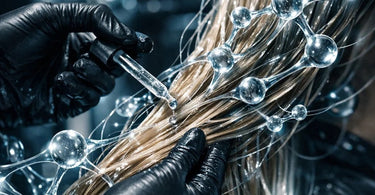
The right choice for better results... especially when it comes to saving your clients' hair from the brink of crispy disaster. Let's be honest, between balayage, perms, and that one client who swears her at-home flat iron is "professional grade," hair bonds are taking a beating. That's where the magic of salon-only bond builders comes in. These aren't your grandma's deep conditioners; they're like microscopic construction crews dispatched to the disaster zone that is damaged hair. Think of them as the special forces of haircare, and they only deploy from professional salon suppliers. The difference between a good hair day and a "why does it feel like straw?" day is literally molecular, and today we're putting on our lab coats (over our cute aprons, of course) to geek out on the science.
Ever snapped a rubber band? That's essentially what happens to hair during chemical services or extreme heat styling. The internal structures, the bonds, break. Salon bond builders are formulated to seek out and repair those specific breaks at a fundamental level, something generic moisturizers can't do. They're the intelligent, targeted solution your service menu has been missing.
Hair 101: It's All About the Bonds, Baby
To understand the repair, we need to know what's broken. Hair is primarily made of the protein keratin. This keratin isn't just a blob; it's a long chain of amino acids that fold and cross-link with each other using different types of bonds. The three main bonds that give hair its shape and strength are:
Hydrogen Bonds: The social butterflies of the bond world. They're weak, temporary bonds that form between water molecules and the hair. These are the bonds you break every time you wet hair and reform when you blow-dry it into style. They're responsible for about 35% of hair's strength but are easily broken and remade.
Salt Bonds: A bit stronger and more stable. These are formed between positively and negatively charged amino acid side chains in the hair. The pH of your products can affect these bonds, which is why using professional-grade, pH-balanced shampoos and conditioners matters so much.
Disulfide Bonds (The VIPs): These are the strong, covalent bonds that form the permanent structure of your hair. They're what give hair its natural curl pattern. Chemical services like perms (which break and reform them), relaxers, and permanent color actually break these disulfide bonds to alter the hair's shape or deposit color. Once broken incorrectly or excessively, they cannot reform on their own. This is where the real damage occurs, leading to porosity, breakage, and loss of elasticity. It's like the steel framework of a building getting corroded.
The Molecular Rescue Mission: How Bond Builders Work
Salon-only bond builders are engineered with specific active ingredients that mimic the hair's natural bonding structure. They work in a few brilliant ways:
1. Cross-Linking Agents: The star players in many bond builders are molecules like maleic acid or other carboxylated monomers. These molecules are small enough to penetrate the hair shaft. Once inside, they act like a bridge or a piece of molecular rebar. They seek out the broken sites (where sulfur atoms from disulfide bonds are dangling) and form new, strong cross-links between the broken protein chains. They don't just coat; they become a structural part of the hair again, restoring integrity from the inside out.
2. Protein & Peptide Support: Many formulas include hydrolyzed proteins or amino acids. Think of these as the patch kit. These small protein fragments fill in gaps and eroded areas along the hair cortex, smoothing the surface and improving strength. They work synergistically with the cross-linkers to shore up the entire internal structure. For the ultimate in-salon repair treatment, pairing a bond builder with a professional keratin treatment can be transformative.
3. Moisture Balance & Protection: Repair is useless if the hair just gets damaged again. Advanced bond builders also include ingredients that reinforce hydrogen and salt bonds, helping hair retain optimal moisture levels. They often contain silicones or polymers that create a flexible, protective shield around the hair shaft to guard against future thermal and environmental damage. This is crucial for clients who use hot tools daily—point them towards professional styling tools that offer better heat control.
Why "Salon-Only" Isn't Just a Marketing Gimmick
You can find "bond repair" claims at the drugstore, so what's the big deal? The concentration and chemistry. Professional bond builders contain higher, more effective levels of these active cross-linking ingredients. They are also formulated to work in conjunction with chemical services.
A pro can customize the application: adding it to lightener to protect during bleaching, using it as a stand-alone treatment, or applying it post-color to lock in integrity. The results are measurable in terms of increased elasticity, reduced breakage, and improved shine—things you can feel during the service and see afterward. It turns a potentially damaging process into a strengthening one. It's the kind of value-add that justifies your pricing and builds fierce client loyalty. They'll notice their color lasts longer and their hair feels healthier, making them less likely to skip appointments.
Integrating Bond Builders into Your Services (and Your Bottom Line)
This isn't a backbar secret; it's a front-and-center service upgrade. Here's how to make bond builders work for you:
Consultation is Key: Use a consultation mirror. Stretch a strand of wet hair. Does it snap immediately? That's lost elasticity from broken bonds. Explain the science simply: "Your hair's internal support structure is damaged. This treatment sends in a repair crew to rebuild it from the inside." Clients love understanding the "why."
Service Add-On: Offer it as a non-negotiable add-on for all chemical services. "To ensure your hair is stronger leaving than when you came in, I include our bond-building booster with every color service."
Stand-Alone Treatment: Market a "Molecular Repair Treatment" for clients with overly processed, brittle, or heat-damaged hair. Process it under a heating cap or steamer for maximum penetration.
Retail Power: Sell the take-home maintenance system. The in-salon treatment is the major renovation; the at-home products are the regular maintenance. This creates recurring revenue and better results. Pair it with a good detangling brush to prevent mechanical damage.
Beyond Hair: The Bonding Principle in Everything You Do
Fascinatingly, the principle of "bond building" applies across your spa. It's about creating strong, resilient connections. You're building bonds with your clients through trust. You're helping skin care ingredients bond to healthy skin after a dermaplaning treatment. You're ensuring lash extensions have a perfect bond to the natural lash. It's all connected! Speaking of which, don't forget to protect your clients' skin bonds during hair services with quality cotton and neck strips.
Stocking up on these professional-only powerhouses is what sets you apart. It transforms you from a stylist to a hair health expert. Your clients come to you for results they can't get anywhere else, and understanding (and utilizing) advanced chemistry is how you deliver that.
Ready to equip your salon with the latest in bond-building technology? Explore our curated selection of professional bond builders and repair treatments at Pure Spa Direct. We carry the top brands that stylists trust to deliver real, structural repair. Because in today's market, you're not just selling a haircut or a color—you're selling hair integrity. And that's a bond worth building.
