
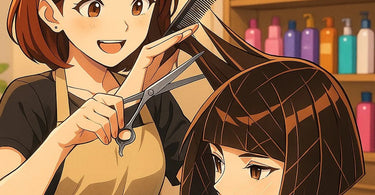
Your key to better results... isn’t just a sharper pair of professional shears, it’s knowing which way to point them. Think about the last time a client walked out with a haircut that just... sat perfectly. No amount of product, no frantic blow-drying—it just worked. That, my friends, is the sweet spot where mathematical precision meets artistic flair, and it’s what separates a good stylist from a great one. It’s the silent language of angles, elevations, and sections that your shears speak with every snip. Let’s demystify the 90% so you can focus on sprinkling in that glorious 10% of magic.
We’ve all had the nightmare: you follow the tutorial perfectly, use the same techniques, but the hair just won’t fall the way it did on the mannequin (speaking of which, check out our training manikins for guilt-free practice). It’s not you; it’s physics. Hair is a fiber, and like any fabric, it has a grain, a weight, and a natural direction it wants to go. Your job isn’t to fight it, but to become its masterful director.
The Foundation: It’s All About the Head Shape (No, Not Phrenology)
Before you even pick up your clippers or shears, you have to read the canvas. A client’s head is not a perfect sphere—it’s a landscape of curves, planes, and corners. The parietal ridge, the occipital bone, the hairline’s peaks and valleys—these are the landmarks that dictate your entire plan. Cutting hair perpendicular to the floor on a rounded crown will give you a completely different result than cutting it following the curve of the head. This is where your geometric eye comes in. Visualize the head as a 3D map, and your sections are the contour lines. A great cut follows and enhances this natural topography, while a fight against it leads to constant bad-hair-day battles for your client.
The Holy Trinity: Angle, Elevation, and Overdirection
These three concepts are the primary colors of your haircutting palette. Mix them wrong, and you get mud. Mix them with intention, and you create a masterpiece.
Angle: This is the tilt of your shears in relation to the subsection of hair. A 0-degree angle (blades parallel to the floor) creates a blunt, weighty line. A 45-degree angle introduces bevel and softness. A 90-degree angle (perpendicular) removes maximum weight and encourages mobility. Choosing the wrong angle is like using a sledgehammer to hang a picture—effective, but disastrous for the intended outcome.
Elevation: Where are you holding the hair relative to its natural fall? 0 degrees of elevation (no lift) cuts the hair exactly where it lives. 45 degrees of elevation builds gradual weight. 90 degrees (straight out) removes weight directly at the point where you hold it, creating layers. Elevation is your primary tool for building shape and removing bulk, and it works hand-in-glove with your choice of angle.
Overdirection: This is the sneaky one, the secret weapon. It’s when you comb a section of hair away from its natural falling position to cut it. Why? To create seamless connections between lengths or to intentionally place weight. For example, overdirection from the crown forward can build weight in the front for a fringe area, while still maintaining length in the back. It’s the geometry of illusion, and it’s pure gold for personalized styling.
The Tools of the Trade: Your Geometric Instruments
You can’t build a house with a spoon, and you can’t master geometry with dull, clunky tools. The right instruments become an extension of your intention.
- Shears & Texturizing Shears: Your main sculpting tools. A sharp, balanced pair of professional shears allows for clean, precise angles. Texturizing shears are for subtracting weight with calculated randomness—think of them as your “softening” tool.
- Clippers & Trimmers: For the sharpest, cleanest lines and fades, the geometry is everything. The guard number is your elevation, the lever is your angle control. Mastering the blend between lengths is a geometric puzzle of its own.
- Combs & Brushes: Your sectioning and directing tools. A fine-tooth comb for razor-sharp parts, a wide-tooth for managing bulk, and a great round brush for executing the final shape during the blow-dry. Don’t underestimate them!
- The Chair & Your Feet: Seriously! Moving around your client, having them tilt their head, raising or lowering your salon chair—this changes your perspective and ensures you’re cutting to the true head shape, not a distorted view.
Putting It Into Practice: The “Aha!” Moment
Let’s take a common problem: triangle head. You know, when the hair at the perimeter is too heavy and blouses out, creating a wide, triangular shape. The geometry fix? You need to remove weight from the widest part of the triangle. This means creating interior layers with higher elevation (90 degrees) at the parietal ridge, using overdirection to blend those layers into the longer perimeter, and potentially texturizing the very ends to break up the solid line. You’re not just “cutting layers;” you’re solving a spatial equation for balance.
Or, for a stubborn cowlick at the front hairline. Fighting it with force just makes it poke up more. The geometric solution is to cut the hair slightly longer *in the direction it wants to go*, using its natural movement as part of the style. You work *with* the growth pattern, not against it, using precise angles to integrate the length.
The 10% Magic: Where Art Meets Science
So where’s the magic? It’s in the 10% you add *after* the geometry is flawless. It’s the intuition that tells you this client’s hair needs a slightly softer angle here for her personality. It’s the confidence to break a “rule” because you understand the *why* behind it. It’s the final pass with the texturizing shears not just to remove weight, but to create a specific light-reflective texture. It’s in the finishing products—a dab of the right premium hair wax or spray to define the shape you’ve engineered.
The magic is also in the experience. It’s the soothing atmosphere you create with aromatherapy in the air, the comfort of a luxurious heated towel around their shoulders, and the confidence you exude because you know your craft inside and out. That’s a service clients return for.
Stock Your Geometric Toolkit at Pure Spa Direct
Mastering the direction of the cut requires practice on great mannequins, precision with top-tier shears and clippers, and a salon environment that supports your work. From brushes and combs for perfect sectioning to chairs and stations that give you the right vantage point, Pure Spa Direct is your partner in building a geometrically-sound business.
Explore our vast selection of professional hair salon supplies and iconic brands like Wahl, BaBylissPro, and Fromm International to find the perfect tools. Because when you nail the 90% geometry, the 10% magic feels effortless, and that’s when clients start calling you a wizard.
