
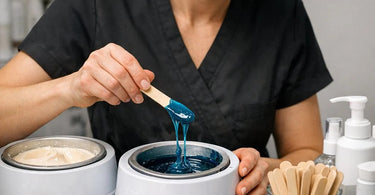
Stay ahead, stock this... Seriously, babe. We need to have a heart-to-heart. You're standing in your treatment room, armed with a spatula, ready to wage war on unwanted fuzz. But in the back of your mind, a tiny, very eco-conscious version of you is side-eyeing that mountain of wax strips heading for the landfill. We love a smooth leg, but we don't love choking the planet with single-use plastics and sticky trash. So, what's a conscientious esthetician to do? Enter the great debate: Hard wax vs. Soft wax.
You might think saving the planet means sacrificing performance, but honey, that is where you are wrong. We are diving deep into the sticky science (pun absolutely intended) of your waxing supplies to figure out which method lets you sleep better at night. Is the grass (or should we say, the hair) greener on the other side? Let's break down the environmental impact of hard wax versus soft wax, and trust us, by the end of this, you'll be ready to green up your spa supplies without sacrificing that satisfying “rip.”
The Soft Wax Situation: Convenient with a Carbon Cost
Let's look at Soft Wax first. This is your classic soft strip wax. You slather it on, press a non-woven strip on top, and “whoosh”—hair is gone. It's fast, efficient for large areas like legs and arms, and a staple in high-traffic salons. But from an environmental standpoint? Soft wax has a dirty little secret, and it's not the ingrown hair products you use after. The waste is real.
Think about the lifecycle of a soft wax service. You use the wax (often petroleum-based, but we'll get to that), a wooden or plastic spatula, and then a fabric/paper strip. That strip is used once and tossed. For a full leg wax, you might go through 10 to 15 strips! And because those strips are coated in wax and bodily fluids, they are rarely recyclable. They head straight to the dump. We love the efficiency of wax cartridges and rollers, but those plastic components add up too. It's a lot of single-use waste for a few weeks of smooth legs.
Hard Wax Heroes: The Low-Waste Warrior
Now, let's talk about our hero: Professional Stripless Hard Wax. This stuff is a game-changer, not just for your clients' sensitive skin (goodbye, ouch!), but for your trash can. Because hard wax adheres to the hair and not the skin, it dries firm and is removed without a fabric strip. You just pull the wax edge and “pop”—it's done.
Here is where the environmental magic happens: Zero fabric strips. Seriously. You eliminate that entire category of waste. You are only disposing of the wax itself. While the wax is a consumable, many high-quality hard waxes are moving toward bio-based or natural ingredient lists, which we will geek out on in a minute. If you want to drastically cut your salon waste overnight, switching to a stripless system is the most visible change you can make. Plus, using less product per application means your bulk wax deals last even longer. Cha-ching AND green points!
But Wait, What's the Wax Actually Made Of? (Ingredients Matter)
Strips are half the battle, but what about the goop itself? Historically, waxes (both hard and soft) were derived from petroleum. You know, crude oil. While effective, petroleum isn't exactly a renewable resource, and the extraction process is pretty nasty for Mother Earth. Luckily, the beauty industry is evolving faster than a unibrow grows back.
Today, you have incredible options. Look for waxes that utilize Pine Rosin (a natural, renewable resin tapped from living pine trees) and Vegetal Oils. Brands like ItalWax and Starpil are leading the charge with low-melting-point formulas that are gentler and often derived from sustainable sources. Even better? Candelilla Wax. This plant-based wax is a vegan alternative to Beeswax, and recent studies (like one published in the journal *Molecules* in 2022) have shown that eco-friendly extraction processes using citric acid create a harder, lighter wax without harsh chemicals like sulfuric acid .
So, when you are shopping, flip that bucket over. If it is full of natural resins and oils, you are winning. If it is a petroleum derivative, maybe it's time to try a professional wax warmer loaded with something greener.
The Spatula Struggle: Wood vs. Metal vs. Silicone
Don't forget the applicator! This is a sneaky waste contributor. Disposable wooden spatulas are biodegradable (yay!), but they still require trees and manufacturing energy. If you go through hundreds a day, that's a footprint.
The ultimate eco-move? Metal or Silicone Spatulas. Yes, they exist! You can buy a set of professional wax spatulas and applicators that are heat-resistant and designed to be sterilized and reused thousands of times. Imagine never buying a wooden stick again. While the upfront cost is higher, the long-term savings and waste reduction are astronomical. If metal spatulas aren't your vibe (some techs hate cleaning them), look for sustainably sourced birchwood sticks. But for the zero-waste queens out there, metal is the holy grail.
Beyond the Wax Bowl: Holistic Salon Recycling
Okay, so you've switched to hard wax and metal spatulas. You are crushing it. But what about the other stuff? The gloves, the packaging, the old towel steamers filters? You don't have to go it alone.
Have you heard of Green Circle Salons? These legends are the world's first sustainable salon solution. They help you recycle the “unrecyclable” beauty waste, including wax strips, gloves, foils, and even leftover hair color. By partnering with a program like this, you can divert up to 95% of your waste from landfills . You add a small “Eco Fee” to services (clients are usually thrilled to pay it for clean air), and they handle the dirty work. It's a brilliant way to market yourself as an eco friendly salon without spending your weekends scrubbing recycling bins.
Soft Wax Strips: If You Can't Ditch 'Em, Improve 'Em
I know some of you are reading this and thinking, “But Doug, my clients LOVE their soft wax. I can't quit strips.” I hear you. For those leg and arm services, soft wax is speed personified. If you must use strips, be smart about it.
Look for Biodegradable or Bamboo Strips. Standard strips are often a blend of plastic and polyester fibers to give them strength. But newer eco-strips are hitting the market made from renewable plant fibers. They might cost a penny more, but they break down much faster in the environment. Also, be aggressive with your usage. Don't use a huge strip for a tiny lip wax. Match the strip size to the area to avoid waste. It sounds small, but those inches add up to miles of waste saved over a year.
Wrapping It Up (Without the Strip)
So, who wins the eco-battle? Hard wax takes the crown. By eliminating the fabric strip entirely and often relying on more natural, plant-based resin ingredients, it is the clear winner for the low-waste, high-performance Spa Masters out there. However, the “Green Queen” award goes to the salon owner who uses a holistic approach.
Whether you use ItalWax or Lycon, the goal is to be mindful. Switch to metal spatulas, join a recycling collective like Green Circle Salons, and turn off your wax warmers when you aren't using them to save electricity. Saving the planet doesn't mean you have to give up silky smooth skin. It just means we need to be a little smarter about how we rip that band-aid off.
Ready to Green Up Your Treatment Room?
Feeling inspired? Don't toss all your current stock in a dumpster (that defeats the purpose!). Use it up responsibly, and when it's time to reorder, make the switch to sustainable options. We have everything you need to build a greener business.
Explore our massive selection of eco-friendly disposable alternatives or stock up on Complete Waxing Kits that prioritize natural ingredients. Your clients will love the results, and the planet will breathe a little easier. Now go forth and wax responsibly, you beautiful earth muffins!
)