
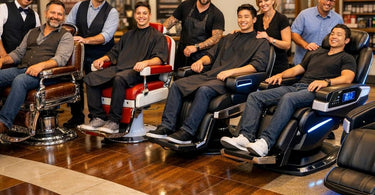
Do the job right the first time. That's what my grandma always said, and honestly, she wasn't just talking about not having to rewash the dishes. She was talking about the foundation of everything—especially when it comes to your business. And for those of us in the barbering and beauty game, there is no foundation more critical than the chair your client is sitting in. Think about it. The barber chair is where the magic happens. It’s the stage for the haircut that gives someone the confidence to ask for a raise, the straight-razor shave that makes a guy feel like a movie star, and the moment of peace where a busy professional finally gets to sit down and breathe. So, how did we go from simple wooden seats to high-tech thrones that practically give your client a hug? Let's take a ride through the glorious, and often hilarious, evolution of the barber chair. Spoiler alert: it's way more interesting than your average history lesson.
Picture this: it's the mid-1800s. The barber isn't just cutting hair; he's also pulling teeth and performing minor surgery. (I know, right? Imagine adding a root canal to your beard trim service. No thank you.) The chairs they used were essentially just sturdy wooden armchairs. They looked like something you'd find in your grandma's parlor, not a place you'd trust with a straight razor near your jugular. They had high backs and maybe a footrest, but that was about it. If the barber wanted you tilted back to get a better angle on your sideburns, you just held on and hoped for the best. It was a simpler time, but not exactly known for client comfort or, you know, safety .
The Golden Age: When Barber Chairs Got Their Swagger
Then came the late 19th century, and thank goodness, because a revolution was brewing. The first big game-changer was the one-piece reclining barber chair patented in 1878 by the Archer Company . Suddenly, you could lean a client back without them needing to be a contortionist. Shortly after, Eugene Berninghaus from Cincinnati said, "Hold my beer," and invented the first chair that could both recline and revolve . Cue the angels singing. The barber chair was officially a multi-tasking machine. By the early 1900s, a German immigrant named Ernest Koken introduced the hydraulic-operated chair and the joystick side lever, giving barbers the kind of control that would make a pilot jealous . This was the birth of what we consider the classic barber chair—heavy, made of cast iron and leather, with all those art deco curves that make our design-loving hearts flutter. These chairs weren't just tools; they were a statement. They turned the barbershop into a social club, a place where guys went to get the scoop as much as a fresh cut . Brands like the Koken Chair Company and the Emil J. Paidar Company were the rockstars of their day .
The mid-20th century is often called the Golden Age of barber chairs, and for good reason. These were the chairs with the heavy chrome accents, the thick, tufted leather (or durable PVC, for the savvy business owner), and the kind of solid construction that could survive a zombie apocalypse. They were built to last. This was the era of the iconic designs we still try to emulate today. But as the 1950s rolled on, something interesting happened. A company from Japan, Takara Belmont, started importing chairs that looked just as good but cost 20-30% less . By 1970, they had gobbled up the American market, acquiring the Koken name and production equipment . It was a changing of the guard, proving that innovation and value could beat out even the most established tradition.
The Tech Revolution: Your Chair is Now Smarter Than Your Phone
Fast forward to today, and we're living in a wonderland of technology where your barber chair might actually be smarter than you are. Okay, maybe not smarter, but definitely more technologically advanced. We've come a long way from pumping a hydraulic lever. Now, we have electric motors that adjust height and recline at the touch of a button, offering precision down to a tenth of an inch . This is huge for barbers. A smooth, silent adjustment lets you get the perfect angle for a fade without that embarrassing "thump" that jostles your client mid-cut . Brands like Spa Masters and Prosana are in on this action, bringing high-tech functionality to the modern barbershop.
Let's talk about the current king of the castle, the Takara Belmont Legend chair. This thing is less a chair and more a personal assistant for barbers. It features a dual-sided control panel that lights up, so you're not fumbling around under a client's cape like you're trying to find your keys in the dark . There's a foot switch for hands-free height and rotation adjustments, which is a total game-changer when you're in the zone . And the full-flat reclining feature? That’s not just for a shave anymore. That opens up a whole new world of services like head spa treatments and extended facials, turning your barber chair into a multi-service machine . You can even find the perfect electric options like the Ki New York Electric Barber Chair, which features separate motors for up/down and recline, giving you that luxury car feel in your shop . It’s all about creating a premium experience that makes your clients feel like the VIPs they are .
Ergonomics: Because Your Back Didn't Sign Up for This
Here’s where it gets really personal. For the first hundred-plus years of barbering, the chair was designed for the client. But the modern evolution has finally put the barber center stage. And thank goodness, because have you ever tried to do a precision fade while hunched over like a question mark? It's not fun. New chairs are designed with ergonomics that support the barber’s body as much as the client's. We're talking about synchronized tilt mechanisms that help maintain a neutral posture for the stylist, reducing strain on the lower back and shoulders . Studies have even shown that ergonomically optimized chairs can reduce chronic back pain by over 40% for barbers . That means less ibuprofen and more years in the game. It also means better services for your clients because you're not distracted by a nagging ache in your lumbar region. You can find ergonomic wonders from top-tier furniture brands like DIR Salon Furniture and Whale Spa, which combine sleek, modern design with the kind of smart engineering that keeps your body happy.
And let's not forget the seat itself. We're moving past the days of rock-hard foam that goes flat after six months. Modern chairs feature memory foam that conforms to the client's shape, waterfall-edge seats to reduce pressure on the back of the legs, and even built-in lumbar support that can be adjusted on the fly . Some high-end models are even incorporating smart sensors that can monitor posture and suggest adjustments to keep both barber and client in the optimal position . If you're really looking to spoil your clientele, consider chairs with built-in heat and cooling features. Imagine a client settling into your chair on a cool morning and being greeted by a gentle, soothing warmth. It’s a detail that says "luxury" before you've even picked up your shears . And for those long services like intricate beard work or a detailed facial, a cooled seat can be a lifesaver .
The Sustainability Shift: Looking Good and Doing Good
It’s not just about tech and comfort anymore. The modern barber chair is also getting an eco-friendly makeover. Manufacturers are starting to use recycled metals, biodegradable foams, and low-VOC finishes that are better for the environment and for the air quality in your shop . No one wants to walk into a barbershop and get a headache from off-gassing chemicals. This shift toward sustainable materials is a win-win. It reduces your carbon footprint, and it creates a healthier, more pleasant environment for everyone who walks through your door. It's the kind of forward-thinking that today's conscious consumers appreciate. You can find brands like Berodin and Lycon who, while known for waxing, represent the kind of premium, professional-grade quality that aligns with this elevated approach to your business, proving that excellence can be found in every corner of your shop, from the products you use to the chair you sit on.
So, what does all this mean for you, the modern barber, salon owner, or spa professional? It means your chair is no longer just a piece of furniture. It’s an investment in your business, your brand, and your own physical well-being. Whether you're drawn to the vintage aesthetic of a classic DIR Salon Furniture piece or the high-tech wizardry of a fully electric model, the chair you choose sets the tone for your entire operation. It’s the first thing clients see and the last thing they feel before they leave looking like a million bucks. It tells them if you're a $20 chop shop or a premium experience worth every penny. At Pure Spa Direct, we get that. We’re not just distributors; we’re your partners in creating a space that wows from the moment clients walk in. From classic barber chairs to the latest in high-tech professional salon equipment, we have the thrones that will help you build your empire. Because in this business, the right chair doesn't just support your client; it supports your entire dream. Now go forth and choose your throne wisely. Your back—and your bottom line—will thank you.
