
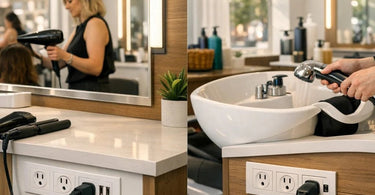
Smart tools for better work. It's the mantra we live by here at Pure Spa Direct, and if you've ever had to play musical chairs with a Facial Steamer because the cord wouldn't reach the one working outlet behind the treatment table, you know exactly why we're talking about this. Let's be real for a second: the layout of your electrical outlets is not the sexiest topic in the beauty industry. It doesn't have the glamour of a new gel polish collection or the transformative promise of a high-tech microcurrent machine. But if you're running a salon, spa, or barber shop, ignoring your electrical setup is like trying to bake a cake without flour. You might have all the fancy sprinkles (hello, Nail Art Rhinestones!), but the foundation is a hot mess. So, grab your favorite spa beverage, settle into your stylish salon chair, and let's get real about where those plugs should actually go. Because a tripped breaker in the middle of a brow lamination is nobody's idea of a relaxing workday.
Before we dive into the nitty-gritty, let's acknowledge the villain in this story: the dreaded outlet desert. You know the scenario. You've just invested in a brand new, state-of-the-art pedicure spa chair that comes with all the bells, whistles, and vibrating massage functions. You're so excited to offer your clients the ultimate foot pampering experience. But when the delivery team leaves, you realize the chair's power cord is exactly six inches too short for the only outlet in the pedicure bay. Suddenly, you're looking at a $500 electrical bill to install a new outlet, or a very long, very ugly extension cord that becomes a tripping hazard. I've been there, and my esthetician bestie has literally used the phrase 'I would sell my left foot for another outlet in this room' more times than I can count. It's not just an inconvenience; it's a revenue killer. When you're constantly rearranging your workflow to accommodate your equipment's access to power, you're losing precious time that could be spent on upselling that luxury retail serum or, you know, actually breathing between clients.
The 'Why' Behind the Wattage: More Than Just Plugging Stuff In
Look, I'm not an electrician. I'm a product enthusiast who has spent way too many hours in salon suites wondering why the genius who designed the space thought one outlet behind a heavy armoire was sufficient. But I've learned the hard way that planning your electrical needs is as crucial as planning your color palette or your choice of plush towels. It's about safety, efficiency, and keeping your sanity. Imagine a busy Saturday afternoon. You've got a hard wax pot warming up for a Brazilian, a towel steamer puffing away for a facial, a blow dryer on full blast, and a wax warmer plugged in for brows. If all these are daisy-chained onto a single power strip, you're not just asking for a blown fuse; you're flirting with a fire hazard. And honey, we're in the business of making people look and feel beautiful, not starring in our own version of 'This Old House: Salon Fire Edition.' So, the first step is understanding that each piece of equipment has a specific power appetite. That little Facial Steamer might seem innocent, but it can draw a surprising amount of current, especially when it's heating up. The same goes for your High Frequency Machine and your Ultrasonic Facial Machine. Your goal is to distribute the load so no single circuit is playing the role of superhero.
The Grand Blueprint: Mapping Out Your Station Zones
So, how do we avoid the outlet apocalypse? It starts with a map. No, you don't need a degree in architecture (though it wouldn't hurt). But you do need to walk through your space—whether it's a cozy single-room studio or a sprawling multi-chair salon—and think about 'zones.' Each zone is a dedicated work area, and each zone needs its own dedicated power source. Let's break it down by the types of services you offer, because a barber's electrical needs are very different from a nail tech's, and your zone planning should reflect that.
Zone 1: The Hair Zone (Salon & Barber)
This is the rock concert zone. It's where the big players live. Your color station needs outlets for a flat iron, a curling wand, and maybe a BaBylissPRO blow dryer. If you're a barber, you've got Wahl clippers and trimmers that need to be plugged in or charged. My advice? Install a power strip under the counter or a pop-up outlet unit on the vanity itself. For each stylist station, plan for at least four outlets. And if you're doing perms or color services that require a perm solution heater, that needs its own dedicated outlet—and probably its own circuit, because nothing kills a perm vibe like a breaker popping halfway through the processing time. Also, consider the placement of your Towel Steamers. They are the unsung heroes of the shampoo area, but they need a dedicated spot. Don't tuck them in a corner where they'll be sharing power with the disinfectant station and the coffee maker. That's a recipe for a very sad, very cold towel situation.
Zone 2: The Skin & Wax Zone (Esthetician Heaven)
Ah, the esthetician's domain. This is where the magic of skincare happens, and it's a veritable symphony of plug-in devices. You have your Facial Steamers, which need a stable outlet with a clear path for their water tank. You have your Galvanic Machines, Ultrasonic Skin Scrubbers, and let's not forget the Rotary Brush Exfoliator Machines. But the real outlet hog in the esthetician room is often the waxing setup. If you're a waxing warrior (and we love you for it), you know the drill. A professional wax warmer for your hard wax, another for your soft wax, a towel steamer for post-wax comfort, and a hot stone heater if you're fancy. And you need a UV sterilizer for your spatulas. For a waxing room, I recommend having a dedicated 'wax bar'—a counter or a cart with its own multi-outlet power strip (one that has a built-in circuit breaker, please!). This way, all your wax-related tools are in one place, and you're not running cords across the room where a client might trip. And for the love of all that is smooth, make sure your ItalWax warmer has a dedicated spot where it's not going to be jostled. Spilled wax is a whole other blog post.
Zone 3: The Nail Zone (Tech Territory)
Nail techs are the queens and kings of multi-tasking, and their electrical needs are unique. You've got your Nail Table and Manicure Station which is essentially a hub of activity. You need outlets for your LED bright lamps (good lighting is non-negotiable), your dust collector (because breathing is essential), and your gel polish curing lamps. If you're offering acrylic services, you might have an electric nail file. And if you're really fancy, you have a Pedicure Chair/Spa with its own motor, water jets, and vibration features. These chairs are power-hungry. They should ideally have a dedicated outlet on their own circuit. For your manicure table, the best setup is an above-the-table or below-the-table power strip that gives you at least four to six outlets. This keeps your cords organized and away from your client's personal space. And please, please, please, make sure your cleaners and disinfectants are stored away from your power sources. Water and electricity are not friends, and neither are acetone spills and your lamp's power cord. I've seen it happen, and it's not pretty.
Location, Location, Location: The Art of the Outlet Placement
Okay, so you've mapped your zones. Now, let's talk about where to actually put the outlets. It's not just about quantity; it's about strategy. Have you ever tried to plug a Magnifying Light into an outlet that's directly behind your client's head? It's awkward, and the cord dangles in a way that's both unsafe and unsightly. Instead, think about 'accessibility.' Outlets should be placed at a height that's easy to reach without straining your back or having to move heavy furniture. For stations, consider pop-up outlets on the counter surface. These are sleek, safe, and eliminate dangling cords. For areas like behind a luxury spa bed, consider placing outlets on the wall at a height that is accessible from the side of the bed, not directly behind the headrest. This allows you to plug in your Massage Table Warmers or a client's personal device charger without disrupting the serene atmosphere. And let's not forget the retail area. You need outlets for your point-of-sale system, for demonstration tools (like a hot brush to show how it works on a client), and for charging any handheld devices you use for booking or client consultations. A strategically placed outlet near your retail display can also be a subtle cue for clients to charge their phones while they browse your premium skincare products. It's a little touch that screams 'we've thought of everything.'
The Equipment Factor: Knowing Your Tools' Needs
Your equipment is your livelihood, and its power requirements should guide your outlet placement. Let's take a look at some specific pieces of equipment that often get overlooked. First, the Vichy Shower. This is a high-ticket item that is a dream for body treatments, but it requires a specific electrical setup, often a dedicated, GFCI-protected circuit. You can't just plug it into any old outlet. Similarly, a Body Wrap Heating Blanket or an infrared mat is a power-hungry device. It's not something you want to share a circuit with your Oxygen Facial Machine. And speaking of facial machines, your Radio Frequency Machine and Microcurrent Machine are delicate instruments. They need a stable, consistent power supply to function correctly. Power fluctuations from other devices cycling on and off (like a towel steamer clicking on to reheat) can affect their performance. Ideally, these advanced machines should have their own dedicated outlets and circuits. When you're investing in equipment from brands like Silhouet-Tone or Equipro, you want to protect that investment by ensuring it has the clean, reliable power it needs to deliver the results your clients expect. The same goes for your Light Therapy Devices. These are fantastic for adding a high-tech, relaxing element to your services, but they need to be placed where the cord won't become a tripping hazard and where the outlet is easily accessible to turn it on and off without disrupting the client's experience.
The Safety Dance: GFCI and Why It's Your Best Friend
Alright, let's get serious for a minute. I know I promised a little humor, but safety isn't a joke. If you are anywhere near water—and in a salon, that's basically everywhere—you need GFCI outlets. GFCI stands for Ground Fault Circuit Interrupter. These are the outlets with the 'test' and 'reset' buttons. They are designed to cut power instantly if they detect a current leak, which can prevent electrocution. If you have an outlet within six feet of a sink, a shampoo bowl, a pedicure spa, or any water source, it absolutely must be GFCI-protected. This is not just a suggestion; it's building code in most places, and it's common sense. Imagine a client in a pedicure chair with water circulating, and your extension cord falls into the foot bath. Without GFCI, that's a catastrophic scenario. With GFCI, the power shuts off before anyone gets hurt. It's that simple. So, when you're planning your outlet placement, make sure all outlets in wet areas are GFCI. Also, consider using tamper-resistant outlets, especially if your salon is in a location that might have children visiting. These have built-in shutters that prevent little fingers from poking things into the slots. It's a small upgrade that adds a huge layer of protection.
Extension Cords: The Evil Twin of Bad Outlet Placement
I know, I know. You're reading this and thinking, 'Kelly, this all sounds great, but I'm not made of money. I can't rewire my entire salon.' I get it. But let's have a heart-to-heart about extension cords. They are a temporary solution that too often becomes a permanent fixture. And that is a problem. Extension cords are not designed to be used as permanent wiring. They're a tripping hazard, they're a fire hazard if overloaded, and they're just plain ugly. If you find yourself relying on extension cords to power your Facial Steamer or your wax warmer, it's a sign that your electrical layout is failing you. Instead of a permanent extension cord solution, consider a power strip with a surge protector for a bank of equipment in one area. But even that has limits. A power strip is not a substitute for a dedicated circuit. If you're plugging in five high-draw devices, a power strip won't magically create more power. It just gives you more places to plug them in, which can lead to an overloaded circuit. If your space has a chronic shortage of outlets, it's worth the investment to have an electrician add more. Think of it as a business expense that will save you money in the long run by preventing equipment damage, reducing the risk of fire, and making your staff infinitely more efficient (and less likely to quit because they're tired of crawling under furniture to plug things in).
Future-Proofing Your Palace of Beauty
Finally, let's talk about the future. The beauty industry evolves at lightning speed. Five years ago, who had a Lash Lift & Perm station in their salon? Ten years ago, Dermaplaning was a niche treatment. Now, these services are standard. And the equipment is only going to get more sophisticated and more power-hungry. So, when you're planning your outlet placement, don't just think about what you need today. Think about what you might need tomorrow. If you're adding a new treatment room, have the electrician install more outlets than you think you'll need. Put in a dedicated circuit for a future Hydrodermabrasion machine or a Endermologie machine. If you're remodeling, consider adding floor outlets in the middle of a spacious room if you plan to have a treatment table in the center. These are much harder to add later. Also, think about your staff's comfort. In a busy hair salon, having a charging station for your stylists' tools (like cordless clippers and trimmers) is a must. A dedicated charging cabinet with its own power source keeps things organized and ensures that all your Fromm shears are always ready to go. Ultimately, a well-planned electrical system is like a good foundation for a flawless makeup application: you don't see it, but you definitely notice when it's done wrong. So, embrace the power, plan those outlets, and create a space where your equipment—and your team—can perform at their absolute best. And when you need the best equipment, from ItalWax to CND, remember we've got your back here at Pure Spa Direct. Now go forth and plug things in safely, you magnificent beauty guru, you!
)