
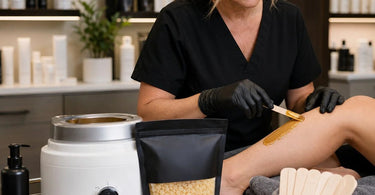
Your success starts with smart decisions... and one of the smartest decisions you can make is understanding the magic of the products you use daily. Let's be real—there is a certain kind of anxiety that hits when you peel back a strip of hard wax, and it brings skin with it instead of that stubborn peach fuzz. Or worse, the hair stays put, mocking you like a bad review on Yelp. If you have ever found yourself staring at a wax pot, wondering why your usually flawless service turned into a sticky, red disaster, it is time to geek out on the chemistry behind the cure. Today, we are diving headfirst into the fascinating (yes, fascinating) science of hard wax adhesion. We are going to answer the age-old question that keeps estheticians up at night: Why does this magical goo only grip the hair and leave the skin alone, and why does it sometimes fail spectacularly?
As distributors, we at Pure Spa Direct don't make this stuff; we just bring you the best of it. We have seen the formulas evolve from mysterious blocks of resin into sophisticated polymers designed for maximum comfort. But a lot of pros are still treating hard wax like it is just melted plastic. They slap it on, hope for the best, and then blame the manufacturer when it goes wrong. Honey, it is time to break that cycle. Understanding the science isn't just for nerds in lab coats—it is for professionals who want to charge premium prices and keep clients coming back for that painless Brazilian you promised them.
The Chemistry of the Grip: Not Your Grandmother's Wax
First, let's get one thing straight: hard wax is a material engineer's dream. Unlike soft strip wax that adheres to both hair and skin (and requires that trusty cloth strip to yank it all off), hard wax is formulated differently. Its primary job is to be what we call a "shrink-wrap." The magic lies in the specific blend of resins and polymers.
The primary adhesive agents in most professional hard waxes are rosin-based compounds like Glyceryl Rosinate or Hydrogenated Rosinate . These aren't just sticky for the sake of being sticky. These compounds are specifically designed with a molecular structure that has a natural affinity for keratin—the protein that makes up hair . Think of it like a magnetic attraction; the resin molecules are physically drawn to the hair shaft.
However, if you have a great resin, you need a plasticizer to give it that "flexible but not brittle" texture. This is where Ethylene/VA Copolymer enters the chat . It provides the elasticity that allows the wax to flex as you flick it off, preventing it from shattering like glass. Paraffin and Beeswax help with the consistency, ensuring the wax doesn't pull on the skin barrier . So, when that perfect strip of wax cools and you peel it, the polymer matrix has essentially formed a rigid cast around the hair follicle, while the paraffin/oil blends act as a release agent against the skin.
The "Shrink-Wrap" Effect: Why It Spares the Skin
So, why doesn't it stick to the skin? The beauty of hard wax lies in the physics of the "shrink-wrap" effect. When you apply warm professional stripless hard wax, it is a liquid. As it cools and hardens, it contracts slightly, physically tightening around the hair and microscopic ridges in the follicle. This creates a mechanical grip rather than just a chemical bond .
Think of it like putting your hand in a latex glove. The glove grips your fingers (the hair), but when you pull it off, it slides right off the skin because the contact points are different. Hard wax is engineered to do the same thing. The cooling process makes it lose its "tackiness" to the live skin cell structure but maintain its grip on the hair. This is why hard wax is a savior for sensitive areas like the bikini line and underarms—because it physically pulls the hair out without tugging on the dermis, leaving the skin smooth and less reactive.
Why Your Prep Ruins the Science (Even if the Wax is Perfect)
Alright, now for the part where I might hurt your feelings. If your wax isn't gripping the hair and it is leaving red patches, it is likely not the wax's fault. It is you. (I say this with love, bestie). The science fails when the canvas is wrong. Hard wax needs a specific surface energy to work its magic . If the skin is covered in lotion, oil, sweat, or, God forbid, residual moisturizer, you have created a barrier that changes the surface energy. The wax can't physically or chemically bond to the hair because it is too busy trying to bond to the Shea Butter you didn't wipe off. This results in a weak, cloudy bond that breaks off halfway down the hair shaft, leaving you with breakage and an angry client.
This is why we harp on using a dedicated pre-wax cleanser. Alcohol strips the skin completely dry and cools it down, causing the wax to harden too fast and grab the dead skin cells instead of the living hair . A proper pre-wax cleanser maintains the skin's natural pH and moisture balance while removing the physical dirt, ensuring the wax only grabs the hair. If you are still using rubbing alcohol to prep, we need to stage an intervention.
Don't Skip the Wingmen: Oils and Powders
Sometimes, the skin is just too moist. We live in Florida, people! It is humid. If your client is sweating, your wax is going to slide around like a hockey puck. This is where pre-wax oil and powder come into play. The oil creates a microscopic sacrificial layer. It prevents the wax from gripping the skin's moisture barrier, ensuring that when you pull, the wax releases the skin and keeps its death grip on the hair .
Powder absorbs excess moisture and creates a frictionless, matte surface for the wax to grip . Using these prep products isn't just an extra step to sell product; it is the engineering hack that makes the formula work perfectly. It is the bridge between good results and flawless results.
The Bottom Line: Master the Material
Understanding the science behind hard wax adhesion transforms you from a technician into a true professional. You stop guessing and start diagnosing. When you know that resin bonds to keratin, you don't blame the wax warmer when the wax sticks to skin; you check your prep. You understand why certain waxes are better for coarse hair (they have higher rosinate ratios) and why certain brands like ItalWax or Cirepil are known for their "film" properties—it is all in the polymer science .
At Pure Spa Direct, we carry the heavy hitters—Lycon, Berodin, Waxness, and Gigi—because we know you demand the best raw materials. But even the best formula can't fix bad technique or skipped steps. So, next time you reach for that spatula, remember the science. You are not just removing hair; you are engineering a better skin experience for your clients. And when they rave about how "it didn't even hurt," you can smile and know you nailed the physics.
Now, go stock up on those bulk wax deals and complete waxing kits so you never have to run out of the good stuff. Your clients—and their smooth skin—will thank you.
