
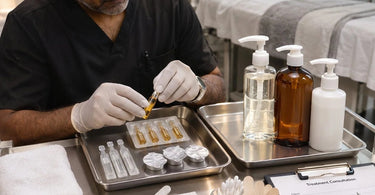
Quality drives loyalty with this tool, and few products demonstrate that better than a professional facial serum. Whether you are delivering a customized hydrating facial, performing a targeted brightening treatment, or building a signature service menu, the serum you choose can influence everything from treatment consistency to your bottom line. But there is one purchasing decision that deserves more attention than it usually receives: should your spa invest in single-dose professional serums or purchase larger bulk containers? Both approaches have advantages, and the smartest choice is not necessarily the one with the prettiest packaging or the lowest price per ounce. After all, a bargain is not much of a bargain if half the bottle expires before you can use it. Let's explore how to select the right format for your treatment room, your clients, and your business.
Understanding the Difference Between Single-Dose and Bulk Professional Serums
Professional serums are concentrated skincare formulations designed to deliver specific ingredients as part of a treatment protocol. Depending on the formula, they may focus on hydration, improving the appearance of uneven skin tone, supporting the skin barrier, or addressing visible signs of aging.
When shopping for professional serums, estheticians generally encounter several packaging formats. Understanding how those formats work is the first step toward making a profitable purchasing decision.
Single-dose serums are individually packaged portions intended for a single application or treatment, according to the manufacturer's instructions. They may come in sealed ampoules, capsules, vials, or small packets. The individual portion is opened when needed, limiting repeated exposure of the remaining inventory to air, handling, and environmental contaminants.
Bulk professional serums contain multiple treatment portions in a larger bottle or container. They may feature pumps, droppers, dispensing caps, or other packaging systems. These formats allow professionals to measure the quantity needed for each service while purchasing a larger total volume.
Neither format automatically guarantees superior ingredient quality, treatment performance, or safety. Formulation, preservation, packaging design, storage conditions, and proper handling all influence how a product performs.
1. Calculate the Real Cost Per Facial Treatment
Let's talk numbers, because glowing skin is wonderful, but glowing profit margins are pretty fabulous too.
Bulk serums typically offer a lower purchase price per milliliter than individually packaged portions. However, purchase price alone does not reveal the actual cost of using the product during a professional facial.
Imagine comparing two hypothetical serum options. A box containing 20 single-dose ampoules costs $80, making each treatment portion $4. A 100 mL professional serum bottle costs $120, and the manufacturer recommends using 2 mL per treatment.
At that dosage, the bulk bottle contains approximately 50 treatments, resulting in a theoretical product cost of $2.40 per service. That is a meaningful difference when the treatment is performed frequently.
But the calculation changes if your team uses inconsistent quantities, the bottle expires before it is finished, or significant product remains trapped in the packaging.
A more realistic calculation is:
Actual serum cost per treatment = Total purchase cost divided by the number of usable treatments delivered.
For example, if the $120 bulk bottle produces only 30 usable treatments before the remaining contents must be discarded, the effective cost increases to $4 per treatment. Suddenly, the bulk savings have disappeared.
Before placing a large order, calculate how many treatments your spa performs monthly, the recommended serum quantity for each service, and how long the product remains usable after opening.
2. Consider Product Freshness, Stability, and Exposure to Air
Serum freshness deserves special attention, particularly when working with formulations containing ingredients that may be sensitive to light, oxygen, or temperature.
Some forms of vitamin C, for example, can undergo oxidation when exposed to unfavorable conditions. Other ingredients may experience changes in appearance, texture, or performance over time, depending on their formulation and packaging.
Individually sealed serum portions can help reduce repeated exposure of unopened product to the treatment room environment. This makes them worth considering for specialized formulations that are used less frequently.
However, single-dose packaging does not automatically mean a serum is more potent, preservative-free, sterile, or longer lasting. Those characteristics depend on the manufacturer's formulation, packaging validation, and product specifications.
Bulk serums may also provide excellent stability when packaged appropriately. Airless pumps, opaque containers, and protective dispensing systems can help limit certain types of exposure.
When evaluating professional skincare products, review the manufacturer's storage instructions, expiration information, and recommended period of use after opening.
Do not assume that every serum should be refrigerated or that a product remains suitable indefinitely simply because it still looks normal.
3. Evaluate Hygiene and Cross-Contamination Risks
Hygiene is one of the strongest arguments for choosing single-dose packaging in a professional treatment environment.
A properly handled, individually packaged portion can reduce repeated contact with the main product supply. Once opened, the portion is used according to the manufacturer's instructions, rather than being returned to a shared container.
This approach can simplify dispensing during back-to-back facial appointments, particularly when different estheticians share treatment rooms.
Bulk packaging requires careful attention to dispensing practices. Staff should avoid touching dispenser openings to skin, used gloves, applicators, or contaminated surfaces.
For appropriate formulas, dispensing onto a clean, designated surface or into a suitable mixing bowl can support consistent application practices.
Professional applicators and spatulas can also help estheticians transfer products without repeatedly placing fingers into shared containers.
Remember that single-dose does not necessarily mean sterile, and a bulk product is not inherently unhygienic. The goal is to use packaging and handling procedures appropriate for the formula and its intended professional application.
One practical rule deserves a permanent home in your treatment room: never return unused dispensed serum to its original container. Saving a few drops is not worth introducing avoidable contamination.
4. Match the Serum Format to Your Treatment Volume
The number of facials your spa performs has a major influence on which packaging format makes financial sense.
A busy facial studio performing dozens of treatments weekly may consume a bulk serum quickly enough to minimize unused inventory. A smaller spa offering specialized facial services only occasionally may find individually packaged products more economical.
Consider three common scenarios.
High-volume facial studio: A hydrating serum appears in nearly every signature facial. Because the product is used consistently, a larger professional bottle may provide an attractive cost per service.
Specialty treatment provider: An esthetician offers an occasional targeted facial using a serum that is not part of the regular menu. Single-dose portions may reduce the risk of opening a large container that cannot be finished within its recommended use period.
Multi-esthetician spa: Several professionals use different treatment rooms and follow standardized protocols. Either format may work well, depending on whether staff can consistently control dispensing, storage, and product tracking.
The important question is not simply how many clients you see. It is how frequently each individual formula appears in your services.
5. Think About Dosage Consistency and Staff Training
Consistency is essential when delivering professional skincare treatments. Clients expect the same level of service whether they book with your most experienced esthetician or a newly trained team member.
Single-dose serums can make portion control easier when the manufacturer has designed each unit for the intended treatment quantity.
That simplicity can be valuable for spas with several employees, rotating schedules, or standardized service packages.
Bulk serums offer greater flexibility, but they may require more precise dispensing procedures. One esthetician's idea of two pumps might be another esthetician's enthusiastic interpretation of four.
Over time, these small differences can create surprisingly large inventory expenses.
If you choose bulk packaging, develop written dispensing guidelines based on the manufacturer's instructions. Explain the appropriate quantity for each treatment, the correct application technique, and how to prevent unnecessary waste.
Train staff to use measured doses where appropriate rather than assuming that more product creates better results. A professional treatment should be intentional, not an expensive game of serum roulette.
6. Consider the Role of Specialized Facial Treatments
Not every facial treatment requires the same serum format. Some services benefit from flexible product quantities, while others are designed around a specific formula and application sequence.
For general hydration facials, a versatile bulk serum may work efficiently across numerous appointments.
For specialized services, individually packaged portions may simplify inventory planning and ensure that a designated quantity is available for each booking.
Estheticians offering dermaplaning, hydrodermabrasion, or other advanced facial services should also evaluate whether a particular serum is appropriate for the treatment method and the client's skin condition.
Do not assume that a serum intended for topical application is automatically suitable for use inside facial equipment or for application immediately after intensive exfoliation.
Follow equipment compatibility requirements, product labeling, and the manufacturer's professional treatment protocol.
Explore advanced facial treatment products when building service-specific protocols, and select serum formats based on actual treatment requirements rather than packaging appearance.
7. Examine Packaging Waste and Environmental Considerations
Packaging is another factor worth considering, especially for spa businesses working to reduce unnecessary material consumption.
Single-dose serums often require more individual packaging components per treatment. Depending on the product, these may include glass ampoules, plastic capsules, foil packets, protective trays, and outer cartons.
Bulk containers may generate less packaging waste per milliliter of serum used, particularly when their contents are consumed efficiently.
However, a large bottle that expires while mostly full creates product waste that should also be considered.
Environmental impact depends on multiple factors, including packaging materials, recyclability, manufacturing, shipping, and actual product utilization. Neither option should automatically be labeled the environmentally superior choice without considering those details.
If sustainability is part of your spa's purchasing strategy, compare supplier packaging specifications and available local recycling options.
For glass ampoules, establish an appropriate procedure for opening and disposing of broken glass safely. A beautiful facial should not come with an unexpected sharp-object adventure.
8. Review Storage Space and Inventory Organization
Every spa owner knows that treatment room storage has a mysterious ability to disappear just when another delivery arrives.
Bulk bottles can reduce the number of individual packages employees need to organize, but larger containers may take up more room at each treatment station.
Single-dose serums can be arranged by treatment type, allowing staff to select the appropriate portion without moving multiple bottles between rooms.
However, managing numerous small units may increase inventory counting time and require additional organization.
Evaluate your existing storage systems before making a purchasing decision.
Useful considerations include available cabinet space, inventory turnover, temperature requirements, product labeling, and access during treatments.
Bottles and jars may be useful for organizing compatible treatment supplies, but professional serums should generally remain in their original packaging unless the manufacturer specifically supports transferring them to another container.
Transferring a formula can introduce contamination, compromise stability, and eliminate important identification information.
9. Compare Shelf Life Before and After Opening
One of the most overlooked purchasing details is the difference between a product's unopened shelf life and its usable life after opening.
A manufacturer may specify an expiration date, a period-after-opening recommendation, or other storage and handling limits. These instructions should guide purchasing and inventory rotation.
Individual sealed portions remain unopened until needed, which can make inventory planning easier for infrequently used formulas. Once opened, however, a single-dose product may need to be used promptly or discarded according to the manufacturer's instructions.
Bulk containers may remain suitable for multiple appointments after opening, provided they are stored and handled correctly and used within the manufacturer's recommended period.
Before ordering, ask practical questions: What is the unopened shelf life? Is there a defined period after opening? Does the packaging protect the formulation from light and air? Are special storage conditions required? What happens if the dispenser becomes damaged?
Also use a first-expiring, first-out inventory system so products approaching their expiration dates are prioritized when appropriate.
Good inventory management may not sound glamorous, but neither does discovering six expensive bottles hiding behind a stack of facial towels.
10. Consider the Client Experience and Perceived Value
Packaging can influence how clients perceive a professional facial service.
Opening an individual ampoule during an appointment may create a sense of customization and reinforce the impression that the treatment was carefully prepared for that client.
This presentation can work particularly well for premium facials, specialized add-on services, and treatment packages featuring distinct product steps.
However, the presentation should never replace meaningful product selection. A beautifully packaged serum that is poorly matched to the client's skin concerns is not a luxury upgrade.
Bulk serums can support an equally professional experience when they are dispensed hygienically and incorporated into a thoughtful treatment protocol.
Clients are ultimately paying for your knowledge, service quality, and ability to select appropriate products, not simply for the container they came in.
If you offer premium skincare upgrades, explain the purpose of the formula and why it was selected. Avoid promising results that the product's ingredients and available evidence cannot substantiate.
11. Build a Hybrid Serum Inventory Strategy
For many professional spas, the most practical solution is not choosing one format exclusively. It is combining both.
A hybrid inventory strategy allows you to purchase frequently used formulas in larger sizes while maintaining individual portions for specialty treatments or lower-demand services.
For example, a spa might stock a versatile hydrating serum in bulk because it appears in most facial protocols. Meanwhile, an occasional specialty treatment could use individually packaged portions to avoid tying up inventory in a slow-moving bottle.
This approach can help balance product availability, treatment flexibility, storage needs, and purchasing expenses.
Begin by reviewing your service menu and dividing serums into three categories: high-frequency essentials, moderate-frequency treatment products, and occasional specialty formulas.
Then choose a purchasing format based on expected consumption, the manufacturer's usage instructions, and the product's stability requirements.
A hybrid approach can be especially helpful when expanding a service menu because it allows estheticians to test demand for new treatments without immediately investing in large quantities of every specialized formula.
12. Ask These Questions Before Placing Your Next Wholesale Order
Before adding another professional serum to your inventory, conduct a quick purchasing review.
How many treatments will use this serum each month? Estimate demand based on actual bookings rather than optimistic projections.
How much serum does each treatment require? Use the manufacturer's recommended quantity to determine realistic treatment yield.
What is the effective cost per service? Include expected product loss, expired inventory, and dispensing inefficiencies.
What packaging protects the formula appropriately? Consider light exposure, air contact, contamination risks, and product-specific stability requirements.
How easy is it for employees to dispense correctly? A slightly more expensive format may offer operational advantages if it improves consistency and reduces waste.
Can the product be stored under suitable conditions? Verify whether the treatment room or designated storage area meets the manufacturer's requirements.
Does the formula match the intended service? Review its directions, contraindications, and compatibility with the treatment protocol.
Will the inventory be used before it expires? Estimate turnover conservatively, particularly for specialized products.
These questions help turn serum purchasing into a deliberate business decision rather than a reaction to attractive wholesale pricing.
13. Where Single-Dose Serums Make the Most Sense
Single-dose packaging may be especially useful for spas offering specialized facials, businesses with unpredictable demand for particular formulas, and teams that value pre-portioned treatment products.
It can also be attractive when a formula requires packaging that limits repeated environmental exposure, provided the manufacturer has designed and validated the product for that purpose.
The tradeoffs may include higher per-treatment packaging costs, more individual units to manage, and additional packaging waste.
When comparing options, evaluate whether the operational benefits justify the total cost rather than assuming that individual portions always deliver a better treatment.
14. Where Bulk Professional Serums Make the Most Sense
Bulk formats are often well suited to busy spas with standardized, frequently performed facial services.
They may offer lower product costs per application, fewer individual packages to open, and convenient access to formulas used throughout the workday.
The biggest advantages emerge when staff follow consistent dispensing procedures and use inventory efficiently.
Potential disadvantages include unused product approaching expiration, contamination risks associated with improper handling, and inconsistent dosing between employees.
These concerns can often be reduced through appropriate packaging selection, staff training, and careful inventory management.
For additional service essentials, explore spa essentials for professionals and professional cotton, sponges, and wipes to support organized, hygienic treatment room workflows.
15. Work With a Professional Skincare Supplier That Supports Your Business
Choosing between single-dose and bulk professional serums becomes easier when you can compare treatment products and related supplies in one place.
At Pure Spa Direct, we understand that professional purchasing decisions affect more than your supply budget. They influence scheduling, employee workflow, service consistency, and the quality of the experience you provide to clients.
As a professional spa and salon supply distributor, Pure Spa Direct helps beauty professionals shop for skincare products, treatment room supplies, and equipment from established manufacturers.
Browse our premium skincare collection or search for facial ampoules, vitamin C serums, and hyaluronic acid serums to explore products relevant to your treatment menu.
Always review individual product specifications to confirm package size, intended professional use, and availability of the format you need.
The Bottom Line: Choose the Serum Format That Works for Your Spa
The decision between single-dose and bulk professional serums should come down to how your spa actually operates.
Single-dose formats can simplify portion control, support specialty treatments, and reduce repeated exposure of unopened inventory. Bulk formats can deliver attractive cost efficiency for high-volume services, particularly when staff dispense products consistently and maintain proper storage and handling procedures.
Neither approach wins every time. The ideal purchasing strategy considers treatment demand, formulation stability, hygiene, employee workflow, product waste, and the actual cost per completed service.
For many estheticians, the smartest answer is a combination of both formats: bulk sizes for dependable everyday favorites and individual portions for carefully selected specialty services.
Because the goal is not to own the biggest serum collection in town. It is to deliver consistent, professional treatments while keeping your business healthy, organized, and profitable. Your clients deserve beautiful care, your treatment room deserves practical products, and your budget deserves a little pampering too.
