
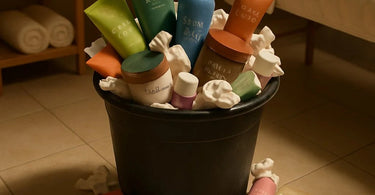
The right products for every professional... are the ones you're not throwing away. Let's be real for a second: your trash can is like that brutally honest friend who tells you when your highlight is looking a little too 2005. It doesn't lie. If you're seeing enough hard wax in that bin to recreate the Great Wall of China, or enough leftover hair color to paint a small car, your waste is quietly staging a coup against your profitability. The beauty industry wastes a staggering 15 million pounds of color annually in the U.S. alone—that's over a quarter of every tube purchased never touching a client's head. Your trash can is basically tattling on your bottom line, and today we're learning to speak its language.
Think of this as a waste intervention, but with less judgment and more practical solutions that will save you money, make your operation greener, and honestly, give you that satisfying feeling of getting your life—and your salon—in order.
The Tell-Tale Bin: Decoding What Your Waste is Whispering
Your garbage is a narrative of your operational habits. Let's translate the horror story it's probably telling.
The Saga of the Over-Mixed Color: The industry average for a retouch is 40 grams, but are you mixing that same amount for every client, regardless of their hair length or density? If you're mixing 40 grams for a client who only needs 25, that extra 15 grams takes a one-way trip to the plumbing. On the flip side, if you're consistently mixing too little and have to go back for more, you're disrupting service flow and still not tracking true usage. This inconsistency wreaks havoc on your inventory and your profit margins, which can vary by up to 20% across different services if left unchecked.
The Tragedy of the Half-Empty wax cartridges: If your bin is filled with applicators that still have usable product on them, or containers that aren't scraped clean, you're literally throwing money away. The same goes for nearly-full gel polish bottles with just a little left at the bottom that's "too hard to get out." That "little bit" adds up to a shocking amount over a month.
The Mystery of the Single-Use Items: A forest's worth of paper towels? Enough table paper to wrap a skyscraper? An army of plastic applicators? While some single-use items are non-negotiable for hygiene, many can be reduced, replaced, or used more efficiently. North American salons collectively discard over 110,000 pounds of aluminum foils every single day. Is your business contributing more than its fair share to that statistic?
From Wasteful to Profitable: Your 90-Day Waste-Loss Diet
Turning this ship around doesn't require a magic wand—just a bit of strategy and some new habits. Here's your action plan.
Week 1-4: The Investigation PhaseStart by conducting a simple waste audit. For one week, don't change anything—just observe. Sort and weigh your common waste streams: leftover color, wax, saturated cotton rolls, etc. This data is your baseline. You can't manage what you don't measure. Tools like the ENERGY STAR Portfolio Manager® offer a free, consistent way to track this data over time. Knowledge is power, and in this case, knowledge is also profit.
Week 5-8: The Strategy & Implementation PhaseNow, attack the biggest waste sources you identified.
Implement Precise Formula Tracking: Ditch the guesswork. Use a system to track the exact color formulas and amounts used per client. This eliminates color waste at the source and ensures perfect consistency for your clients every time they visit. Having a personalized track record is more efficient for your business, your stylists, and your clients.
Set Product Allowances: Define a standard amount of product—be it pre-wax products, sugar scrubs, or cuticle oil—to be used per service. Charge for any additional product used beyond this allowance. This safeguards your margins without shocking your clients with a whole new pricing structure.
Embrace Smart Pricing: Flip your pricing logic. Instead of basing prices on industry averages, start with the profit margin you want to achieve (e.g., a standardized 50% gross margin across all services) and adjust your pricing and policies to guarantee it. This one change can have a dramatic uplift on your overall profitability.
Week 9-12: The Optimization & Culture ShiftThis is where you build lasting change.
Color-Code Your Bins: Make recycling a no-brainer. Use a consistent color system throughout your salon. Blue bins for recyclables like paper and cardboard, green for general waste, and brown for organic waste if you have a composting program. Clear signage with pictures makes it easy for everyone to do the right thing. Keeping recycling bins right next to trash bins makes it just as easy to recycle as it is to throw something away.
Invest in Reusables: Where hygiene allows, switch to reusable alternatives. Think high-quality towels instead of paper towels for some tasks, reusable mixing bowls, and towel steamers to elevate the client experience while reducing waste.
Team Up & Train: Create a green team or add waste reduction to your existing staff meetings. Get your whole team involved in brainstorming ways to reduce waste. Offer incentives and celebrate milestones. When your staff understands that waste reduction directly impacts the salon's success (and potentially their commissions), they become your biggest allies in this effort.
The Green (and Green-Backed) Bottom Line
Getting a handle on your waste isn't just about feeling good for the planet—though that's a fantastic perk. It's a solid business strategy. Reducing color waste alone means you're only charging clients for what actually touches their head, not for what gets poured down the drain. This fairer pricing builds client trust and loyalty.
Furthermore, with states like California enforcing stricter waste regulations under laws like SB 1383, and a growing number of clients (over 40% of beauty shoppers) prioritizing safer ingredients and sustainable practices, getting ahead of the curve now positions your salon as a forward-thinking, responsible business.
So, the next time you take out the trash, give it a good look. It's no longer just a bin of waste; it's a treasure map pointing directly to hidden profits and a more sustainable, successful future for your salon. And that's a story worth telling.
)