
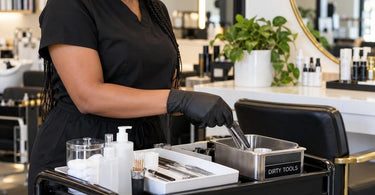
Quality work begins with quality tools, but keeping those tools organized after they have been used is just as important as choosing them in the first place. In a busy spa or salon, a treatment cart can go from perfectly organized to tiny rolling tornado in approximately three appointments. Creating a clearly defined dirty-tool area gives every used implement an immediate destination, helps keep clean and used items from getting mixed together, and makes the transition from one client to the next much easier to manage.
This is not about making your cart look Pinterest-perfect. It is about creating a workflow that makes sense when you are busy, wearing gloves, answering a client's question, reaching for supplies, and mentally calculating whether you have enough time to inhale lunch before the next appointment. A dedicated dirty-tool zone removes one small decision from that equation: used reusable tools go here. Every time.
What Is a Defined Dirty-Tool Area?
A defined dirty-tool area is a specific section of your service cart reserved only for reusable implements and other appropriate items that have already been used and are waiting to be cleaned, disinfected, sterilized, or otherwise reprocessed according to the item, service, manufacturer instructions, applicable regulations, and your facility's procedures.
Depending on the services you provide, that could include Spa Tools & Implements for Professionals, manicure implements, facial tools, reusable bowls, brushes, combs, tweezers, extraction implements, or other service tools that should not return to clean storage immediately after use.
The dirty area does not need to consume half the cart. In many treatment rooms, it can be a clearly labeled removable tray, container, or designated lower shelf. The key is that everyone working in the space understands exactly what belongs there and, equally important, what does not.
Clean Tools and Used Tools Should Never Play Guessing Games
The biggest advantage of a designated area is wonderfully simple: visual clarity. A tool sitting randomly beside a product bottle raises questions. Is it clean? Was it just used? Did someone set it down while preparing the room? Is it waiting to be disinfected? Suddenly a pair of tweezers has become the star of a mystery novel nobody asked to read.
A defined workflow removes that ambiguity. Clean implements remain in their designated clean storage area. Used reusable implements move directly to the dirty zone. Disposable items go into the appropriate waste receptacle instead of joining the reusable tools for a reunion tour.
This separation can be especially useful when carts hold lots of small items, such as tweezers, Applicators & Spatulas, brushes, clippers, nail implements, and facial tools. The smaller the tool, the easier it can be for it to disappear into the general cart clutter.
A Better Dirty Zone Can Make Turnover Easier
Fast room turnover should come from a good system, not from cutting corners. At the end of a service, you should be able to look at the cart and immediately identify what needs attention before the next client.
If used reusable tools are scattered across multiple shelves, trays, counters, and bowls, cleanup becomes a scavenger hunt. A dedicated collection point creates a more orderly starting point for your established cleaning and disinfection process.
That can be especially helpful in treatment rooms where several different services are performed throughout the day. An esthetician might move from a facial to a brow service. A nail professional may switch between manicures, gel services, and nail art. A barber might cycle through combs, brushes, guards, and cutting tools. Different services create different cleanup requirements, but the basic organizational principle remains the same: once a reusable tool becomes used, it leaves the clean workflow.
Choose a Container That Works With Your Actual Services
The best setup is the one your team will consistently use. Look at the quantity, size, and type of reusable tools you normally generate during one service and choose a dirty-tool container accordingly.
A shallow tray may work for a small number of implements. A larger removable container may be more practical when a service uses several tools. If you are handling sharps or potentially hazardous materials, follow all applicable handling, containment, safety, and disposal requirements rather than treating them like ordinary salon implements.
Whatever you choose should be made from a material suitable for your cleaning and disinfection procedures. Smooth, durable, easy-to-clean surfaces generally make far more sense than decorative baskets, porous organizers, or that adorable little container you found and immediately fell emotionally attached to. Cute is lovely. Cleanable is lovelier.
Pure Spa Direct carries a broad assortment of Professional Cleaners & Disinfectants for Salons and Spas, Protective Gloves & Masks for Salon and Spa Professionals, and professional service supplies that can help you build a workflow around the requirements of your specific practice.
Label It Like You Mean It
Even when the dirty zone seems incredibly obvious to you, label it. This becomes especially useful in multi-provider spas, salons, barber shops, nail salons, schools, and treatment rooms shared by multiple professionals.
A simple label such as USED TOOLS, DIRTY IMPLEMENTS, or TO BE CLEANED can remove uncertainty. The exact wording matters less than consistency and clarity.
Consider labeling clean storage areas too. A cart that visibly separates clean supplies from used items creates a workflow that new employees can understand much faster. It can also make training easier because the physical setup reinforces the procedure instead of asking everyone to remember an invisible rule.
Do Not Turn the Dirty Zone Into Permanent Storage
The dirty-tool area is a temporary stop, not a retirement community for forgotten implements. Used tools should move into your established reprocessing workflow as promptly as practical.
Visible debris and product residue generally need to be removed before appropriate disinfection or sterilization steps because cleaning and disinfection are not interchangeable. Follow the tool manufacturer's instructions, the disinfectant label directions, required contact time, applicable state and local regulations, and any professional requirements governing the services you provide.
If you use an EPA-registered disinfectant, follow its label exactly, including dilution when applicable, surface compatibility, immersion or application instructions, and required wet contact time. A disinfectant cannot do its job if it is wiped away before the labeled contact time is complete. This is not one of those situations where improvisation deserves bonus points.
Keep Disposable Supplies Out of the Reusable Tool Pile
A dirty-tool container is intended for appropriate reusable items awaiting reprocessing. Single-use supplies should be handled and discarded according to their instructions and applicable requirements rather than tossed into the same container.
Keeping disposables and reusables separated prevents unnecessary handling and makes cleanup more efficient. This is particularly useful for services that use plenty of Professional Cotton, Sponges, and Wipes for Salons & Spas, Compressed Sponges, and other single-service items alongside reusable implements.
Think About Cart Placement Too
Where you place the dirty zone matters almost as much as having one. Ideally, the setup should encourage a clean-to-used workflow without requiring you to reach back across clean products or unused implements while handling something that has already been used.
For example, frequently used clean supplies might occupy an easy-to-reach upper portion of the cart while the defined dirty container sits in another clearly separated position. Your exact configuration will depend on the cart, room layout, services, and applicable sanitation requirements.
Also think about what clients can bump, what might spill, and whether the container can be removed without disturbing clean inventory. Those little ergonomic details matter when the cart is being used eight hours a day rather than photographed for eight seconds.
Dirty-Tool Zones Are Useful Beyond the Facial Room
This concept applies across beauty and wellness businesses. Nail professionals working with Manicure Essentials can establish a defined location for reusable implements after each client. Waxing professionals can keep used reusable tools separate from fresh Waxing Supplies for Professionals. Salon and barber teams using Professional Hair Brushes & Combs for Stylists can create similar workflows for items awaiting proper cleaning and disinfection.
Massage, lash, brow, facial, and body treatment rooms can adapt the same principle to whatever reusable implements are appropriate to those services. The container may change. The location may change. The underlying rule does not: clean and used equipment should have clearly differentiated places in the workflow.
Make the System Easy Enough to Survive a Saturday
A sanitation system that only works when the schedule has generous gaps is not much of a system. Think about your busiest day. Back-to-back appointments. Someone arrives early. Someone else is late. The phone rings. A product needs restocking. Your coffee has been sitting untouched for so long that it may now qualify as an archaeological specimen.
That is exactly when clearly designated areas are valuable. Good organization should reduce thinking, reaching, sorting, and second-guessing. Every item should have an obvious place before, during, and after the service.
If staff members continually place used tools somewhere other than the defined dirty area, investigate why. Is the container too small? Too far away? Difficult to remove? Already full halfway through the day? A practical workflow should support the people performing the services rather than forcing them to perform choreography around the cart.
Build the Cart Around a Simple One-Way Workflow
When evaluating your setup, mentally follow a tool through the entire service cycle. Where is it stored when clean? Where is it placed immediately after use? How does it travel to the cleaning and disinfection area? Where does it dry or complete any required reprocessing? Where is it stored afterward?
Each step should have a clear answer. If the answer to any stage is something like, "Usually somewhere on this shelf unless Jenna is working," you have discovered an excellent place to tighten the system.
You can also stock the surrounding workspace with practical sanitation essentials such as disinfectant containers, implement trays, gloves, wipes, and other supplies appropriate to your procedures. Keeping the necessary products conveniently available helps make the correct workflow the easy workflow.
A Tiny Cart Change With a Big Organizational Payoff
A defined dirty-tool area may be one of the least glamorous upgrades you can make to a professional service cart, but glamor is slightly overrated when you are trying to remember whether the tweezer beside the serum bottle is clean.
By creating an unmistakable destination for used reusable implements, you can support clearer separation between clean and used tools, streamline room turnover, make staff procedures easier to follow, and build more consistency into daily sanitation routines.
Start by looking at one cart in one treatment room. Identify where clean implements live, choose an appropriate easy-to-clean container for used tools, label the area clearly, and make sure the entire team understands the workflow. Then stock the cleaning, disinfection, protective, and organizational supplies required for your services and procedures.
Because sometimes the smartest professional upgrade is not another fancy machine. Sometimes it is simply giving the dirty tweezers somewhere official to live until they are properly reprocessed. Tiny upgrade. Much less mystery.
