
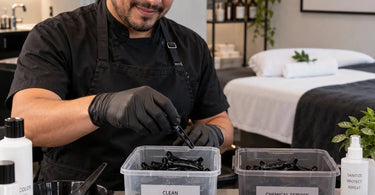
Start each day with the right tools, but let's be honest, a stylist's work station can look like a bomb went off in a craft store by 3 PM. Between the foils, the combs, and the endless array of clips, it's a miracle we ever find that one perfect sectioning clip we just had a second ago. But when it comes to your trusty hair clips, mixing them all up after a heavy day of chemical services is not just an organizational nightmare—it's a recipe for rust, residue, and potential client disaster. If you have ever pulled a clip out of your drawer only to find it covered in a weird, crusty substance or sporting a new shade of hair color that is definitely not its own, this one is for you. Today we are diving deep into the crucial, and often overlooked, practice of separate storage for your clips after chemical treatments, ensuring both your tools and your professional reputation stay pristine.
We all know the drill. A color service goes flawlessly, the client loves their new dimensional hue, and the only thing left to do is clean up. But in the rush to get to the next chair, those trusty hair clips that held the perfect sections of hair get a quick rinse under the tap and are tossed back into the communal drawer with the rest of the flock. That, my friends, is where the trouble begins. The chemical residue left behind from hair color, bleaches, and lighteners can cause a surprising amount of damage to your tools, and cross-contamination is a real risk. Let's get into why keeping your clips separated after chemical services is a non-negotiable best practice.
The Chemical Culprits: What Is Really On Those Clips?
When you are in the zone applying that perfect shade of Professional Hair Color or working with potent Hair Bleaches and Lighteners, you are dealing with powerful chemicals. These products are formulated to penetrate the hair cuticle and alter its pigment, which means they can also interact with other materials. Even after a quick scrub, microscopic remnants of these chemicals can linger on the surface of your clips, ready to wreak havoc on the next tool or client they touch.
Picture this: You just finished a single-process color, did a quick wipe-down, and tossed the clips in the drawer. Those clips now have trace amounts of ammonia, peroxide, or oxidative dyes on them. Later that day, you use a clean-looking clip from that same drawer to pin back a section of hair for a trim. Those latent chemicals can transfer to the new section of hair, potentially causing uneven color or, worse, a reaction with the fresh color or toner you are about to apply. It's a silent form of cross-contamination that many stylists don't consider until they see a patch of hair that just will not take color correctly.
The Hidden Dangers: Rust, Residue, and Ruined Tools
Beyond the risk of cross-contamination, the chemical residue left on clips is incredibly damaging to the tools themselves. Metal clips are particularly vulnerable. When you mix chemically soiled clips with clean, dry ones, the moisture combined with chemical compounds accelerates oxidation and rust . Nothing screams 'professional' quite like reaching for a shiny metal clip only to find it has developed a rusty orange crust. That rust is not only unsightly but can also snag delicate hair and leave discolored marks on the fibers.
Even plastic clips are not immune to the chaos. The volatile solvents in many professional hair products can break down the material over time, making them brittle and prone to snapping. If you have ever had a cheap plastic clip crack in half mid-section, you know the struggle. Storing them all mixed together means the 'danger zone' chemicals from the dirty clips are rubbing off onto your pristine 'scissor-work-only' clips, leading to premature wear and tear on your entire collection.
Is Your Organization System Helping or Hurting?
Let's talk about the practical side of things. Many stylists rely on a single drawer or a jar to hold all their hair clips. While this might look tidy, it is a recipe for disaster when you are dealing with chemical services. A traditional salon hair tool organizer with dedicated slots isn't just for show; it is a crucial component of your workflow and infection control.
As highlighted in a guide to salon tool organization, building a functional station requires clearly defined zones . You need a system that separates your 'clean' tools for cutting and dry styling from your 'chemical' tools used for coloring, perming, and relaxing. In the same way you have a dedicated Hygienic Table Paper for each client, you need to view your clip storage through a sanitation lens.
Think about it: would you use the same set of shears for a haircut that you just used to cut foil? Of course not! So why would you use the same clip to hold a finished blowout that you used to hold a saturated, bleach-heavy section? The logic is the same. Having a separate, labeled container or designated spot for chemical-service clips ensures you never grab the wrong one.
The Solution: A System That Saves Your Sanity
Implementing a separate storage system for your clips doesn't have to be complicated. In fact, it can make your day a whole lot easier. Here are some fail-safe tips to keep your clips in top condition and your station looking like a well-oiled machine.
1. Designate and Decant: The Two-Box Method
The easiest way to solve this problem is to immediately divide your clips. Have one clearly labeled container for 'Chemical Service' clips and another for 'Clean/Dry Service' clips. You can even get fancy with color-coded containers. A storage box with divided compartments works wonderfully, allowing you to separate materials by purpose. This not only prevents rust and chemical transfer but also speeds up your service times because you know exactly where to reach for the right tool .
2. Go Mobile with Magnetic Solutions
If you are running around the salon for back-to-back appointments, a mobile station is a lifesaver. Instead of walking back to your drawer every time you need a different clip, consider using a magnetic solution. Pure Spa Direct has highlighted the LaVaque Stylist Cuff or magnetic bracelets that securely hold metal pins and clips right on your wrist . This is perfect for updos, but it also serves a practical purpose: you can keep your 'clean' clips on your magnetic bracelet, ensuring only the pristine ones touch your post-color styling work.
3. Clean Like a Pro: Decontamination is Key
Separate storage is only half the battle. How you clean those chemically soiled clips makes all the difference. It is recommended to clean implements immediately after use . For clips exposed to heavy chemicals, a simple spray with a disinfectant cleaner might not cut it. Give them a thorough soak in a soapy water solution to break down the chemical residue, followed by a sanitizing dip. Once they are completely dry, they can be returned to their designated clean container. This process ensures that no residual chemicals are stored alongside your clean tools.
4. Fight the Chaos
When the salon is packed and everyone is stressed, it is tempting to just toss clips anywhere. Resist the urge! Establishing a strict rule that clips used during chemical services must be placed in a 'dirty' bin, separate from dry styling clips, is crucial . This is the only way to maintain a truly organized salon. Just as you would never mix dirty Towels with clean linens, you should never mix your chemical clips with your virgin clips.
Beyond Clips: The Bigger Picture of Salon Safety
This concept of separate storage after chemical services applies to more than just clips. Consider your Mixing Bowls and Applicators. These tools absorb and retain chemical residue much more readily than clips. Using a mixing bowl that hasn't been thoroughly cleaned and sanitized for a new client's formula can lead to the dreaded 'mystery reaction,' where the color turns out muddy or completely unexpected. According to Amber Products and other industry standards, all reusable tools must be appropriately sanitized and stored in a clean environment to prevent contamination.
Furthermore, proper storage of these tools is not just about maintaining the integrity of your services; it is about complying with health and safety regulations. Many state boards of cosmetology require that implements used for chemical services be cleaned and stored in a manner that prevents contamination . Violations can lead to fines or even the suspension of your license—a major headache you can easily avoid with a good system in place.
Wrap Up: Keep It Clean, Keep It Separate, Keep It Working
At the end of the day, your tools are your livelihood. Taking a few extra minutes to sort and store your hair clips after a chemical service will save you from the headache of rust, residue, and cross-contamination. It ensures your tools last longer, your clients get consistent results, and your station stays the envy of the salon. So, do your future self a favor: separate your clips, and keep your salon running smoothly.
Feeling inspired to overhaul your station setup? Whether you are looking for new Professional Hair Brushes & Combs for Stylists, innovative organizers, or high-quality Premium Hair Care Products for Salons & Barber Shops, Pure Spa Direct has your back. Head over to our website and stock up on all the essentials you need to create the most organized, efficient, and chemical-free workstation possible. Your tools—and your clients—will thank you!
