
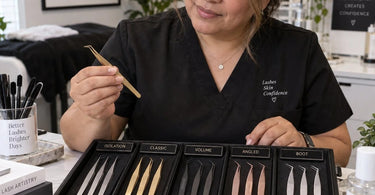
Because efficiency drives success, and nothing kills efficiency faster than digging through a drawer full of tweezers that all look suspiciously identical. You know the scene: you have thirty minutes left on a volume set, you reach for your isolation tweezer, and instead you grab the one with the slightly-off tip that you swore you would retire six months ago. Your client's eye twitches. Your soul twitches. This is not the energy we want in the lash room.
Here is the uncomfortable truth that nobody tells you when you are building your lash toolkit: organizing tweezers by color, by handle design, or by which one was on sale that one time is a recipe for chaos. The lash artists who glide through their appointments with the calm of a spa Buddha are not faster because they have magical hands. They are faster because their tweezers are organized by function. Straight isolation here. Curved volume there. Boot tweezer exactly where it belongs. No guessing. No grabbing. No silent screaming.
If your current tweezer organization system involves a vague pile on your lash cart and a prayer, this blog is for you. We are going to break down why function-first organization is the secret weapon your lash station has been begging for, and how it can transform your services from frantic to flawless.
The Great Tweezer Identity Crisis (Or: Why They All Look The Same Until They Don't)
Let us talk about the emotional rollercoaster of tweezer shopping. You browse online, see a beautiful pair with rose gold handles and a sleek matte finish, and you think: yes, this is the one. It arrives. You love it. Then you realize it is almost indistinguishable from the three other tweezers you already own because they all have similar shapes and your brain cannot remember which one is the isolation and which one is for classic application.
Lash tweezers come in a dizzying array of shapes, and the differences between them are not cosmetic. They are functional. A straight tweezer is your workhorse for isolation and classic lashes, designed to separate individual natural lashes with precision . A curved tweezer has that gentle arc that lets your wrist relax while you reach inner corners and navigate clients with deep-set eyes or prominent brow bones . Boot tweezers, with their wider angled tips, are the volume artist's best friend, giving you a broader sweet spot for picking up multiple lash extensions without the fan collapsing . Isolation tweezers often feature specialized angles or S-curves to weave between dense lashes without disturbing the neighbors .
If you are organizing by appearance, you might as well be organizing by which handle sparkles more in the light. It sounds cute. It does not work.
Function-First Organization: The System That Actually Saves Your Sanity
Here is how to think about your tweezer collection like a professional who values their time, their sanity, and their client's lash retention.
Zone 1: Isolation Station
Your isolation tweezers are the first tools you touch in every appointment. They need to be immediately accessible, ideally on your dominant-hand side, and they need to be the ones you trust to separate even the tiniest inner-corner lashes without drama. Straight isolation tweezers or fine-tipped curved options belong here . If you have multiple isolation tweezers because you work with a range of natural lash types, organize them by the specific challenge they solve. Curly lashes that tangle together? That is your super-fine-tip tweezer. Deep-set eyes where the lash line hides? That is your longer curved isolation tweezer .
Zone 2: Volume Fan Central
If you offer Premium Lash Extensions, your volume tweezers deserve their own dedicated zone. Boot tweezers, L-shape tweezers, and fan-making specialists should live together, separated from your isolation tools so you never accidentally grab the wrong one mid-fan . Label them if you need to. There is no shame in a tiny label that says "BOOT" on your tweezer holder. Your future self will thank you.
Zone 3: The Detail Squad
This is where your Lash & Brow Service Supplies that handle the finishing touches live. Your contour point tweezers for grabbing stray vellus hairs during brow clean-up. Your fine-point tools for lash lift and tint services where precision is everything . These tweezers are not used for every client, but when you need them, you need them now. Do not bury them under your lash trays.
Why Your Brain (And Your Back) Will Thank You
Let us get science-adjacent for a moment. Your brain is terrible at remembering that the tweezer with the slightly thicker handle is the volume one and the one with the slightly shinier tip is the isolation one. When you organize by function, you are not relying on visual memory. You are relying on spatial memory. Your hand reaches for the isolation zone because that is where isolation tweezers live. It is automatic. It is fast. It is the kind of muscle memory that lets you focus on the actual artistry instead of playing a guessing game with metal tools.
And speaking of backs and hands: the wrong tweezer for the wrong job is a one-way ticket to hand fatigue and wrist pain. Isolation requires endless delicate grip-and-release motions, so isolation tweezers should be lightweight with just the right tension . Volume fanning requires a different grip entirely. When you grab the wrong tweezer, your hand compensates. Your wrist angles awkwardly. By client number four, you are dreaming of a massage and questioning your career choices.
The Hygiene Bonus You Did Not See Coming
Organizing by function also makes your cleaning routine infinitely easier. When your tweezers are grouped by what they do, you can rotate them systematically. Isolation tweezers get used first, so they get cleaned first. Volume tweezers get used during the application phase. Your detail tweezers come out for finishing. This rotation means no pair of tweezers is constantly exposed to adhesive residue and disinfectant while another pair sits pristine and forgotten .
And can we talk about the horror of grabbing a supposedly clean tweezer only to find a tiny crust of lash adhesive on the tip? When you organize by function, you can inspect each zone before a client arrives. Check the isolation station. Check the volume station. Nothing ruins a serene lash appointment faster than a sticky tweezer and a client who notices you wiping it on your sleeve.
Proper tweezer care is non-negotiable for professional lash artists. Adhesive buildup, oils, and makeup residue can transfer between clients if tools are not properly cleaned and disinfected . Organizing by function makes it easier to spot the tweezers that need extra attention and to keep your entire collection in rotation so no single pair wears out prematurely.
Building Your Function-First Setup Without Losing Your Mind
You do not need a fancy custom-built tweezer palace. You need a system that works for your space and your workflow.
Vertical Tweezer Holders
A vertical holder protects delicate tips from bending or chipping and keeps your tweezers upright and visible . Look for options with multiple slots so you can dedicate specific slots to specific functions. Isolation in front. Volume in the middle. Detail in the back. Your hand will learn the geography in a day.
Magnetic Tweezer Cases
If you are short on counter space or you travel for mobile appointments, magnetic cases keep tweezers secure and separated . Some have compartments or slots that make it easy to designate zones. Just make sure the magnets are not strong enough to interfere with your lash work if you are in a dry climate .
Labeled Zones on Your Cart
If you use a rolling lash cart, designate shelves or sections by function. Top shelf: isolation and application tweezers. Middle shelf: volume tools and lash trays. Bottom shelf: cleaning supplies and backup tools . This setup means you never have to think about where something is. It is where it belongs.
The Confidence Factor (Yes, It Is Real)
When your tweezers are organized by function, something subtle but powerful happens. You stop second-guessing yourself. You stop wasting mental energy on tool selection and redirect that energy to the actual lash work. Your movements become more fluid. Your sets become more consistent. Your clients notice.
Clients may not know the difference between a boot tweezer and a curved isolation tweezer, but they absolutely notice when their lash artist is calm, focused, and efficient. They notice when you are not rummaging through a drawer mid-appointment. They notice when your station looks intentional and professional. That trust translates into better reviews, better retention, and better tips.
And honestly? There is a certain joy in opening your lash drawer and seeing order instead of chaos. It is the same joy as a perfectly organized Professional Nail Care station or a Spa Tools & Implements drawer that does not make you sigh. Your workspace is a reflection of your craft. Treat it like one.
One Last Thing About Those Pretty Tweezers
We are not saying aesthetics do not matter. A beautiful pair of tweezers that feels good in your hand and looks professional on your station can be a genuine pleasure to use. But appearance should never be the organizing principle. Function is what pays the bills. Function is what keeps your clients safe and comfortable. Function is what lets you finish a volume set in a reasonable amount of time without your hand cramping into a claw.
So go ahead and buy the pretty tweezers. Enjoy them. But when you get home, organize them by what they do. Your future self, your clients, and your sanity will all thank you.
Now go forth and lash with the confidence of someone who knows exactly which tweezer is in their hand. Your lash room is about to become a much happier place.
)